Doctor Stephen Strange was the world’s greatest neurosurgeon and the Earth’s Sorcerer Supreme, defending the world against invasions from other dimensions and supernatural threats. He has lost and regained the role several times and journeyed to the strangest of places, even met Eternity itself, but he has always been there to defend this dimension against threats of every size and shape imaginable.
And now he’s dead.
Who will protect the Earth? Who will keep the supernatural evils at bay?
And who killed Doctor Strange?
Death of Doctor Strange Bloodstone #1 NM $6
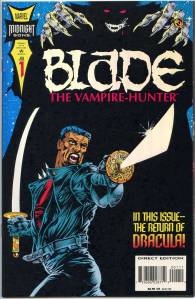
Death of Doctor Strange – Blade #1 NM $5
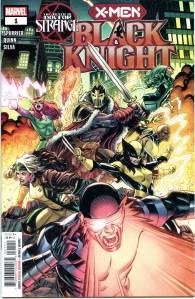
The Death of Doctor Strange – X-Men Black Knight #1 NM $5
The Werewolf by Night character (birth name Jacob Russoff, legal name Jacob Russell, nicknamed Jack) first appeared in Marvel Spotlight #2 (Feb. 1972) and was based on an idea by Roy Thomas. The series name was suggested by Stan Lee and the debut story was crafted by Gerry Conway and Mike Ploog.The character made additional appearances in Marvel Spotlight #3 and #4 and then graduated to his own eponymous series in September 1972. Jack Russell co-starred with Tigra in Giant Size Creatures #1 (July 1974), which was the first appearance of Greer Grant as Tigra instead of the Cat. That series was retitled Giant-Size Werewolf with its second issue.
Darth Maul’s time as apprentice to Darth Sidious has long been cloaked in shadows, but at last his tale of revenge will be reveled. From writer Cullen Bunn and artist Luke Ross comes a tale of rage unleashed as Darth Maul prepares for his first encounter with the Jedi.
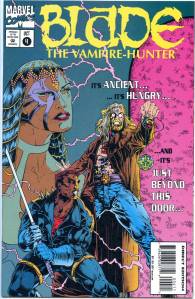
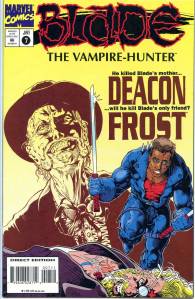
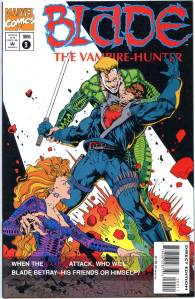
Following the cancellation of Nightstalkers, Blade debuted in his first color-comics series, Blade: The Vampire Hunter #1–10 (July 1994 – April 1995), written by Ian Edginton (with the last two issues by Terry Kavanagh) and penciled by Doug Wheatley.
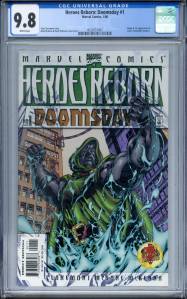
In the years after the Heroes Reborn event, Marvel published a series of one-shots that revisit the pocket universe created by Franklin Richards. These can be read in any order and even touch on some characters who were not featured in the original storyline.
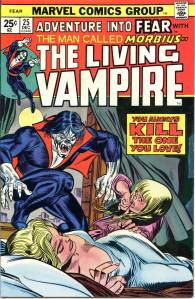
Morbius, the Living Vampire, introduced in The Amazing Spider-Man #101 (Oct. 1971), became the starring feature with Adventure into Fear #20 (Feb. 1974), and continued through the rest of the run. After a single issue by writer Mike Friedrich and penciler Paul Gulacy, Steve Gerber wrote several issues in which Morbius went on a picaresque interdimensional journey and fought the Caretakers of Arcturus and was advised by the eyeball-headed character I. Doug Moench and Bill Mantlo followed, successively, as the feature’s writers. Its round-robin of artists included Gil Kane, P. Craig Russell, Frank Robbins, George Evans, and Don Heck. Back up reprints shortly resumed in issue #20. Morbius would receive his own short-lived comic-book series in the 1990s.
Avengers A.I. was an ongoingcomic book series published by Marvel Comics that was released in July 2013, as part of the company’s Marvel NOW! initiative. The series takes place after the events of Age of Ultron, where the world has been colonized by A.I.s “who may or may not have positive feelings about the way humanity has been treating them for the past 100 years.” The series ended in April 2014.
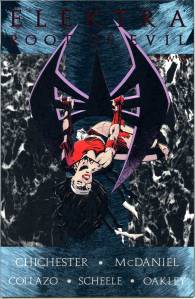
Created by Frank Miller, Elektra first appeared in Daredevil #168 (January 1981). Miller originally intended this issue, which was essentially a filler story, to be Elektra’s only appearance, but she instead became a frequently appearing villain in Daredevil until her death in issue #181 (April 1982). She was resurrected shortly after, but the story contained a narrative note which indicated that Daredevil would never encounter her again.
After over a decade’s absence, she reappeared in Daredevil #324-327 (January–April 1994), and went on to a brief stint as a supporting character in Wolverine (in #100-106). Daredevil writer D. G. Chichester recounted that he and editor Ralph Macchio had
bandied about the idea [of bringing back Elektra] in a casual fashion now and again, but neither of us wanted to do it as a gimmick. On the rare occasion I thought I had a legitimate angle to use her, Ralph was cool to the idea. But as we geared up for what would become Fall From Grace, Ralph out of the blue said, “What about bringing back Elektra?” — and it was really the missing piece that clicked together all the loose pieces of the story in my head, and became the nexus for everything tying together as well as it did. In my mind, it’s always been her to whom the title refers.
This upset Frank Miller, who claimed that Marvel had previously promised him that the character would not be used in any publication.She has since appeared in two eponymous ongoing series and several mini-series.
Every thousand years, Dracula enters a chrysalis state for four days, leaving him in a vulnerable state. During this time the most powerful vampires from around the world gather in Transylvania to protect him. Now they are about to be joined by an eclectic team of vampire slayers that have gathered to take down the legendary Vampire King – including the best and most dangerous slayer of them all – Blade!
This film adaptation includes one possible explanation of the title’s significance in story context: the narrative line, “Blade runner. You’re always movin’ on the edge.”
This was a reprint of issue 22 of the Marvel Comics Super Special series of titles, which by this time only printed Marvel’s movie adaptations, but without the feature content contained in the special.














 EHT Comics