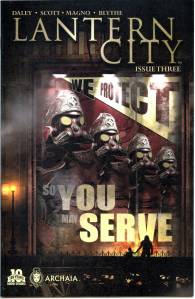
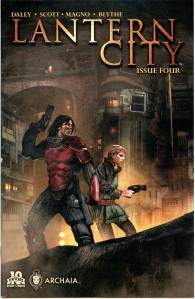
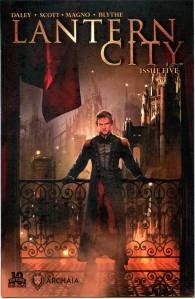
Sander Jorve is a reluctant hero shaped by a tough upbringing, trying to do his best for his family and a working-class revolution he supports. When asked by his wife’s brother, Kendal Kornick, to do the unthinkable and go undercover as a member of the Lantern City Guard, a relentless oppressive police force working for the Grey Empire, Sander must risk his family and his own identity for the chance to make a better world.
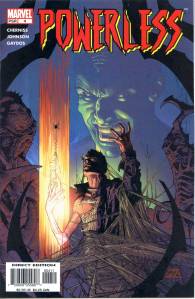
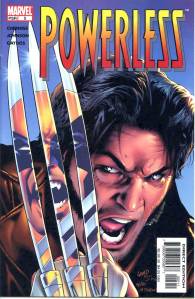
A psychologist named William Watts wakes up in a hospital after a three day coma. Fresh in his mind is the world of Earth-616 which he experienced while asleep. As William returns to his mundane daily life, he encounters three familiar faces: Peter Parker, a high-school student who is pressured by Norman Osborn to conduct industrial espionage on Stark Industires; a blind lawyer Matt Murdock who battles an uphill case against the kingpin to absolve Frank Castle of murder; and an amnesiac soldier named Logan who is led to believe he murdered Charles Xavier. Inspired by Matt’s conviction, William leaves his bystander position and begins to act to help the three: he helps reveal Charles’ murder was done by a third party, citing Logan to investigate Eric Magnus; he convinces Frank Castle to reveal vital information to Matt’s case; and he acts by calling the cops to assist Peter in arresting Osborn. After Frank’s trial, the Kingpin murders Murdock. Castle assassinates Kingpin in retaliation, which places him on the road to becoming the real-life Punisher. The series ends with William contemplating how the coma has shaken him from the stupor of life, as he reflects on his coma identity as Uatu.
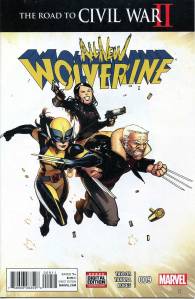
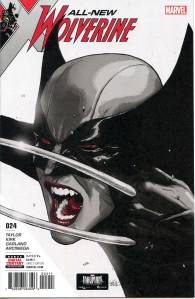
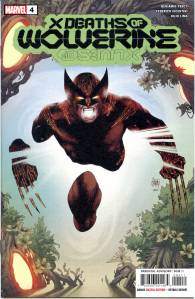
The character X-23 becomes the new Wolverine in the series, succeeding Logan, with a new costume resembling the original Wolverine’s. The series is written by Tom Taylor with art by David López.
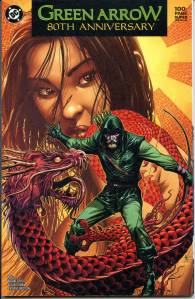
Celebrating the Emerald Archer’s 80th Anniversary! For the last eight decades Green Arrow has been one of the premier (and loudest) characters in the DCU, always at the forefront of where the superhero genre is headed. This over-sized anniversary issue follows in those footsteps, as an all-star lineup of Green Arrow creators, alongside some of the gifted creators of the modern era who have been inpsired by Oliver Queen, unite to pay tribute to the Battling Bowman. See what the past, present and future have in store for Oliver Queen, Black Canary, Connor Hawke, Arsenal, Red Arrow, Speedy, and more in this epic special!
In this second volume, MacKay and artist C.F. Villa took the Black Cat’s larcenous adventures into the realm of cosmic horror with an inaugural arc that tied into the King in Black event. After that arc came to a close in Black Cat #3, Black Cat #4 MacKay and artist Nina Vakueva reintroduce their protagonist’s ongoing war with New York City’s shadowy Thieves Guild and set up an arc that pays off on that long-form story that’s been building since 2019’s Black Cat #1.
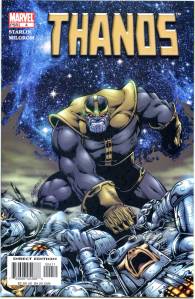
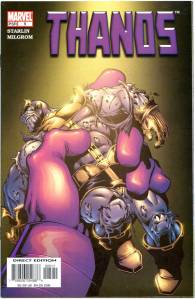
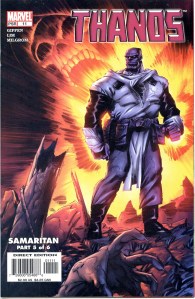
In 2004 Thanos received an eponymous title that ran for 12 issues. After defeating the Hunger, Thanos went to the frontline and gave himself up to the Omega Corps. After a panicked action from the corps they send him to the Kyln. On his way he killed a Skrull agent to give them a reason to imprisoned him. On Kyln, a priest told him about the prison while Thanos is watching the Crunch. When the Priest left, Death appeared and talked to him, telling him She loves him in her way, and that he hadn’t given her anything that she didn’t already have.
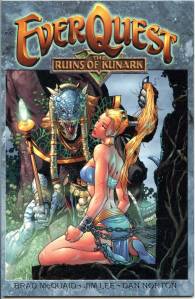
Journey to the land of Kunark alongside High Elven Princess Firiona Vie, as she and her comrades-in-arms must stop an unholy alliance. The great Elven Armies stand ready to defend the realm. But will they be enough to vanquish the rising darkness that threatens all of Norrath?
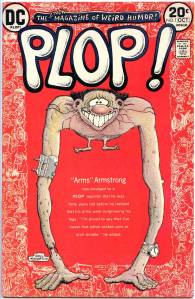
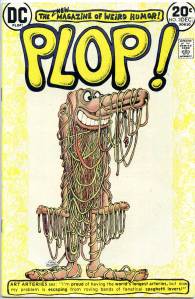
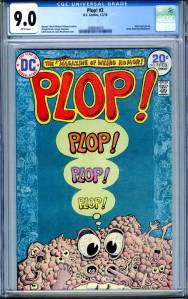
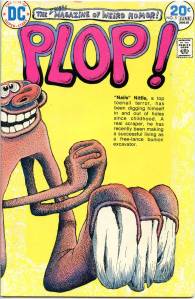
According to Steve Skeates, Plop! was based around a horror / humor story he wrote called “The Poster Plague”, which was published in House of Mystery.
The title initially was intended to be called Zany. A number of the one-panel cartoons published in the comic included the visible prefix ZA, in reference to the originally intended title. Sergio Aragonés credits publisher Carmine Infantino with coming up with the final title: “Joe Orlando and I were sitting in a restaurant talking with Carmine Infantino. They wanted a magazine that was different, something about black humor. Carmine came up with the name. We were talking about it and he said, ‘What will we call it?’ And I said, ‘We can call it anything, because if the magazine is good, then it will stay.’ And he said, ‘No, we can’t call it, for instance … PLOP!’ And I said, ‘Yes, we can.’ And so I started making sketches of things going PLOP! and they laughed and decided the name was good.
If Wolverine’s future lies in the past, what does that mean for the present? The reciprocal series to X Lives of Wolverine, X Deaths of Wolverine is chock-full of revelations for the best there is as well as the fate of mutantkind.
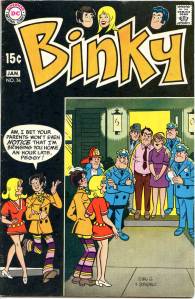
The adventures of teenager Binky Biggs started in DC Comics’ Leave It to Binky #1 (cover-dated March 1948), which ran for 60 issues through 1958. The series was revived by issue #61 (July 1968). With issue #72 (May 1970), the title was shortened to Binky and the series ran until issue #81 (Nov. 1971). Issue #82 was published in Summer 1977.
A spin-off title, Binky’s Buddies, ran 12 issues (Feb. 1969 – Dec. 1970).