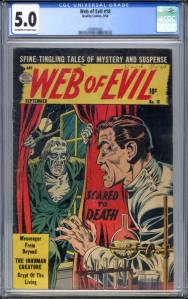
From the people who brought you Captain Marvel comes horror. Web of Evil was an anthology horror comic published by Quality Comics, and was acquired by DC Comics when DC bought Quality in 1956. It rivaled EC’s horror comics, often considered the measuring stick for greatness in this genre. With its smart writing, consistently high-end artwork, and willingness to push-the-envelope with its, violent, graphic depiction of scenes of the macabre, Web Of Evil, as with several EC horror titles, ended up getting Quality Comics in hot water, metaphorically.
Web of Evil #18 CGC 5.0 Off White – White Pages $299
The major event many cite as marking the beginning of the Golden Age was the 1938 debut of Superman in Action Comics #1, published by the predecessor of modern-day DC Comics. The creation of Superman made comic books into a major industry. Some date the start to earlier events in the 1930s: The Overstreet Comic Book Price Guide‘s regular publication The Golden Age Quarterly lists comic books from 1933 onwards (1933 saw the publication of the first comic book in the size that would subsequently define the format); some historians, such Roger Sabin, date it to the publication of the first comic books featuring entirely original stories rather than re-prints of comic strips from newspapers (1935) by the company that would become DC Comics.
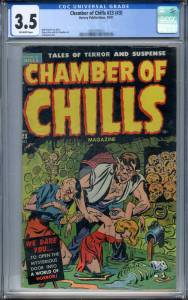
The first Chamber of Chills was a 10-cent horror anthology published bimonthly by Harvey Publications that ran 26 issues (cover-dated June 1951 – Dec. 1954).
Chamber of Chills was formerly Blondie Comics, taking over that comic’s numbering with issue #21. After issue #24 (Dec. 1951), the numbering was reset to #1. Chamber of Chills became Chamber of Clues with the February 1955 issue, and ceased publication two issues later, the last cover-dated April 1955.
Chamber of Chills #23 CGC 3.5 Off-White Pages $349
The first Marvel Tales was the direct continuation of the superhero anthology Marvel Mystery Comics, published by Marvel Comics‘ initial iteration, Timely Comics. This series ran through issue #92 (cover-dated June 1949). Beginning with issue #93 (Aug. 1949), it became Marvel Tales, an anthology of horror, fantasy, and science fiction stories. The bulk of this series was published under the company name Atlas Comics.
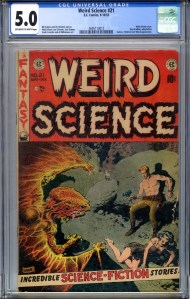
As with other EC Comics, Gaines and Feldstein used some Weird Science stories to teach moral lessons. “The Probers” (#8) features a space shuttle doctor who pays no mind to dissecting various animals, only to end up on an alien planet where aliens plan to dissect him. In “The Worm Turns” (#11) astronauts have fun with Mexican jumping beans but face a similar situation when they hide in a piece of fruit on an alien world and are found by a giant alien. “He Walked Among Us” (#13) was a take on organized religion in which a Christ-like astronaut helps the impoverished populace of an alien world but is killed by those in power, prompting the birth of a religion.
Gaines and Feldstein made cameo appearances in “Chewed Out” (#12), and other EC staffers were drawn into “EC Confidential” (#21).
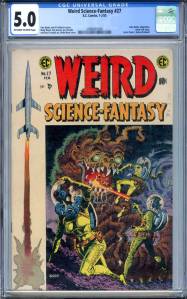
Weird Science 21 CGC 5.0 Off-White to White Pages $489Weird Science Fantasy 27 CGC 5.0 Off White to White Pages $379
In early 1939, the success of Superman in Action Comics prompted editors at National Comics Publications (the future DC Comics) to request more superheroes for its titles. In response, Bob Kane created “the Bat-Man”. Collaborator Bill Finger recalled that “Kane had an idea for a character called ‘Batman,’ and he’d like me to see the drawings. I went over to Kane’s, and he had drawn a character who looked very much like Superman with kind of … reddish tights, I believe, with boots … no gloves, no gauntlets … with a small domino mask, swinging on a rope. He had two stiff wings that were sticking out, looking like bat wings. And under it was a big sign … BATMAN”. The bat-wing-like cape was suggested by Bob Kane, inspired by Leonardo Da Vinci‘s sketch of an ornithopter flying device as a child.
Finger suggested giving the character a cowl instead of a simple domino mask, a cape instead of wings, and gloves; he also recommended removing the red sections from the original costume. Finger said he devised the name Bruce Wayne for the character’s secret identity: “Bruce Wayne’s first name came from Robert Bruce, the Scottish patriot. Wayne, being a playboy, was a man of gentry. I searched for a name that would suggest colonialism. I tried Adams, Hancock … then I thought of Mad Anthony Wayne.” He later said his suggestions were influenced by Lee Falk‘s popular The Phantom, a syndicated newspaper comic-strip character with which Kane was also familiar.
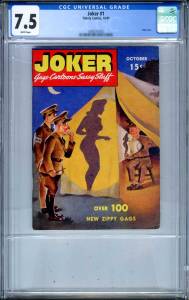
Stan Lee makes an appearance in the one-shot digest Joker, on three separate pages. (The only person to sign their text material.) This title would re-start shortly after as a large bedsheet (Life Magazine size) and run 4 more issues as Volume #1-4 on a quarterly basis. It will also concurrently become a comic book at the same time.
Panic was a bi-monthly humor comic that was published by Bill Gaines‘ EC Comics line during the mid-1950s as a companion to Harvey Kurtzman‘s Mad, which was being heavily imitated by other comic publishers.
Panic was edited by Al Feldstein (who became the editor of Mad a few years later). Beginning with its first issue (February–March 1954), Panic had a 12-issue run over two years. Feldstein was the primary cover artist, with stories illustrated by Jack Davis, Will Elder, Jack Kamen, Joe Orlando, Basil Wolverton and Wally Wood. Some story ideas were by Nick Meglin, later the co-editor of Mad. Scripts were by Feldstein, Elder and Jack Mendelsohn, later a co-screenwriter of Yellow Submarine (1968) and an Emmy-nominated TV comedy writer.
Murder Incorporated would’ve been an obvious title for a hard-hitting true-crime comic book in 1948. The real-life Murder Incorporated, the infamous hit squad of New York City organized crime had been shut down by the early 1940s, but their legend lived on in other media. This Fox Feature Syndicate series was true to its title as it featured true crime tales with a focus on mob killers and other notorious murderers. Murder Incorporated‘s notoriety was such that the series was mentioned by both Fredric Wertham in Seduction of the Innocent, and Geoffrey Wagner in Parade of Pleasure, and it landed on countless municipal government ban lists around the country in 1948, along with much of the rest of Victor Fox’s comic book line. An interesting series in the context of both comic book history and from a true-crime perspective.
Murder Incorporated #1 CGC 4.0 Off-White to White pages $495
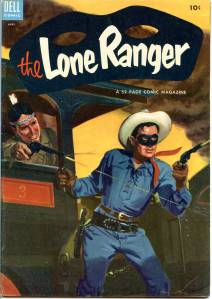
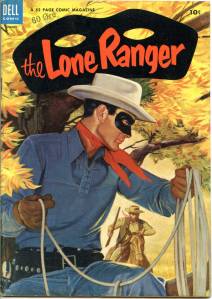
In 1948, Western Publishing, with its publishing partner Dell Comics, launched a comic book series which lasted 145 issues. This originally consisted of reprints from the newspaper strips (as had all previous comic book appearances of the character in various titles from David McKay Publications and from Dell). However, new stories by writer Paul S. Newman and artist Tom Gill began with issue #38 (August 1951). Some original content was presented as early as #7 (January 1949), but these were non-Lone Ranger fillers. Newman and Gill produced the series until its final issue, #145 (July 1962).
Tonto got his own spin-off title in 1951, which lasted 31 issues. Such was the Ranger’s popularity at the time that even his horse Silver had a comic book, The Lone Ranger’s Famous Horse Hi-Yo Silver, starting in 1952 and running 34 issues; writer Gaylord DuBois wrote and developed Silver as a hero in his own right. In addition, Dell also published three big Lone Ranger annuals, as well as an adaptation of the 1956 theatrical film.
The Dell series came to an end in 1962. Later that same year, Western Publishing ended its publishing partnership with Dell Comics and started up its own comic book imprint, Gold Key Comics. The new imprint launched its own Lone Ranger title in 1964. Initially reprinting material from the Dell run, original content did not begin until issue #22 in 1975, and the magazine itself folded with #28 in 1977. Additionally, Hemmets JournalAB published a three-part Swedish Lone Ranger story the same year.