Mystic – Atlas (1951)

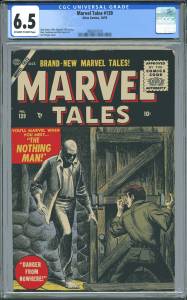
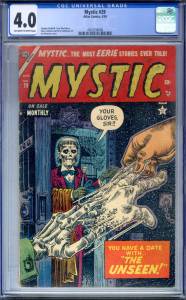
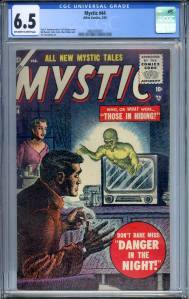
Titled simply Mystic and published by Marvel’s 1950s iteration, Atlas Comics, this was a 61-issue horror-suspense anthology (March 1951-Aug. 1957).

Mystic debuted shortly before Atlas’ Strange Tales, increasing the company’s science fiction/fantasy/horror line from four titles to six. Begun prior to the creation of the comic-book industry’s self-censorship board, the Comics Code AuthorityMystic softened its horror when it went under the auspices of the Comics Code beginning with issue #37 (May 1955). The series’ contributors included artists Bill Everett and John Severin.

Action Comics (Golden Age)

The major event many cite as marking the beginning of the Golden Age was the 1938 debut of Superman in Action Comics #1, published by the predecessor of modern-day DC Comics. The creation of Superman made comic books into a major industry. Some date the start to earlier events in the 1930s: The Overstreet Comic Book Price Guide‘s regular publication The Golden Age Quarterly lists comic books from 1933 onwards (1933 saw the publication of the first comic book in the size that would subsequently define the format); some historians, such Roger Sabin, date it to the publication of the first comic books featuring entirely original stories rather than re-prints of comic strips from newspapers (1935) by the company that would become DC Comics.

Panic (1954)

Panic was a bi-monthly humor comic that was published by Bill Gaines‘ EC Comics line during the mid-1950s as a companion to Harvey Kurtzman‘s Mad, which was being heavily imitated by other comic publishers.

Panic was edited by Al Feldstein (who became the editor of Mad a few years later). Beginning with its first issue (February–March 1954), Panic had a 12-issue run over two years. Feldstein was the primary cover artist, with stories illustrated by Jack DavisWill ElderJack KamenJoe OrlandoBasil Wolverton and Wally Wood. Some story ideas were by Nick Meglin, later the co-editor of Mad. Scripts were by Feldstein, Elder and Jack Mendelsohn, later a co-screenwriter of Yellow Submarine (1968) and an Emmy-nominated TV comedy writer.

Murder Incorporated (1948)

Murder Incorporated would’ve been an obvious title for a hard-hitting true-crime comic book in 1948.   The real-life Murder Incorporated, the infamous hit squad of New York City organized crime had been shut down by the early 1940s, but their legend lived on in other media.  This Fox Feature Syndicate series was true to its title as it featured true crime tales with a focus on mob killers and other notorious murderers.  Murder Incorporated‘s notoriety was such that the series was mentioned by both Fredric Wertham in Seduction of the Innocent, and Geoffrey Wagner in Parade of Pleasure, and it landed on countless municipal government ban lists around the country in 1948, along with much of the rest of Victor Fox’s comic book line.  An interesting series in the context of both comic book history and from a true-crime perspective.

World’s Finest (1950’s)

The series was initially a 96-page quarterly anthology, featuring various DC characters – always including Superman and Batman – in separate stories. Comics historian Les Daniels noted that “pairing Superman and Batman made sense financially, since the two were DC’s most popular heroes”. When superheroes fell out of vogue in the early 1950s, DC shortened the size of the publication to that of the rest of its output, leaving only enough space for one story; this led to Superman and Batman appearing in the same story together starting with World’s Finest Comics #71 (July 1954). The title often depicted Batman gaining superpowers as a way to avoid having him be overshadowed by Superman. Lex Luthor and the Joker first joined forces in issue #88 (June 1957).

Spellbound (1952)

Step into the thrilling pages of Spellbound, a classic Atlas comics series that captivated readers in the 1950s. Through the expert craftsmanship of writer Sol Brodsky and talented artists, Spellbound brings to life unforgettable characters and stunning visuals that will linger in your mind long after you close the cover. Don’t miss out on this captivating series that defined the golden age of Atlas comics.

Boy Commandos (1942)

Boy Commandos spun off into their own title with a ‘Winter 1942’ date. The title sold “over a million copies each month”, and was one of DC’s “three biggest hits” alongside Superman and Batman. Jack Kirby drew around five pages a day of the title, but Jack Liebowitz requested an even faster turn-around – fearing (as happened) that the two would be drafted, as had many other industry professionals. Simon & Kirby hired “inkers, [letterers], colorists, and writers, striving to create a year’s worth of tales” (Boy Commandos was also a quarterly title until Winter, 1945). Among those hired was a young Gil Kane.

Boy Commandos ran until issue #36 (Nov/Dec 1949), and was edited throughout by Jack Schiff. Among the individuals who assisted Simon and Kirby on the title (and its covers) were future-Superman legend Curt Swan, as well as Steve Brodie, Louis Cazeneuve and Carmine Infantino.

Eerie (1951)

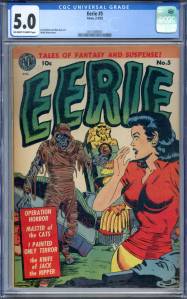
In 1951, Eerie #1, cover-dated May/June 1951, was published by Avon and saw a run of seventeen issues. The first issue of Eerie reprinted “The Strange Case of Henpecked Harry” from one-shot Eerie of 1947 as “The Subway Horror”, and issue 12 printed a Dracula story based on the Bram Stoker novel. Several covers featured large-breasted women in bondage. Artists Joe Orlando and Wallace Wood were associated with the series. The title saw a run of seventeen issues, ceasing publication with its August/September 1954 issue. Eerie then morphed into Strange Worlds with #18, October/November 1954.

MAD (Golden Age)

MAD is an American humor magazine founded in 1952 by editor Harvey Kurtzman and publisher William Gaines, launched as a comic book before it became a magazine. It was widely imitated and influential, affecting satirical media as well as the cultural landscape of the 20th century, with editor Al Feldstein increasing readership to more than two million during its 1974 circulation peak. As of January 2017, Mad has published 544 regular issues, as well as hundreds of reprint “Specials,” original material paperbacks, compilation books and other print projects.

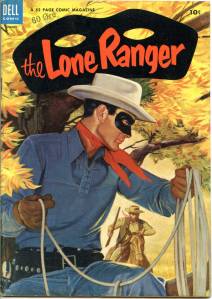
The Lone Ranger (1954)

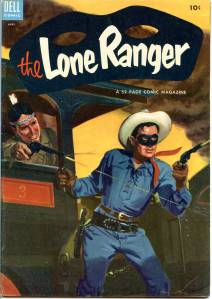
In 1948, Western Publishing, with its publishing partner Dell Comics, launched a comic book series which lasted 145 issues. This originally consisted of reprints from the newspaper strips (as had all previous comic book appearances of the character in various titles from David McKay Publications and from Dell). However, new stories by writer Paul S. Newman and artist Tom Gill began with issue #38 (August 1951). Some original content was presented as early as #7 (January 1949), but these were non-Lone Ranger fillers. Newman and Gill produced the series until its final issue, #145 (July 1962).

Tonto got his own spin-off title in 1951, which lasted 31 issues. Such was the Ranger’s popularity at the time that even his horse Silver had a comic book, The Lone Ranger’s Famous Horse Hi-Yo Silver, starting in 1952 and running 34 issues; writer Gaylord DuBois wrote and developed Silver as a hero in his own right. In addition, Dell also published three big Lone Ranger annuals, as well as an adaptation of the 1956 theatrical film.

The Dell series came to an end in 1962. Later that same year, Western Publishing ended its publishing partnership with Dell Comics and started up its own comic book imprint, Gold Key Comics. The new imprint launched its own Lone Ranger title in 1964. Initially reprinting material from the Dell run, original content did not begin until issue #22 in 1975, and the magazine itself folded with #28 in 1977. Additionally, Hemmets Journal AB published a three-part Swedish Lone Ranger story the same year.