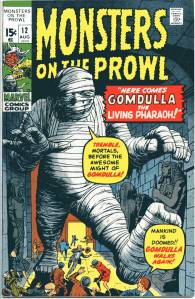
Monsters on the Prowl (1971)

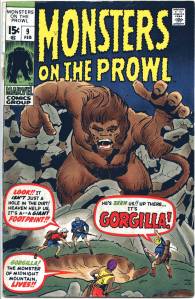
Chamber of Darkness was retitled Monsters on the Prowl with issue #9 (Feb. 1971), this version ran one new story each issue through #13 (Oct. 1971) with the remaining content consisting of reprints from Atlas Comics, Marvel’s 1950s predecessor, and “pre-superhero Marvel”, primarily drawn by Jack Kirby or Steve Ditko. It expanded into a double-sized, 25-cent comic for two issues (#13-14, Oct.-Dec. 1971). Some issues of the reprint books featured new covers by John SeverinMarie SeverinGil Kane, and Herb Trimpe.

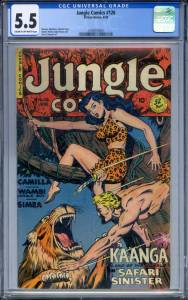
Jungle Comics (1940)

Having not been able to saturate the market’s insatiable demand for jungle sirens with Sheena in Jumbo Comics, Fiction House unleashed another series titled Jungle Comics.  Running 163 issues staring January 1940 the series did not end until Fiction House succumbed to the Comics Code Authority over 14 years later.

Stories featured the main character Kaänga, a rather familiar sounding westerner child raised by apes. Another westerner, Ann Mason, became his mate after he rescued her from slave traders.

John Byrne’s 2112 (1991)

The Next Men characters made a prototypical appearance as “Freaks” in a lithography plate that was published within the History of the DC Universe Portfolio in 1986. Byrne had originally pitched the series to DC Comics, but the series never surfaced there. With some changes, Byrne changed the concept to fit in with his work on the graphic novel 2112, to become the John Byrne’s Next Men series. Two characters from the “Freaks” artwork somewhat retained their physical looks and became the lead characters of the Next Men series: heroine Jasmine and villain Aldus Hilltop.

The Next Men officially debuted in a four-part storyline in Dark Horse Presents #54-57 (later reprinted, in color, as John Byrne’s Next Men #0). The series ran until issue #30 and ended with a cliffhanger. According to Byrne, he intended the series to be science-fiction that had a “sort of smell” of being a super-hero book. In addition to exploring mature topics such as sex, abortion, and child abuse, Byrne also set aside some of the more-traditional conventions of the medium, such as “thought-bubbles” and sound-effects.

Byrne had intended to conclude the story in a second series after a six-month hiatus, but the collapse of the American comic-book industry in the mid-1990s made it financially unfeasible for him to do so, and he returned to working for hire at DC Comics and Marvel Comics.
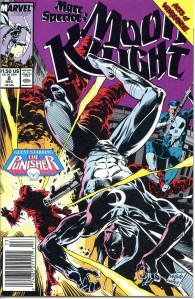
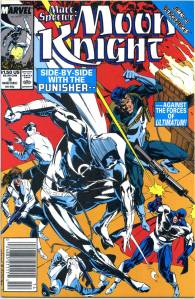
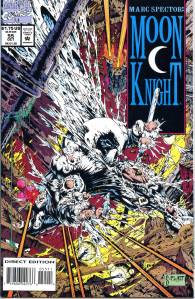
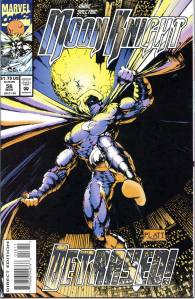
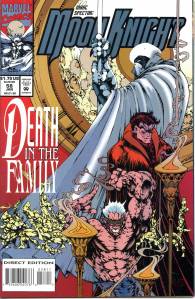
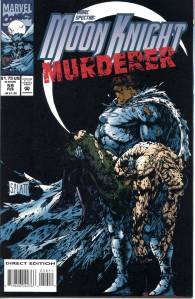
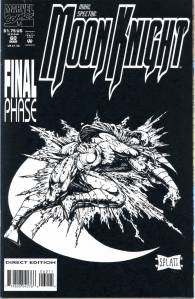
Marc Spector: Moon Knight V1 (1989)

Moon Knight was created by Doug Moench and Don Perlin. He first appeared in Werewolf by Night #32 (August 1975).

 In 1989, a third Moon Knight volume, titled Marc Spector: Moon Knight was published. It was the longest-running series, lasting sixty issues. This volume introduces Moon Knight’s teenage sidekick Jeff Wilde, also known as “Midnight,” the son of Midnight Man, a villain from the first volume of the series. At this time, Moon Knight first encounters the Black Cat. Turned into a cyborg by the Secret Empire, Midnight is seemingly killed in the “Round Robin” story arc of Amazing Spider-Man, spanning issues #353-#358.

 The series was canceled with issue #60 (March 1994), with four of the last six issues drawn by Stephen Platt, who was hired by Image Comics based on the strength of his work on the series.

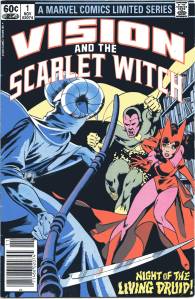
Vision and the Scarlet Witch V1 (1982)

The first limited series was published beginning in November 1982, for four issues. It was written by Bill Mantlo and pencilled by Rick Leonardi. In this series, the villain Magneto is retconned as the father of the Scarlet Witch and Quicksilver, and intending to give up his villainous life. The reveal had some previous clues released in the Avengers and X-Men titles and stayed as comic book canon for decades until it was undone in the 2014 crossover AXIS.

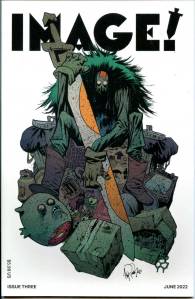
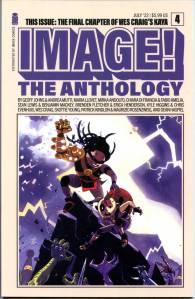
Image Anthology (2022)

Celebrate the 30th anniversary of Image Comics with the anthology series Image! This 12-issue series will treat readers to all-new stories from some of the biggest and best names in comics. Edited by Image Comics’ Publisher Eric Stephenson and featuring a combination of ongoing serials and standalone short stories.

X-Force V5 (2020)

X-Force is the CIA of the mutant world-one half intelligence branch, one half special ops. Beast, Jean Grey and Sage on one side, Wolverine, Kid Omega and Domino on the other.
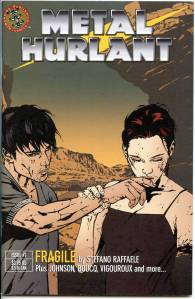
Métal Hurlant (2002)

Métal Hurlant began publishing again in July 2002 by Humanoids Publishing, with a French, English, Spanish and Portuguese version, under the French name. As a “two-headed”, transatlantic (France-US) magazine, led by Fabrice Giger in Los Angeles, it published original short stories, sometimes related to existing or to be published comic books. Its aim was to discover young creators and promote the products from the publisher. This incarnation of the magazine ceased publication with issue No. 14, dated November/December 2004.

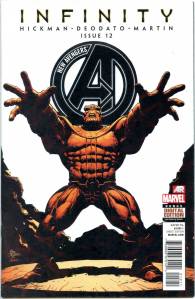
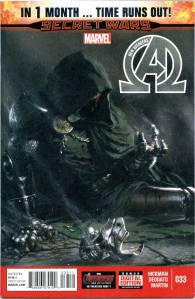
New Avengers V3 (2013)

New Avengers was renumbered as a new volume in January 2013, written by Jonathan Hickman and originally drawn by Steve Epting. The new volume shifted its focus to the powerful group known as the Illuminati, which includes Black BoltCaptain AmericaDoctor StrangeIron ManMister Fantastic, and Namor, who reassembled to confront the threat of incursions. Black Panther and Reed Richards discovered that universal decay centered on Earth was causing universes to collide with one another, with Earth at the focal point. In issue #3, Black Panther, who had previously opposed the existence of the Illuminati, joined the group, and the Beast was brought in to fill the spot vacated by the death of Professor X. In the same issue, Captain America leaves. In issue #12, after having helped the Illuminati to defeat Thanos‘s army, Black Bolt’s brother Maximus joined the team. Bruce Banner joined the team in Avengers Vol. 5 #28 after discovering the universal decay on his own.

Thunderstrike (1993)

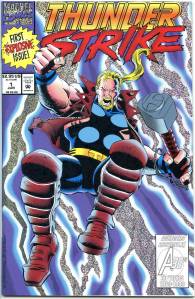
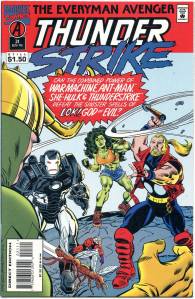
Following Thor #459, Masterson was introduced as “Thunderstrike” in the eponymous series starting in June 1993. The series lasted approximately two years. Thunderstrike ran for 24 issues, the series canceled in September 1995. Creator Tom DeFalco has often claimed that the book outsold Thor and The Avengers combined at the time of its cancellation; although this has been shown to be extremely unlikely.