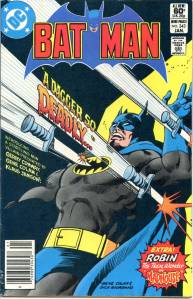
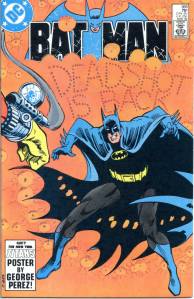
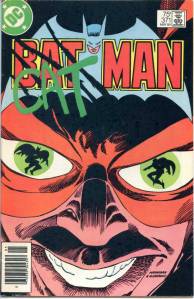
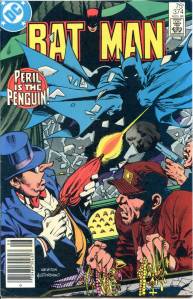
Frank Miller‘s limited series The Dark Knight Returns (February–June 1986), which tells the story of a 55-year old Batman coming out of retirement in a possible future, reinvigorated the character. The Dark Knight Returns was a financial success and has since become one of the medium’s most noted touchstones. The series also sparked a major resurgence in the character’s popularity.
That year Dennis O’Neil took over as editor of the Batman titles and set the template for the portrayal of Batman following DC’s status quo-altering miniseries Crisis on Infinite Earths. O’Neil operated under the assumption that he was hired to revamp the character and as a result tried to instill a different tone in the books than had gone before. One outcome of this new approach was the “Year One” storyline in Batman #404–407 (February–May 1987), in which Frank Miller and artist David Mazzucchelli redefined the character’s origins. Writer Alan Moore and artist Brian Bolland continued this dark trend with 1988’s 48-page one-shotBatman: The Killing Joke, in which the Joker, attempting to drive Commissioner Gordon insane, cripples Gordon’s daughter Barbara, and then kidnaps and tortures the commissioner, physically and psychologically.
The Batman comics garnered major attention in 1988 when DC Comics created a 900 number for readers to call to vote on whether Jason Todd, the second Robin, lived or died. Voters decided in favor of Jason’s death by a narrow margin of 28 votes (see Batman: A Death in the Family). The following year saw the release of Tim Burton‘s Batman feature film, which firmly brought the character back to the public’s attention, grossing millions of dollars at the box office, and millions more in merchandising.
This film adaptation includes one possible explanation of the title’s significance in story context: the narrative line, “Blade runner. You’re always movin’ on the edge.”
This was a reprint of issue 22 of the Marvel Comics Super Special series of titles, which by this time only printed Marvel’s movie adaptations, but without the feature content contained in the special.
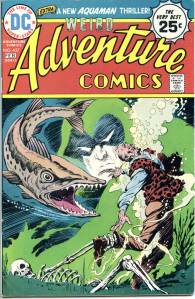
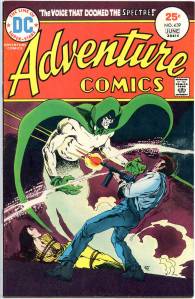
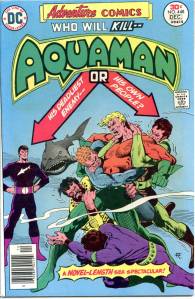
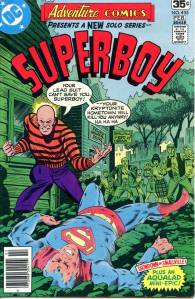
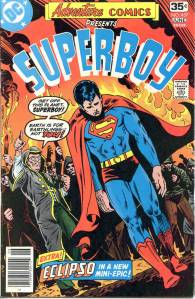
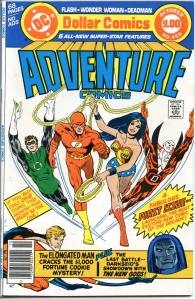
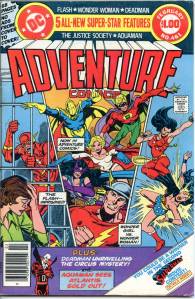
In the late 70’s conventional superheroes returned to the book, beginning behind the Spectre, first a three-issue run of Aquaman (issues #435–437, an early assignment for Mike Grell) and then a newly drawn 1940s Seven Soldiers of Victory script (issues #438–443). Aquaman was promoted to lead (issues #441–452), and backing him up were three-part story arcs featuring the Creeper (#445–447), the Martian Manhunter (#449–451), bracketed by issue-length Aquaman leads. He was awarded his own title and Superboy (#453–458) took over Adventure with Aqualad (#453–455) and Eclipso (#457–458) backups. Following this was a run as a Dollar Comic format giant-sized book (issues #459–466), including such features as the resolution of Return of the New Gods (cancelled in July–August 1978), “Deadman“, and the “Justice Society of America“.
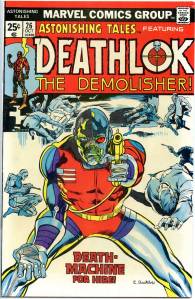
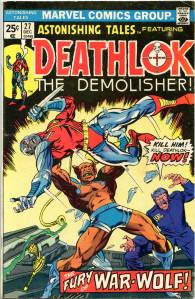
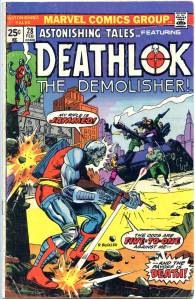
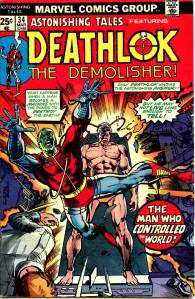
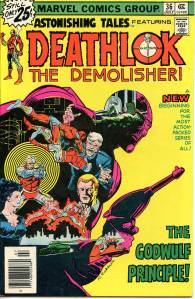
The final feature in Astonishing Tales starred and introduced Deathlok, a conflicted cyborg who predated the popular movie character RoboCop by several years and has become one of the most enduring Marvel characters among those introduced in the 1970s; at least two major iterations of the character, featuring different individuals, starred in series in the 1990s and 2000s. Created by artist Rich Buckler, who devised the initial concept, and writer Doug Moench, the feature ran from #25-28 and 30-36 (Aug. 1974 – Feb. 1975 and June 1975 – July 1976), the final issue. Bill Mantlo scripted issues #32-35, with Buckler himself scripting the finale. Buckler described Deathlok as “an extension of a paranoid fantasy. He was a representation of part of my outlook and world view. He was a culmination of many of the messages in some of the music of the time. He was part of some of the things going wrong in our country at the time. Maybe he was the science that was going wrong.Artist George Pérez made his professional comics debut with a two-page backup feature in issue #25.
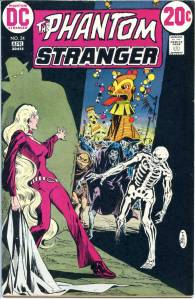
After an appearance in Showcase #80 (February 1969), he received another series beginning May–June 1969 that lasted until February–March 1976. The Showcase appearance and the first three issues of Phantom Stranger consisted of reprints from both the 1950s title and the “Dr. 13: Ghost-Breaker” feature from the last nine issues of Star Spangled Comics at the same time, with new, brief framing sequences. These had Dr. Thirteen, certain that the Phantom Stranger was an impostor, determined to expose him.
Beginning with issue #4 (November-December 1969), the series began featuring all-new material, with stories produced by Robert Kanigher, Len Wein, Jim Aparo, Neal Adams, Tony DeZuniga and others. In these stories, while the Stranger’s past remained a mystery, the writers added a semi-regular cast of characters for him. A demonic sorceress named Tala would become his archenemy; an alchemist/sorcerer named Tannarak was first an enemy and would later assist him against the Dark Circle; and a blind psychic named Cassandra Craft would assist him. Doctor Thirteen, dropped along with the reprints, was given a back-up series here as of #12 (March-April 1971) which morphed into “The Spawn of Frankenstein” in #23 (January-February 1973).
The second volume originally ended with the forty-first issue in November 1975, cover dated March 1976. In January 2010, a forty-second issue was added to the second series during the Blackest Night event, effectively a one-shot.
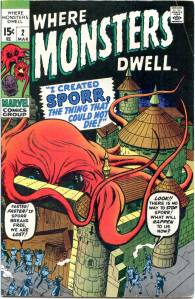
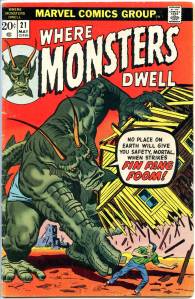
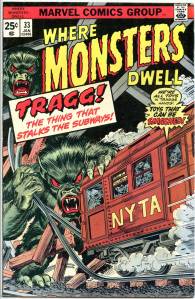
One of Marvel’s revival Horror and Monster comics. It lasted for 38 issues, making it one of the longest running Monster Mags from Marvel in the 1970’s. The series contains stories from many comic legends including Jack Kirby, Steve Ditko, Gil Kane and Bernie Wrightson. Issues #6 contains a reprint of Tales to Astonish #13, which is the 1st appearance of Groot from Guardians of the Galaxy.
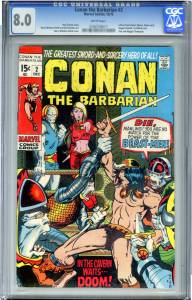
Marvel Comics introduced a fairly faithful version of Conan in 1970 with Conan the Barbarian, written by Roy Thomas with art initially by Barry Windsor-Smith, then John Buscema and Ernie Chan (aka Ernie Chua). The highly successful Conan the Barbarian series spawned the more adult, black-and-white Savage Sword of Conan in 1974, by Thomas, Buscema, and Alfredo Alcala. Savage Sword of Conan soon became one of the most popular comic series in the 1970s.
The Marvel Conan stories were also adapted as a newspaper comic strip which appeared daily and Sunday from September 4, 1978, to April 12, 1981. Originally written by Roy Thomas and illustrated by John Buscema, the strip was continued by several different Marvel artists and writers.
The series was launched with an April 1985 cover dated issue by writer Louise Simonson and penciller Greg LaRocque and featured the return of Spider-Man’s alien black costume, which attempted to rebond with Peter Parker. Peter managed to rid himself of the costume again using church bells and the alien was presumed to have died after that. The first issue featured a cover painting by artist Charles Vess.
In issue #18 (September 1986), Peter Parker is pushed in front of an oncoming train. He thinks to himself that this should not have happened, as his spider-sense would have warned him of the danger. Writer David Michelinie has said that he wrote this as the first “teaser” appearance of the characterVenom, whom he was planning to introduce at a later date. Venom is an amalgam of reporter Eddie Brock and the alien costume. The costume could nullify Spider-Man’s spider-sense, and this was the first clue of a puzzle that Michelinie was planning to weave to introduce Venom.
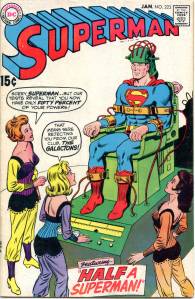
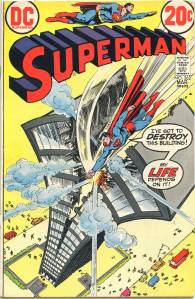
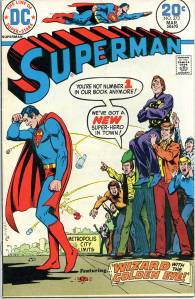
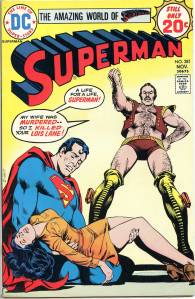
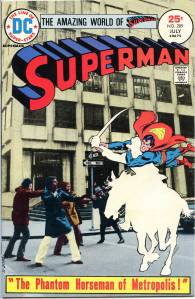
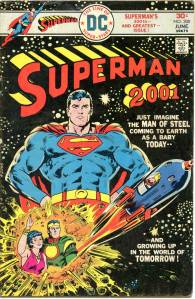
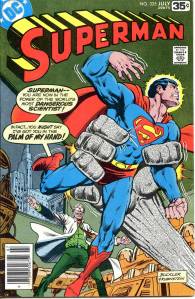
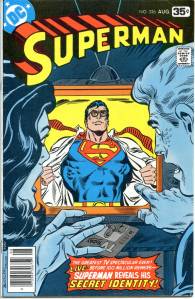
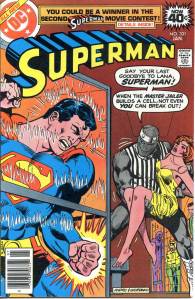
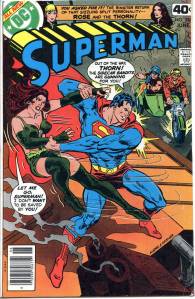
The early 1970s were a time of change for the Man of Steel. As Clark Kent shifted from being a newspaper reporter to a TV newscaster, his alter ego saw the destruction of all remaining Kryptonite on Earth! This period also featured many new villains, including Terra-Man, and the dramatic reintroductions of such foes as Lex Luthor — in green and purple armor!
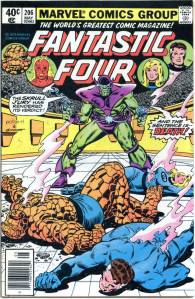
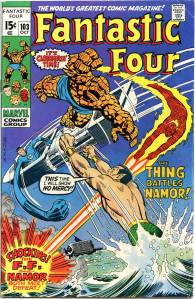
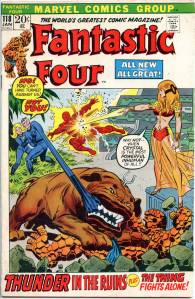
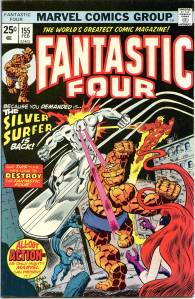
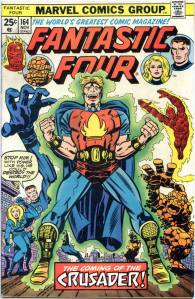
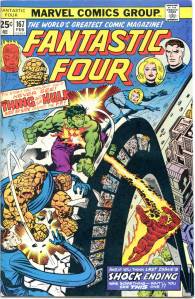
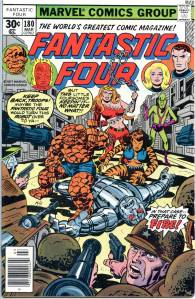
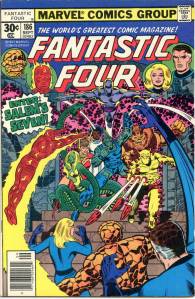
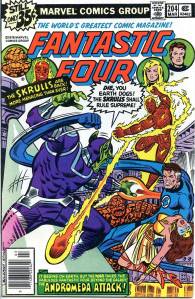
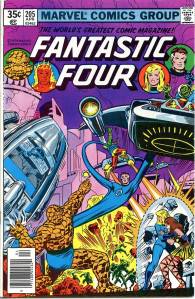
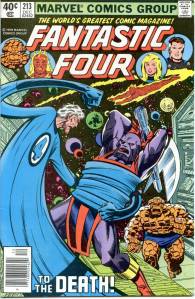
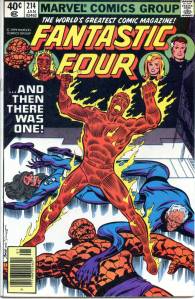
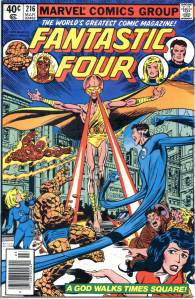
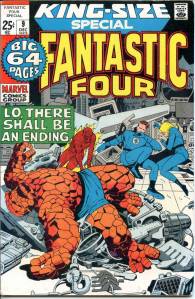
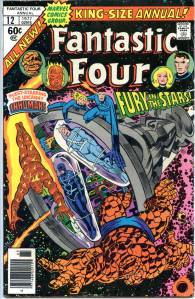
Stan Lee said he created a synopsis for the first Fantastic Four story that he gave to penciller Jack Kirby, who then drew the entire story. Kirby turned in his penciled art pages to Lee, who added dialogue and captions. This approach to creating comics, which became known as the “Marvel Method“, worked so well for Lee and Kirby that they used it from then on; the Marvel Method became standard for the company within a year.
Kirby recalled events somewhat differently. Challenged with Lee’s version of events in a 1990 interview, Kirby responded: “I would say that’s an outright lie”, although the interviewer, Gary Groth notes that this statement needs to be viewed with caution.Kirby claims he came up with the idea for the Fantastic Four in Marvel’s offices, and that Lee had merely added the dialogue after the story had been pencilled. Kirby has also sought to establish, more credibly and on numerous occasions, that the visual elements of the strip were his conceptions. He regularly pointed to a team he had created for rival publisher DC Comics in the 1950s, Challengers of the Unknown. “[I]f you notice the uniforms, they’re the same… I always give them a skintight uniform with a belt… the Challengers and the FF have a minimum of decoration. And of course, the Thing’s skin is a kind of decoration, breaking up the monotony of the blue uniform.” The characters wear no uniforms in the first two issues.




























































 EHT Comics