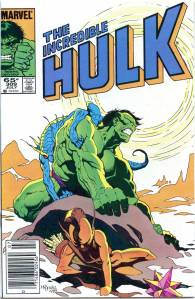
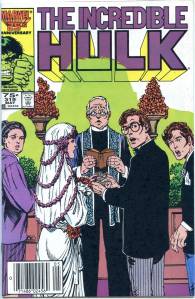
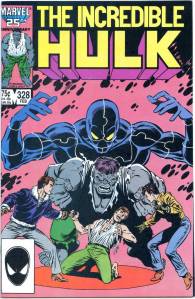
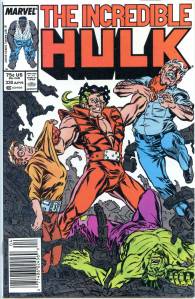
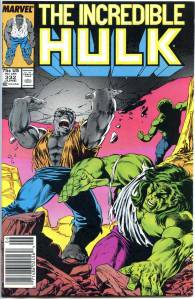
In the 1980s, Banner once again gained control over the Hulk, and gained amnesty for his past rampages; however, due to the manipulations of supernatural character Nightmare, Banner eventually lost control over the Hulk. It was also established that Banner had serious mental problems even before he became the Hulk, having suffered childhood traumas that engendered Bruce’s repressed rage. Banner comes to terms with his issues for a time, and the Hulk and Banner were physically separated by Doc Samson. Banner is recruited by the U.S. government to create the Hulkbusters, a government team dedicated to catching the Hulk. Banner finally married Betty in The Incredible Hulk #319 (May 1986) following Talbot’s death in 1981. Banner and the Hulk were reunited in The Incredible Hulk #323 (Sep. 1986) and with issue #324, returned the Hulk to his grey coloration, with his transformations once again occurring at night, regardless of Banner’s emotional state. In issue #347 the grey Hulk persona “Joe Fixit” was introduced, a morally ambiguous Las Vegas enforcer and tough guy. Banner remained repressed in the Hulk’s mind for months, but slowly began to reappear.
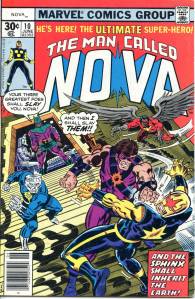
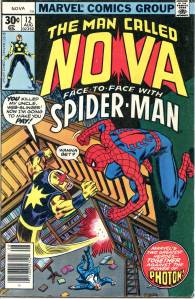
Nova was created by Marv Wolfman and Len Wein in the fanzine Super Adventures in 1966. Seven years later John Romita, Sr. tweaked the design of the character’s uniform. Nova debuted in Nova #1 in 1976, written by Wolfman and drawn by John Buscema. Wolfman intended the teenage character to be an homage to Stan Lee and Steve Ditko‘s Spider-Man, down to his humble working-class roots and alliterative alter-ego. The original Nova series, The Man Called Nova, lasted 25 issues from September 1976 to May 1979. Dangling plot lines were resolved in issues 206-214 of Fantastic Four (also by Wolfman) and issue 24 of Rom the Spaceknight. The character then disappeared into obscurity until returning as a member of the original New Warriors team debuting in The Mighty Thor #411 (December 1989), and continuing through New Warriors #1-75, Annual #1-4 (July 1990—September 1996).
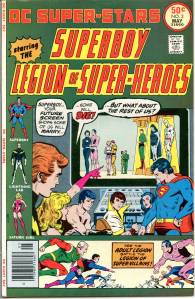
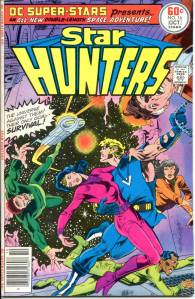
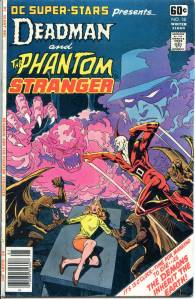
The series’ middle period was marked by theme issues — Aquaman, heroes with guns, sports, magic-users — until issue #12, which heralded the title’s second original story, featuring Superboy. From that point until DC Super Stars was cancelled after issue #18, the series contained new stories about a range of different characters (some being showcased for their own titles), as well as a collection of “secret origin” stories. The Bronze AgeHuntress made her first appearance in DC Super Stars #17 (November/December 1977) in a story written by Paul Levitz and drawn by Joe Staton and Bob Layton.
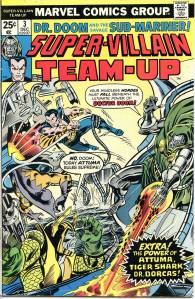
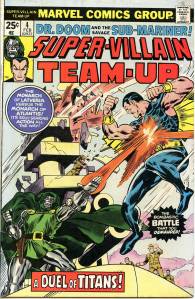
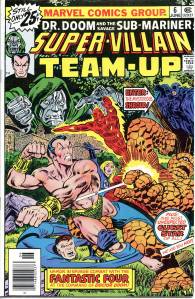
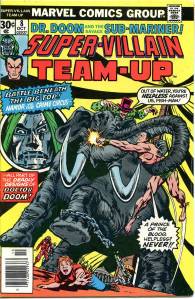
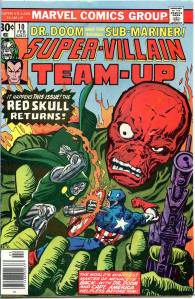
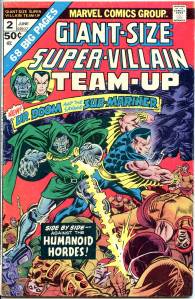
The first series started in 1975 with two giant-size issues before starting as a regular series, and was mostly bi-monthly during its existence. It initially teamed up Doctor Doom and the Sub-Mariner, who had lost his own series, from which it picked up the unresolved plots, especially that of the comatose Atlanteans. After a succession of writers and artists and a crossover with The Avengers, the plot gets resolved in issue #13 when Dr. Doom revives the Atlanteans, thus dissolving his alliance with the Sub-Mariner.
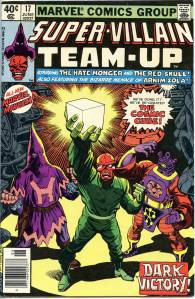
Issue #14 (Oct. 1977), which featured Magneto and Dr. Doom, was billed as the final issue of the series, and its plotline was resolved in The Champions #16. The following year, SVTU continued with issue #15 (Nov. 1978), a reprint of Astonishing Tales #4-5. Issues #16 (May 1979) and #17 (June 1980) featured the Red Skull and the Hate-Monger. The irregular publishing frequency of the final three issues was due to a legal maneuver to prevent DC Comics from trademarking the term “super-villain”.
The series saw the death of the Sub-Mariner’s 1940s sweetheart Betty Dean and the death of her murderer, Dr. Dorcas. Steve Englehart created The Shroud, a character partly inspired by Batman, shortly before he started to work for DC Comics on Detective Comics.
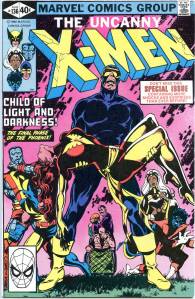
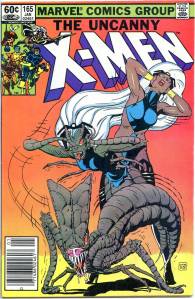
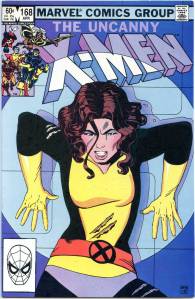
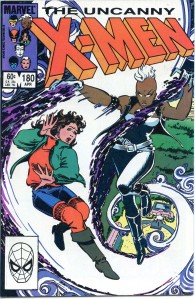
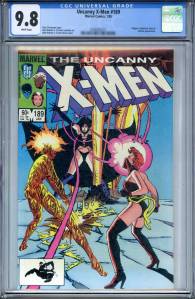
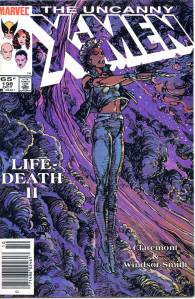
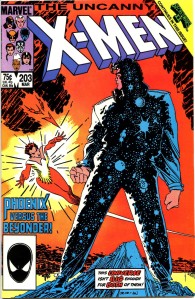
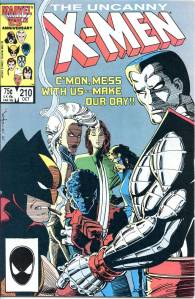
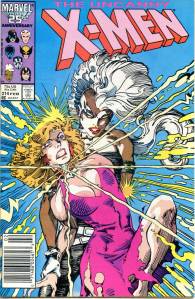
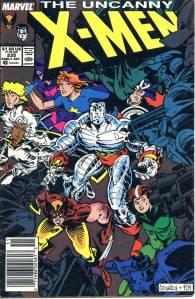
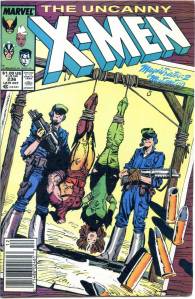
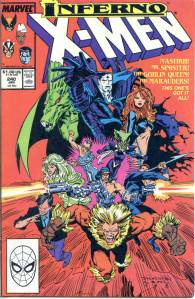
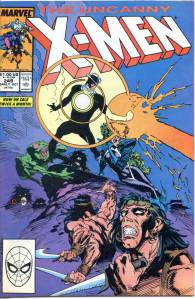
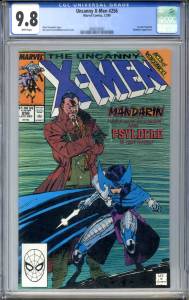
The “Dark Phoenix Saga” in 1980 led to a change in the line-up of the team, with the death of Phoenix (Jean Grey), and Cyclops leaving the team to mourn for her. Comics writers and historians Roy Thomas and Peter Sanderson observed that “‘The Dark Phoenix Saga’ is to Claremont and Byrne what ‘the Galactus Trilogy‘ is to Stan Lee and Jack Kirby. It is a landmark in Marvel history, showcasing its creators’ work at the height of their abilities.” The storyline also saw the introduction of recurring antagonists the Hellfire Club, and its Inner Circle consisting of Sebastian Shaw, Emma Frost, Harry Leland, Donald Pierce, along with Mastermind, previously a member of Magneto’s Brotherhood. The new teenage mutant Kitty Pryde was introduced in #129 (Jan. 1980) and joined the X-Men in #139. The Dazzler, a disco-singing, roller-skating mutant, was introduced in #130 (Feb. 1980), but did not join the team, instead headlining her own solo title.
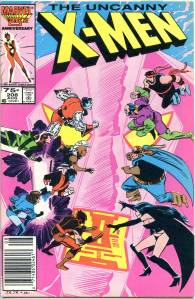
A new Brotherhood of Evil Mutants, led by Mystique, was introduced in the “Days of Future Past” storyline (#141-#142, Jan–Feb 1981) in which a time-travelling Kitty Pryde tried to avert a dystopian future caused by the Brotherhood assassinating Presidential candidate Senator Robert Kelly. Byrne plotted the story wanting to depict the Sentinels as a genuine threat to the existence of the mutant race. He then left the series after #143, being replaced by a returning Cockrum, who in turn was succeeded by Paul Smith and John Romita Jr.
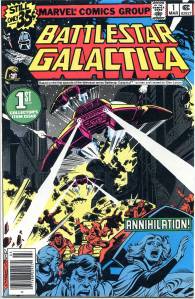
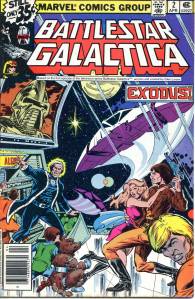
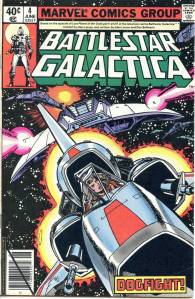
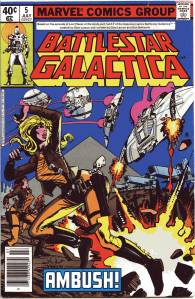
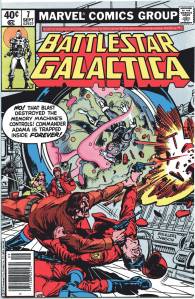
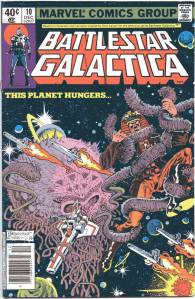
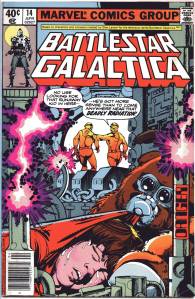
The comic book Battlestar Galactica, based on the ABC television series of the same name, was published monthly by Marvel Comics from March 1979 through January 1981, and lasted 23 issues.
Although there were other attempts to adapt Battlestar Galactica into a comic book format, the Marvel series is considered by many to have been the most successful in terms of run, sales, and content.
This was accomplished against some notable odds. Although Roger McKenzie was most often the writer, and Walt Simonson the most regular artist, the book also had a heavy rotation of guest writers and artists.
Marvel Comics’ began its adaptation of Battlestar Galactica with Marvel Super Special #8, a magazine format comic written by Roger McKenzie and drawn by Ernie Colón which was released as a tie-in to the start of the series. Based on an early script of the three hour series premiere “Saga of a Star World”, this adaptation, which gave a relatively short treatment to the third hour, was also released in a tabloid format and then later as a paperback as well. The tabloid version was also printed by Whitman Comics. Its success led Marvel to print a regular monthly comic depicting the adventures of the ragtag fleet.
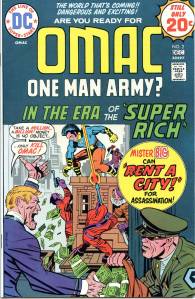
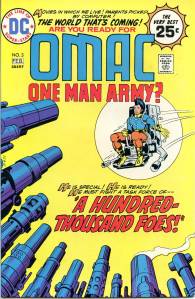
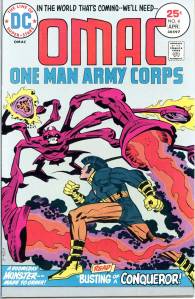
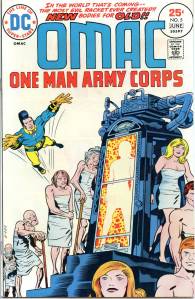
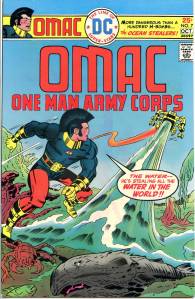
OMAC (Buddy Blank) was created in 1974 by Jack Kirby and published by DC Comics. The character was created towards the end of Kirby’s contract with the publisher, following the cancellation of his New Gods series and was reportedly developed strictly due to Kirby needing to fill his contractual quota of 15 pages a week.As envisioned by Kirby, OMAC is essentially Captain America set in the future, an idea Kirby had toyed with some years earlier while at Marvel Comics, but had never realized.
Set in the near future (“The World That’s Coming”), OMAC is a corporate nobody named Buddy Blank who is changed via a “computer-hormonal operation done by remote control” by an A.I. satellite called Brother Eye into the super-powered One-Man Army Corps (OMAC).
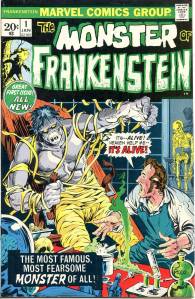
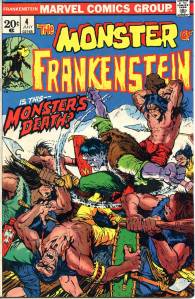
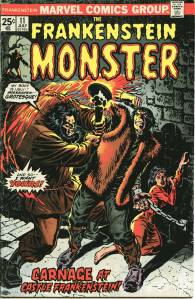
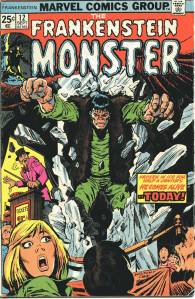
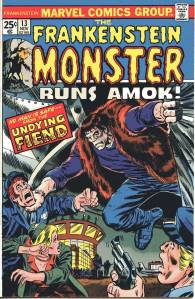
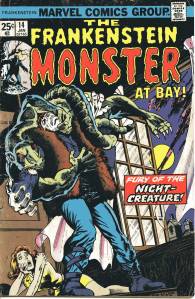
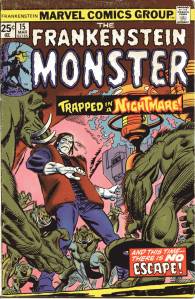
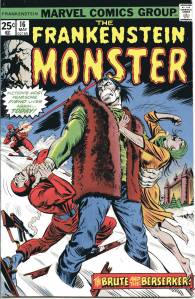
The character received an ongoing series, titled Frankenstein in the postal indicia and initially The Monster of Frankenstein (issues #1-5) and later The Frankenstein Monster as the cover logo, that ran 18 issues (Jan. 1973 – Sept. 1975).This series began with a four-issue retelling of the original novel, by writer Gary Friedrich and artist Mike Ploog. Several more issues continued his story into the 1890s, until he was placed in suspended animation and revived in modern times.




































 EHT Comics