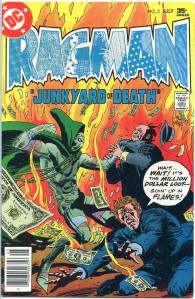
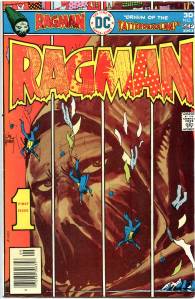
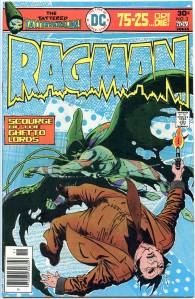
Ragman V1 (1970’s)

Ragman first appeared in the short-lived comic-book series named after him. He is one of a number of Jewish superheroes, and his continuity is tied to that of DC ComicsGolem, derived from the Golem of Prague of Jewish folklore. Ragman was created by writer Robert Kanigher and artist Joe Kubert. Ragman is sometimes compared to the other nighttime defender of Gotham City, Batman.

A Vietnam veteran, Rory had grown up helping his father, a junk man who owned a pawn shop named Rags’n’Tatters. His father always dreamed of making a better life for Rory and constantly promised that someday he would make Rory rich. While drinking with his friends one night, his father discovered 2 million dollars stuffed inside an old mattress that had been pawned just recently. He and his friends decided to hide the money for Rory, since they were too old to truly benefit from it. The money turned out to be the loot from an armored car heist and when the hoods came to the shop one night to get it, they shot down some electrical wires and used them to torture Rory’s father and his friends into revealing where the money was hidden. Rory arrived soon after and seeing his father in agony attempted to pull him free from the wires. A final shock of power ran though the old men and grounded out at Rory, knocking him unconscious. When he woke his father and friends were dead and the hoods responsible were gone. Using a costume made out of old rags (his father had bought it from a stranger before he died and left a note saying Rory could wear it to a costume party) he became Ragman, “The Tatterdemalion of Justice”.
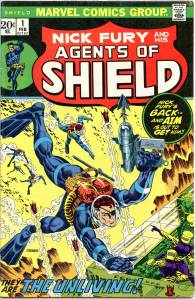
Nick Fury and his Agents of SHIELD (1973)

This series inspired the ABC television series Agents of SHIELD! This reprint comic features 2 classic stories from Marvel’s Silver Age. Classic Stan Lee & Jack Kirby stories with covers by Jim Steranko.

Secrets of Sinister House (1972)

After four issues as The Sinister House of Secret Love, which featured Gothic romance/horror stories written by Michael Fleisher and others, the title changed to Secrets of Sinister House, and the original format and romance angle were abandoned the following issue.

In the same vein as House of Mystery and House of Secrets (as well as its successor, Secrets of Haunted House), Secrets of Sinister House was “hosted” by Eve (the character debuted in issue #6) and included guest appearances by Eve’s cousins Cain and Abel. In issue #16, Eve was removed as host — as editor Joe Orlando departed from the title, replaced by Jack C. Harris — to focus on the concept of the “sinister houses”. The following month, she began nudging Destiny out of Weird Mystery Tales.

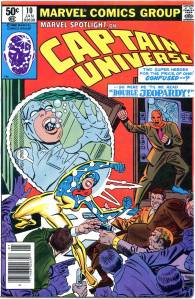
Marvel Spotlight V2 (1979)

Marvel Spotlight was revived in 1979, initially as simply a place to publish inventory stories from the recently cancelled Captain Marvel. However, once these leftover tales were exhausted, the series went on to feature other characters. Tako Shamara first appeared in Marvel Spotlight vol. 2 #5 (March 1980), in a story by Marv Wolfman and Steve Ditko. In his first appearance the character battled a huge dragon from the past called a Wani, a monster that destroyed his ancestors’ villages in 1582. The creature that Tako battled was intended to be Godzilla but since Marvel no longer had the rights to the character, which lapsed the previous year, the creature was modified to a dragon called The Wani. Issue #8 featured the final Captain Marvel solo story before the character’s death.

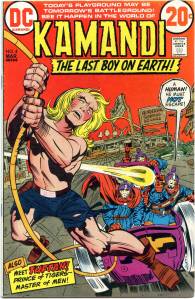
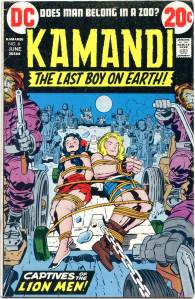
Kamandi (1972)

DC editor Carmine Infantino had tried to acquire the license to publish Planet of the Apes comic books. When this failed to happen, he asked Jack Kirby for a series with a similar concept. Kirby had not seen the films but he knew the rough outline and he had also created a very similar story, “The Last Enemy!”, in Harvey Comics‘ Alarming Tales that predated the original Planet of the Apes novel. He also had an unused comic strip he created in 1956, titled Kamandi of the Caves. Kirby brought all those elements together to create Kamandi. Although his initial plan was to not work on the comic books themselves, the cancellation of Forever People freed him up to do so.

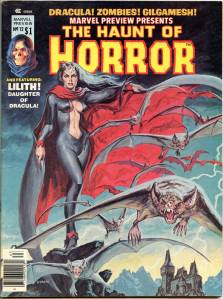
Marvel Preview V1 (1977)

An umbrella title that showcased a different heroic-adventure, science-fiction, or sword-and-sorcery character in virtually every issue. The title introduced the Marvel Comics characters Dominic Fortune in issue #2, Star-Lord in #4,and Rocket Raccoon in #7. The vigilante character the Punisher, introduced as an antagonist in the comic book The Amazing Spider-Man, had his first solo story in issue #2.

The Brave and the Bold (1980’s)

The character Nemesis, also known as Thomas Tresser, debuted in an eight-page backup story in issue #166 (September 1980) written by Cary Burkett and drawn by Dan Spiegle. The Tresser character was created by Burkett in 1979, and named for an actor with whom Burkett was rooming in New Hampshire.

Alan Brennert wrote four issues of The Brave and the Bold featuring Batman teaming with the CreeperHawk and Dove, the Robin of Earth-Two, and the Catwoman.

The title’s final issue featured a team-up of the Batmen of Earth-One and Earth-Two and included a preview of Batman and the Outsiders, the title that replaced The Brave and the Bold on DC’s schedule and became Aparo’s next regular assignment.

Tor (1974)

After his debut in 1,000,000 Years Ago (St. John, September 1953), Tor immediately went on to become one of the first comic book characters to star in 3-D comic books. The second issue of that series was renamed 3-D Comics before being renamed Tor with issue #3 in May 1954. At this point the series was once again in the traditional two-dimensional format. This series lasted until issue #5 (October 1954).

In 1959, Kubert and inker Carmine Infantino unsuccessfully attempted to sell Tor as a newspaper comic strip. The samples consisted of 12 daily strips, reprinted in six pages in Alter Ego #10 (1969) and later expanded to 16 pages in DC Comics‘ Tor #1. DC Comics would publish the Tor series for 6 issues from 1974-1975.

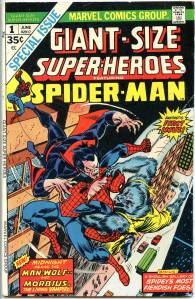
Giant-Size Super-Heroes (1974)

Giant-Size Super-Heroes was intended to be an ongoing series. However, only one issue was published and the series was rennamed Giant-Size Spider-Man with rebooted numbering instead. Morbius the Living Vampire in stalking Manhattan again! His first target is John Jameson, the Man-Wolf; and his second one ? the Amazing Spider-Man! Once Morbius reattaches the moonstone to John Jameson’s neck, the Man-Wolf becomes his to command! Now under the cover of darkness, the deadly duo heads to Empire State University to break into the research laboratory, but the ever-present web-slinger intercepts them along the way! Can Spider-Man defeat these two creatures of the night?

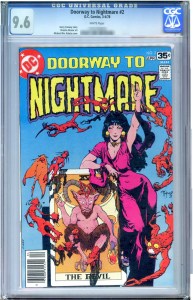
Doorway to Nightmare (1978)

Doorway to Nightmare, introduced in 1978, was the last of the DC “Mystery” line of titles in the 1970s that became the forerunner of Vertigo. It did not have a consistent creative team—the intent was to create writer-artist pairings that had never occurred before, except for the cover art of Michael William Kaluta. Madame Xanadu, the star of the series, was not a host but an active participant, albeit never the main character in her stories.