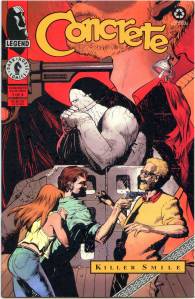
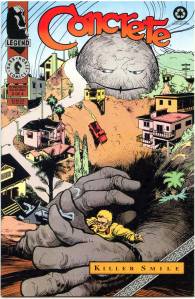
All Larry Munro wanted was a tank of gas. What he got was a gun put to his head. Now he’s being forced to play chauffeur to a pyromaniac looking to burn LA to the ground! Can a 1200-pound Concrete race fast enough to stop the bullet aimed at his best friend’s head? Legend creator Paul Chadwick takes Concrete to a new level of art and a new level of action in this four-issue series.
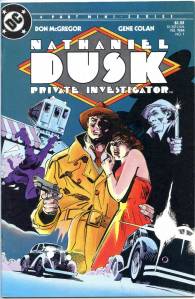
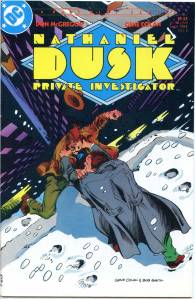
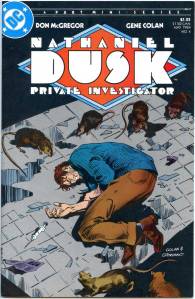
Nathaniel Dusk is a private investigator from New York City whose adventures in the 1930s are portrayed in the stories. He served in the United States armed forces in World War I and was hired by the New York City police force. Dusk fell deeply in love with Joyce Gulino, a beautiful young saleswoman with two children, Jennie and Anthony. Gulino’s ex-husband was a gangster named Joseph Costilino. Costilino later killed his family.
The 2017-2019 miniseries Doomsday Clock, by Geoff Johns and Gary Frank features Nathaniel Dusk in the DC Universe as a noir film character portrayed by a fictional actor named Carver Colman. Colman plays a key role in the story.
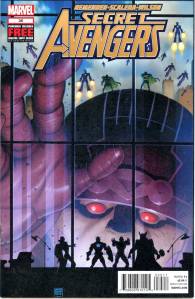
Secret Avengers, published by Marvel Comics features a fictionalblack opssuperhero team of the same name. The series started with Ed Brubaker on writing duties, depicting a black-ops sect of Marvel’s premiere super hero team, the Avengers, which operates under the guidance and leadership of Captain Steve Rogers (the former Captain America). The series is part of the Avengers-line relaunch as part of the “Heroic Age“.
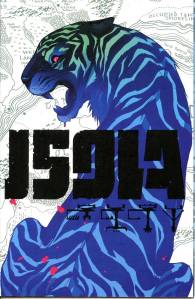
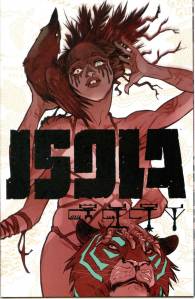
Isola was first announced at the 2016 Image Expo. Writer Brendan Fletcher explained he and writer/artist Karl Kerschl had been working towards the comic since elementary school. The story follows two women, Queen Olwyn, and Rook, her captain of the guard, on a journey to the island of Isola in hopes of reversing a curse that transformed the queen into a tiger. Kerschl and Fletcher cite the films of Hayao Miyazaki as an influence on the tone of Isola. Kerschl worked closely with colorist Michele Assarasakorn (MSassyK) to create a cinematic feel, mapping out colors in advance to reflect the characters’ journey.
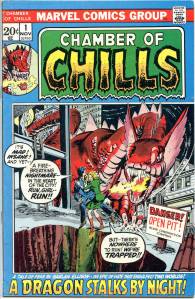
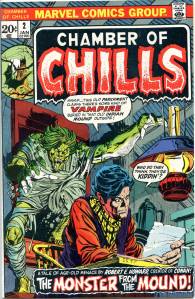
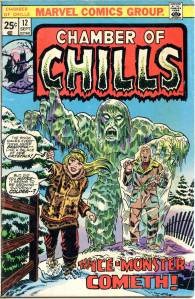
The title was one of four launched by Marvel Comics editor-in-chief Roy Thomas to form a line of science fiction and horror anthologies with more thematic cohesiveness than the company’s earlier attempts that decade, which had included such series as Chamber of Darkness and Tower of Shadows. Whereas those titles generally presented original stories, these new books would instead adapt genre classics and other works.
With the four titles’ debuts set to be staggered over the course of four months, Marvel premiered Journey into Mystery vol. 2 (Oct. 1972),Chamber of Chills (Nov. 1972), Supernatural Thrillers (Dec. 1972), and, with a late start, Worlds Unknown (May 1973). The first issue features an original six-page story by science fiction novelist George Alec Effinger, “Moon of Madness, Moon of Fear”, penciled by P. Craig Russell (then credited as Craig Russell), and a slightly retitled adaptation of the Harlan Ellison short story “Delusions for a Dragon Slayer”, by writer Gerry Conway and artist Syd Shores; in-between was a story by writer Stan Lee and artist Russ Heath, “They Wait in Their … Dungeon”, reprinted from Menace #1 (March 1953), from Marvel’s 1950s forerunner, Atlas Comics.
The bimonthly series ran exclusively new material through issue #4, with one reprinted story added to the mix for the following two issues, and only one new story in issue #7, after which the series became all-reprint. Most of the reprinted stories were 1950s “pre-Code” horror stories, which the industry self-censorship organization the Comics Code Authority had forbidden on Code-approved comics until a loosening of the Code in 1971.
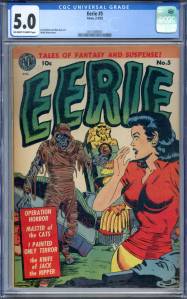
In 1951, Eerie #1, cover-dated May/June 1951, was published by Avon and saw a run of seventeen issues. The first issue of Eerie reprinted “The Strange Case of Henpecked Harry” from one-shot Eerie of 1947 as “The Subway Horror”, and issue 12 printed a Dracula story based on the Bram Stoker novel. Several covers featured large-breasted women in bondage. Artists Joe Orlando and Wallace Wood were associated with the series. The title saw a run of seventeen issues, ceasing publication with its August/September 1954 issue. Eerie then morphed into Strange Worlds with #18, October/November 1954.
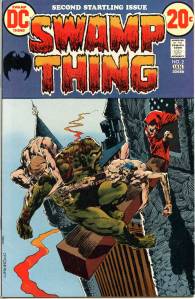
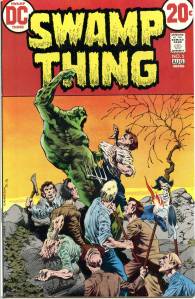
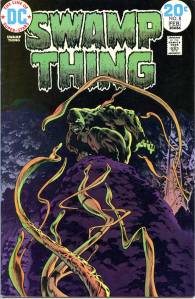
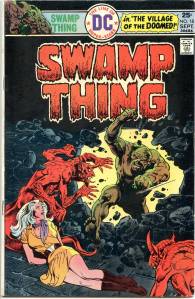
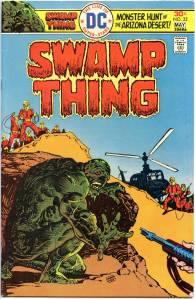
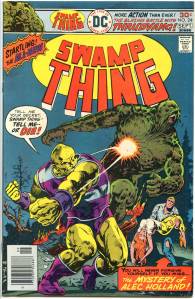
The Swamp Thing character first appeared in House of Secrets #92 (June–July 1971). After the success of the short story in the House of Secrets comic, the original creators were asked to write an ongoing series, depicting a more heroic, more contemporary creature. InSwamp Thing #1 (October–November 1972) Wein and Wrightson updated the time frame to the 1970s and featured a new version character: Alec Holland, a scientist working in the Louisiana swamps on a secret bio-restorative formula “that can make forests out of deserts”. Holland is killed by a bomb planted by agents of the mysterious Mr. E (Nathan Ellery), who wants the formula. Splashed with burning chemicals in the massive fire, Holland runs from the lab and falls into the muck-filled swamp, after which a creature resembling a humanoid plant appears. Roy Thomas and Gerry Conway, who co-created Man-Thing for Marvel Comics a year and a half earlier, thought that this origin was too similar to that of their character, and Wein himself had written a Man-Thing story that was published with a June 1972 cover date, but he refused to change the origin in spite of some cajoling by Conway, who was his roommate at the time. Marvel, however, never took the issue to court, realizing the similarity of both characters to The Heap.
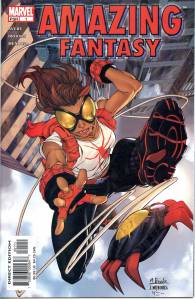
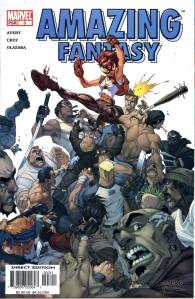
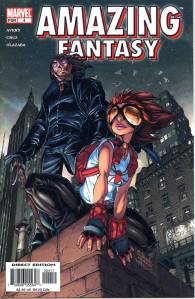
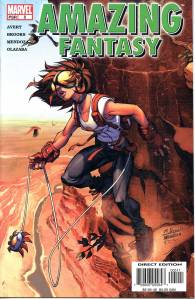
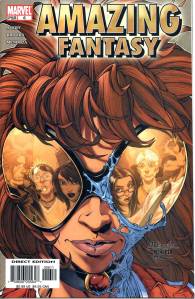
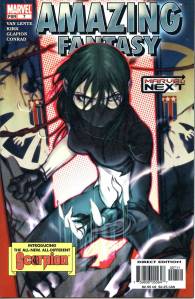
The second volume of Amazing Fantasy ran 20 issues (cover-dated Aug. 2004 – June 2006). The first arc ran through vol. 2, #1–6 and featured a new teenaged heroine, Araña. The second arc, in vol. 2, #7–12, published after a short hiatus, featured a revamped, female version of the supervillain the Scorpion. A back-up feature in vol. 2, #10–12 (Sept.-Nov. 2005) starred the character Nina Price, Vampire by Night. Vol. 2, #13–14 (both Dec. 2005) led with the modern-West feature “Vegas”, backed up by “Captain Universe“
The cover to #15 was a revamped version of the original Amazing Fantasy #15 cover, complete with Spider-Man swinging through a modern-day New York City, while the new heroes watch in awe in the background.
The final arc, in vol. 2, #16–20 (Feb.-June 2006), introduced Death’s Head 3.0, a revamp of the Marvel UK character, written by the original version’s creator, Simon Furman. Issues #18–19 contain two “Tales of the New Universe” stories as backup features, while #20 featured a Western backup, “Steamrider”
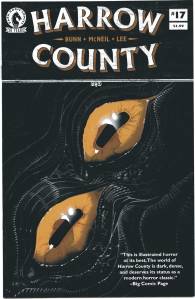
Harrow County began as a serialized prose story called Countless Haints, written by Cullen Bunn and released on his website. Countless Haints ran for ten chapters before it was retired. Later the story was repurposed as an ongoing comic with artist and co-creator Tyler Crook. The main character Madrigal was renamed Emmy, the time period was shifted from present day to the 1930s, and the location was changed from Ahmen’s Landing to Harrow County.
When Bunn began working on the series, he wrote the first two arcs so that they told a fairly complete story, though he hoped Harrow County would be popular enough to become an ongoing series. Crook chose to do the book in watercolors to get away from the computer and to make the project more fun for himself. As part of the promotional material for the comic, he created a special ordering form and made process videos showcasing his watercolors. He even wrote music for the first two arcs.
During Harrow County’s run, Cullen Bunn and Tyler Crook regularly shared their process in a column called The Harrow County Observer, Tyler Crook’s YouTube channel, and in the extensive sketchbook sections of the trade paperback collections.
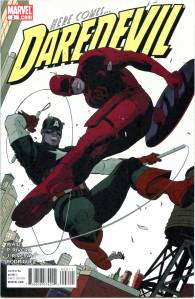
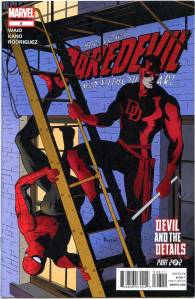
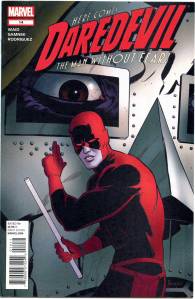
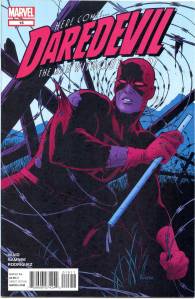
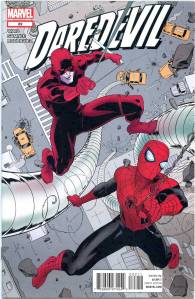
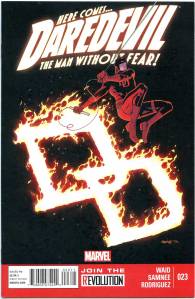
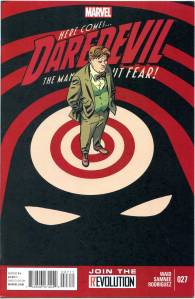
In July 2011, Daredevil relaunched with vol. 3, #1 (Sept. 2011), with writer Mark Waid. Waid focused on emphasizing the character’s powers and perception of the physical world. In the premiere issue, Murdock finds he can no longer serve as a trial lawyer due to past allegations of his being Daredevil causing a case he represents in court to turn into a media circus. Two issues later, Nelson and Murdock have developed a new business strategy of serving as consulting counselors, by teaching clients how to represent themselves in court.



















 EHT Comics