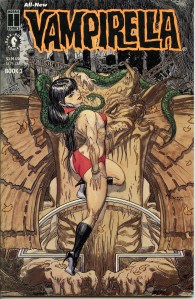
Upon Warren’s bankruptcy, Harris Publications acquired the company assets at auction in August 1983, although legal murkiness and a 1999 lawsuit by Warren publisher James Warren resulted in his reacquisition of the rights to sister publications Creepy and Eerie. Harris Comics published Vampirella stories in various series and miniseries from 1991 to 2007. Harris also published Vampirella #113, a one-issue continuation of the original series, containing solely reprinted stories, in 1988.
Green Lantern V5 (2011) New 52
In September 2011, The New 52 rebooted DC’s continuity. In this new timeline, DC Comics relaunched Green Lantern with a new issue #1, written again by Geoff Johns and penciled by Doug Mahnke. As with all of the books associated with the DC relaunch, Hal Jordan appears to be about five years younger than the previous incarnation of the character. Superheroes at large have appeared only in the past five years, and are viewed with at best, suspicion, and at worst, outright hostility.
DC Comics editorial confirmed that the entire history of Johns’ previous run on the Green Lantern title is still a part of the continuity of The New 52, with major storylines “Rebirth“, “Sinestro Corps War“, “Blackest Night“, and “Brightest Day” all still forming the backbone of the recent history of the characters.[60] As a result, the new volume of Green Lantern continues directly from the events of War of the Green Lanterns, with Sinestro serving as a Green Lantern and Hal Jordan beginning the series powerless on Earth.
Uncanny X-Men V1 (2010’s)
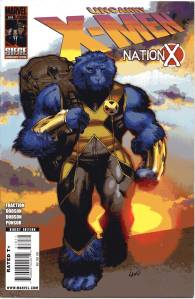
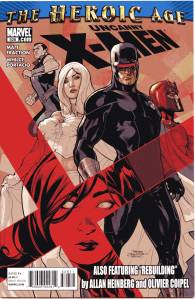
Matt Fraction became co-author from #500, and sole author from #504. The entire X-Men team relocated to San Francisco – first to the city, and then, after the “Utopia” crossover with Dark Avengers, to an island named Utopia in San Francisco Bay. The Nation X storyline focused on the return of the re-powered Magneto, and him coming to Utopia. The Second Coming crossover saw the return of Hope Summers, the baby from the “Messiah Complex” arc, to the present day, as a young adult; and the emergence of the “Five Lights”, the first new mutants to have arisen (apart from Hope) since the Decimation. Nightcrawler was killed during this storyline and the Beast left in protest after his discovery of Cyclops’ secret death squad X-Force. Kieron Gillen took over co-authorship of the series with #531, and became sole writer from #534.1. The original series ended with #544.
Fantastic Four (2000’s)
Beginning with issue #554 (April 2008), writer Mark Millar and penciller Bryan Hitch began what Marvel announced as a sixteen-issue run. Following the summer 2008 crossover storyline, “Secret Invasion“, and the 2009 aftermath “Dark Reign“, chronicling the U.S. government’s assigning of the Nation’s security functions to the seemingly reformed supervillain Norman Osborn, the Fantastic Four starred in a five-issue miniseries, Dark Reign: Fantastic Four (May–Sept. 2009), written by Jonathan Hickman, with art by Sean Chen. Hickman took over as the series regular writer as of issue #570 with Dale Eaglesham and later Steve Epting on art.
The Infinity War (1992)
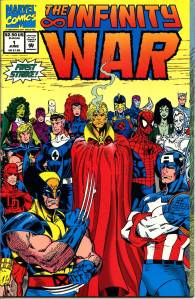
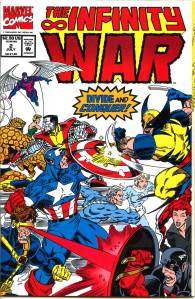
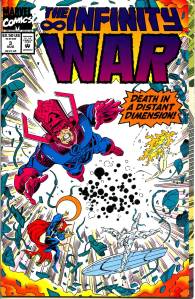
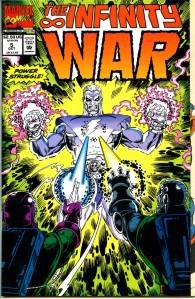
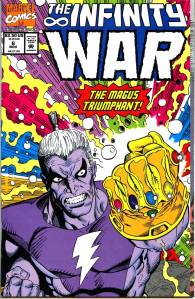
The Infinity War is a six-issue limited series published by Marvel Comics in 1992. The series was written by Jim Starlin and penciled by Ron Lim, Ian Laughlin, Al Milgrom, Jack Morelli and Christie Scheele.
In this series, The Magus, the purged, evil side of Adam Warlock believed to have been dead, has returned in order to collect the Infinity Gems and recreate the Infinity Gauntlet itself. He sent evil doppelgangers of Marvel’s superheroes to attack and usurp the originals. Thanos, exiled since his defeat during the Infinity Gauntlet event, learned of the Magus’ plans and set out to aid Adam Warlock and the heroes in defending the universe.
The storyline is a direct sequel to the 1991 Infinity Gauntlet crossover, and was followed by Infinity Crusade in 1993.
Hellblazer (1988)
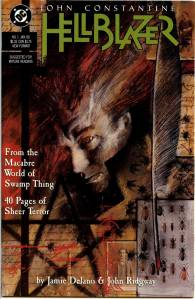
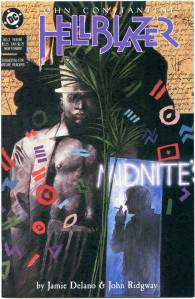
After favorable reader reaction to John Constantine‘s appearances in the comic book series Swamp Thing, where he had been introduced by Alan Moore during his authorship of the title, the character was given his own comic book series in 1988. The series was intended to bear the title Hellraiser, but this title was revised before publication due to the contemporaneous release of Clive Barker‘s unrelated film of the same name. Initial writer Jamie Delano was, in his own words, “fairly ambivalent” about the change of title.
The initial creative team was writer Jamie Delano and artist John Ridgway, with Dave McKean supplying distinctive painted and collage covers. Delano introduced a political aspect to the character, about which he stated: “…generally I was interested in commenting on 1980s Britain. That was where I was living, it was shit, and I wanted to tell everybody.” The book, originally published as a regular DC Comics title, became a Vertigo title with the imprint’s launch in March 1993 (issue #63 of the series). In October 2011, it was announced that this would join DC titles in being published digitally on the same day as its physical release, starting in January 2012.
Monster World (1964)
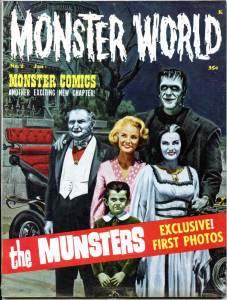
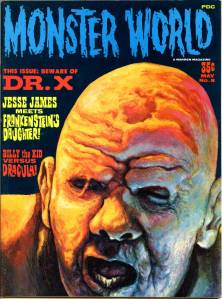
Begun by James Warren, Warren Publishing’s initial publications were the horror-fantasy–science fiction movie magazine Famous Monsters of Filmland and Monster World, both edited by Forrest J Ackerman. Warren soon published Spacemen magazine and in 1960 Help! magazine, with the first employee of the magazine being Gloria Steinem.
After introducing what he called “Monster Comics” in Monster World, Warren expanded in 1964 with horror-comics stories in the sister magazines Creepy and Eerie – black-and-white publications in a standard magazine format, rather than comic-book size, and selling for 35 cents as opposed to the standard comic-book price of 12 cents. Such a format, Warren explained, averted the restrictions of the Comics Code Authority, the comic-book industry’s self-censorship body.
Sky Doll: The Yellow City (2000)
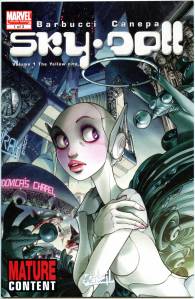
Meet Noa, a so-called Sky Doll; a life-like female android without rights, who exists only to serve the State’s needs and desires. But when Noa meets two so-called “missionaries” who aid in her escape from her tyrannical master, all hell breaks loose for our cyborg siren as she uncovers clues that she may be much more than just a robotic toy. The first release in a new partnership between Marvel and cutting-edge French publisher Soleil!
Namor, the Sub-Mariner (1990)
Namor again received an ongoing series in 1990. Namor, the Sub-Mariner, which ran 62 issues (April 1990 – May 1995), was initially written and penciled by John Byrne who took over the inking as well from issues #4–21. Unlike all of Namor’s previous series, the cover logo emphasized the character’s name rather than the “Sub-Mariner” epithet. From #26–38, the series’ penciler and eventual penciler-inker was then-newcomer Jae Lee, with Bob Harras scripting from #33–40. After three fill-in issues, the remainder of the series was written by Glenn Herdling and pencilled by Geof Isherwood. This series followed Namor as CEO of Oracle, Inc., a corporation devoted to reducing pollution, particularly in the oceans, and provided the stage for the return of the 1970s martial artist superhero Iron Fist, who had been presumed dead. Whereas J. M. DeMatteis saw his series as an opportunity to explore Namor much more deeply than he had been able to in the team book The Defenders, John Byrne felt that the character did not work well outside of a group context and accordingly gave Namor, the Sub-Mariner a massive supporting cast.
Blade: Vampire Hunter (1999)
There is a dark movement creeping through the night — a gathering of the bloodsucking kind! And this vampiric convention heralds the coming of the most terrifying demonic entity ever — the dreaded Daywalker! Only one man possesses the means to halt this unholy entrance, and that man is Blade, the half-vampire/half-human warrior! But what if the slayer himself is slain?