Vampire Tales (1973)

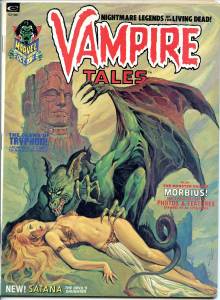
Vampire Tales ran 11 issues cover-dated 1973 to June 1975. With sister titles including Dracula LivesMonsters Unleashed and Tales of the Zombie, it was published by Marvel Comics‘ parent company, Magazine Management, and related corporations, under the brand emblem Marvel Monster Group. Published b-monthly, the magazine cost 75 cents.

The magazine starred Morbius the Living Vampire, in a feature written primarily by Don McGregor, with pencilers including Pablo MarcosRich BucklerTom Sutton, and Mike Vosburg, and later by writer Doug Moench, with artist Sonny Trinidad. The vampire hunter Blade starred in two stories by writer Marv Wolfman and artist Tony DeZuniga, in issues #8-9 (Dec. 1974 – Feb. 1975). Steve Gerber contributed a Morbius story to issue #1 (Aug. 1973) and a story starring Lilith, Dracula’s daughter, to issue #6 (Aug. 1974).

Issue #2 (Oct. 1973) introduced Satana, the Devil’s Daughter, in a four-page teaser by writer-editor Roy Thomas and artist John Romita Sr.; and detective Hodiah Twist and his assistant Conrad Jeavons, created by Don McGregor and penciler Carlos Garzon.

Miracleman – Marvel (2014)

At New York Comic Con 2013, Marvel announced that they had solidified their rights to Miracleman and that Neil Gaiman would finish the story he had started 25 years earlier. The series is being reprinted in a giant-sized format, with each issue containing a reprint of the corresponding issue of the Eclipse Comics series, reprints of select Mick Anglo Marvelman stories, and non-fiction material such as essays, photos, and Marvelman design sketches. The first issue, reprinting the recolored and relettered stories from Warrior #1 & 2/Miracleman #1, was released on January 15, 2014.

The reprints continued, collecting remastered and recolored work of the original run, with hardcover collections following, and in September 2014 the first new Miracleman material under the Marvel Comics banner was announced. Featuring a ‘lost’ story by Grant Morrison that he wrote in the 1980s, and drawn by Joe Quesada, it will be joined by a brand new story by Peter Milligan and Mike Allred.

The reprints proceed through #16 when the series was retitled Miracleman: The Golden Age which reprinted issues 17-22. Miracleman by Gaiman & Buckingham: The Silver Age issues 1 to 3 were announced for release in 2017.

Vault of Evil (1973)

In the early 1970s, horror was hot once again, and Marvel filled that demand with a number of titles, including  Chamber of Chills, Supernatural Thrillers, Crypt of Shadows, and Fear. Like many of these, Vault of Evil relied on reprint material from its 1950s precursor, Atlas comics.

Bizarre Adventures (1981)

With #25 (March 1981) the title Marvel Preview was changed to Bizarre Adventures, which ran for an additional ten issues before ceasing publication. To offset the dark tone of most of the stories, editor Denny O’Neil had writer Steve Skeates produce a humor feature called Bucky Bizarre to close out each issue. A story originally prepared for Marvel’s Logan’s Run comic book series was published in Bizarre Adventures #28 (Oct. 1981). The final issue, #34, was a standard-sized color comic book, featuring the cover-blurb, “Special Hate the Holidays Issue”, with anthological Christmas-related stories, including one starring Howard the Duck.

Immortal Hulk (2018)

After Bruce Banner’s death during Civil War II and subsequent resurrection during the events of Avengers: No Surrender, the Devil Hulk suppressed the rest of Banner’s personalities and became the “dominant” Hulk. Now calling themselves the “Immortal Hulk”—due to it manifesting at night even if Banner is killed during the day and apparently unable to be killed itself—the collective personalities reveal during a conversation with Doc Samson that the Immortal Hulk actually embodies Banner’s desire for a protective father figure, and that Banner’s inability to “imagine love without pain” is why he had previously perceived it as being a malevolent, Sadistic entity.
Daredevil (1970’s)

Gerry Conway took over as writer with issue #72, and turned the series in a pulp science fiction direction: a lengthy story arc centered on a robot from thousands of years in the future trying to change history. Even long-standing arch-villain the Owl was outfitted with futuristic weaponry and vehicles. Conway also moved Daredevil to San Francisco beginning with Daredevil #86, and simultaneously brought on the Black Widow as a co-star for the series. The Black Widow served as Daredevil’s crime-fighting ally as well as his love interest from issue #81–124 (Nov. 1971–Aug. 1975), of which #93-108 were titled Daredevil and the Black Widow.

In a story arc overlapping Wolfman, Shooter, and McKenzie’s runs on the series, Daredevil reveals his identity to Heather Glenn and becomes partially responsible for the suicide of her father; their relationship would persist but would prove increasingly harmful to both of them. Though the Black Widow returned for a dozen issues (#155–166) and attempted to rekindle her romance with Daredevil, he ultimately rejects her in favor of Glenn.

Iron Man (1980’s)

Tony Stark’s health deteriorates, and he discovers the armor’s cybernetic interface is causing irreversible damage to his nervous system. His condition is aggravated by a failed attempt on his life by Kathy Dare, a mentally unbalanced former lover, which injures his spine, paralyzing him.[68] Stark has a nerve chip implanted into his spine to regain his mobility.[69] Stark’s nervous system continues its slide towards failure, and he constructs a “skin” made up of artificial nerve circuitry to assist it. Stark begins to pilot a remote-controlled Iron Man armor, but when faced with the Masters of Silence, the telepresence suit proves inadequate. Stark designs a more heavily armed version of the suit to wear, the “Variable Threat Response Battle Suit”, which becomes known as the War Machine armor. Ultimately, the damage to his nervous system becomes too extensive.

Marvel Voices (2021)

Tales brought to you by some of the best and emerging talent in comics. Marvel’s Voices, the podcast series that explores diverse storytellers and their journeys, leaps onto the page in these comic anthologies starring favorite Marvel heroes.

Marvel Voices Community #1 NM $9

Avengers: No Road Home (2019)

Voyager, the mysterious heroine at the center of the No Surrender event, has sought to recruit a team of Avengers to deal with a terrible threat – the powerful Queen of Night is stealing the light throughout the universe. Now Hawkeye, the Immortal Hulk, Hercules, Scarlet Witch, Vision, Spectrum and newest addition Rocket Raccoon must assemble to face this threat through space and… into the Hyborian Age?

The Incredible Hulk – Future Imperfect (1992)

The Incredible Hulk travels to an apocalyptic future to face his ultimate challenge…himself. Meet the Maestro, the Hulk’s future imperfect self. Approximately a hundred years into the future, a nuclear war has killed almost all of Earth‘s superhumans and has taken the world to the brink of extinction. A future version of the Hulk called Maestro has seized control after being driven insane by the nuclear radiation he has absorbed and the bitterness he feels towards the world at his continued treatment. He has the intelligence of Bruce Banner and the absorbed radiation has significantly enhanced his strength. Can even the Green Goliath defeat a foe whose strength rivals his own? A foe who knows his every move before he even makes it?