The Gunslinger Born is an expansion and interpretation of events covered in The Dark Tower series, beginning with Roland Deschain‘s manhood test against Cort and ending with the last events of the flashback sequences in Wizard and Glass. Later arcs will “cover the time period between Roland leaving Hambry and the fall of Gilead“. The Gunslinger Born is followed by The Long Road Home, whose first issue was released on March 5, 2008.
The Dark Tower – the Gunslinger Born #1 NM- $4
The Dark Tower – the Gunslinger Born #2 NM- $3
The Dark Tower – the Gunslinger Born #3 NM NM $4
The Dark Tower – The Gunsllinger Born #4 NM $4
The Dark Tower – The Gunslinger Born #4 2nd printing variant NM $5
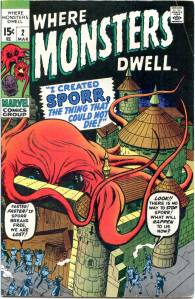
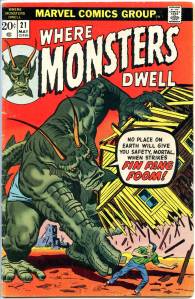
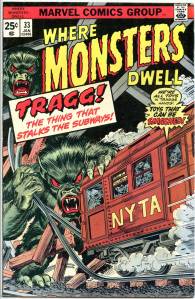
One of Marvel’s revival Horror and Monster comics. It lasted for 38 issues, making it one of the longest running Monster Mags from Marvel in the 1970’s. The series contains stories from many comic legends including Jack Kirby, Steve Ditko, Gil Kane and Bernie Wrightson. Issues #6 contains a reprint of Tales to Astonish #13, which is the 1st appearance of Groot from Guardians of the Galaxy.
In 2019, a 5 part mini-series titled Silver Surfer: Black was released featuring art from Tradd Moore in collaboration with writing from Donny Cates. The series is an extension of a Guardians of the Galaxy storyline which the Surfer was sucked into a black hole and ejected into unfamiliar space territory. This run follows the Surfer as he traverses the spaceways on a journey back home.
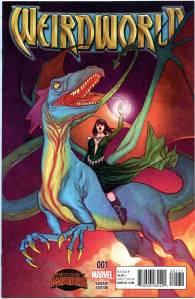
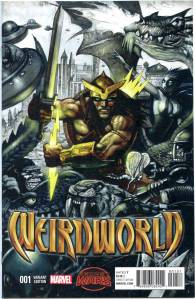
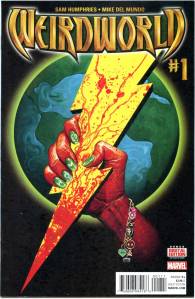
As part of the 2015 Secret Wars storyline, a series titled Weirdworld starring Arkon was released in June 2015 which featured other characters like Morgan le Fay of Earth-15238, Skull the Slayer, a variation of Jennifer Kale from Earth-11234 that is the Queen of Weirdworld’s Man-Things, and characters from The Saga of Crystar. Weirdworld is featured on the map of the storyline’s version of Battleworld as a floating island composed of fragments from many alternate reality magical realms like Polemachus, Crystalium, Klarn, and the original Weirdworld. By the end of the miniseries, Weirdworld manifested on Earth-616 in the Bermuda Triangle.
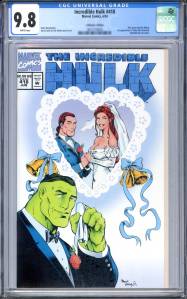
The 1990s saw the Green Hulk return. In issue #377 (Jan. 1991), the Hulk was revamped in a storyline that saw the personalities of Banner, Grey Hulk, and Savage Hulk confront Banner’s past abuse at the hands of his father Brian and a new “Guilt Hulk” persona. Overcoming the trauma, the intelligent Banner, cunning Grey Hulk, and powerful Savage Hulk personalities merge into a new single entity possessing the traits of all three. The Hulk also joined the Pantheon, a secretive organization of superpowered individuals. His tenure with the organization brought the Hulk into conflict with a tyrannical alternate future version of himself called the Maestro in the 1993 Future Imperfectminiseries, who rules over a world where many heroes are dead.
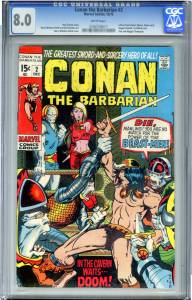
Marvel Comics introduced a fairly faithful version of Conan in 1970 with Conan the Barbarian, written by Roy Thomas with art initially by Barry Windsor-Smith, then John Buscema and Ernie Chan (aka Ernie Chua). The highly successful Conan the Barbarian series spawned the more adult, black-and-white Savage Sword of Conan in 1974, by Thomas, Buscema, and Alfredo Alcala. Savage Sword of Conan soon became one of the most popular comic series in the 1970s.
The Marvel Conan stories were also adapted as a newspaper comic strip which appeared daily and Sunday from September 4, 1978, to April 12, 1981. Originally written by Roy Thomas and illustrated by John Buscema, the strip was continued by several different Marvel artists and writers.
The series was launched with an April 1985 cover dated issue by writer Louise Simonson and penciller Greg LaRocque and featured the return of Spider-Man’s alien black costume, which attempted to rebond with Peter Parker. Peter managed to rid himself of the costume again using church bells and the alien was presumed to have died after that. The first issue featured a cover painting by artist Charles Vess.
In issue #18 (September 1986), Peter Parker is pushed in front of an oncoming train. He thinks to himself that this should not have happened, as his spider-sense would have warned him of the danger. Writer David Michelinie has said that he wrote this as the first “teaser” appearance of the characterVenom, whom he was planning to introduce at a later date. Venom is an amalgam of reporter Eddie Brock and the alien costume. The costume could nullify Spider-Man’s spider-sense, and this was the first clue of a puzzle that Michelinie was planning to weave to introduce Venom.
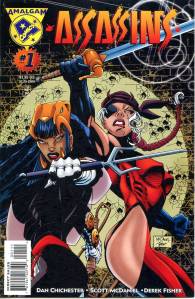
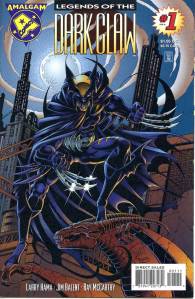
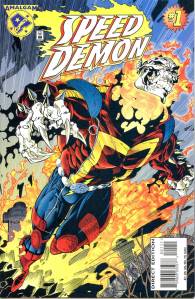
On two separate occasions – April 1996 and June 1997 – Marvel and DC co-published issues under the Amalgam Comics imprint. The issues were presented as if the imprint had existed for decades, with stories and editorial comments referring to a fictional history stretching back to the Golden Age of Comics, including retcons and reboots. For example, they referred to Secret Crisis of the Infinity Hour (an amalgamation of Marvel’s Secret Wars, DC’s Crisis on Infinite Earths, Marvel’s The Infinity Gauntlet, and DC’s Zero Hour), which featured the well-known cover of Crisis on Infinite Earths #7, but with Super-Soldier holding his sidekick’s body, instead of Superman holding Supergirl. Several issues included fake letter columns to provide the illusion of background to the stories, with the “fans'” hometowns formed by amalgamating the names of existing cities.
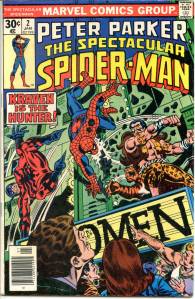
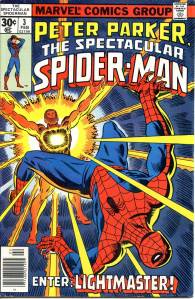
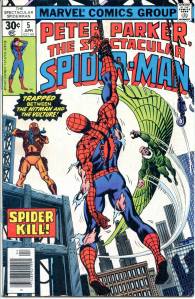
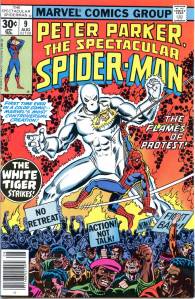
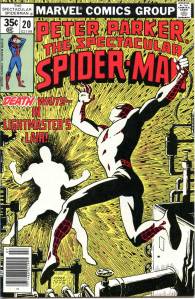
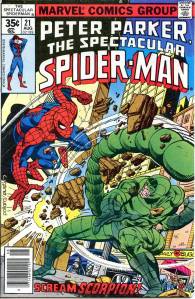
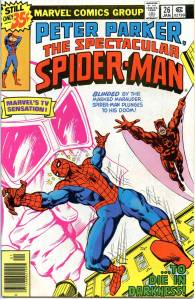
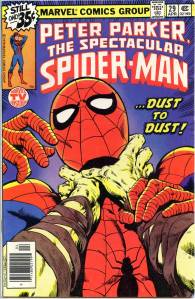
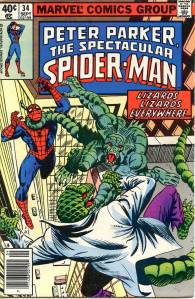
Peter Parker, The Spectacular Spider-Man debuted on December 1976. Shortened to simply The Spectacular Spider-Man with #134 (Jan. 1988), this was the second Amazing Spider-Man monthly comic-book spin-off series, after Marvel Team-Up, which also featured Spider-Man. The monthly title ran 264 issues (including a #-1 issue) until November 1998.
The series was launched by writer/editor Gerry Conway and artist Sal Buscema and Mike Esposito. Buscema drew the title until mid-1978. After Buscema’s departure, a succession of artists (including Mike Zeck, Jim Mooney, Ed Hannigan and Greg LaRocque) penciled the series for approximately five years. Frank Miller, who would later become the artist on Daredevil, first drew the character in Peter Parker, The Spectacular Spider-Man #27.

























 EHT Comics