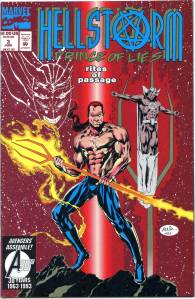
Hellstorm, the son of Satan in his second own ongoing series. Masterminded by Warren Ellis. In this series Hellstorm delves deep into the darkness.


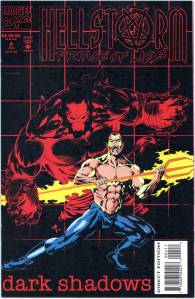
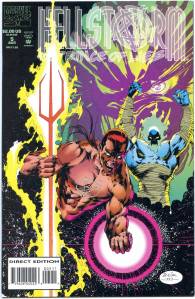

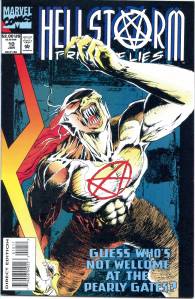
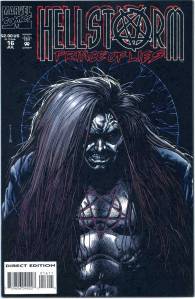
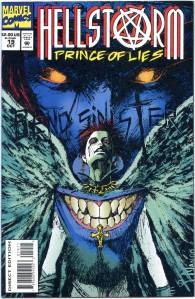

Hellstorm, the son of Satan in his second own ongoing series. Masterminded by Warren Ellis. In this series Hellstorm delves deep into the darkness.
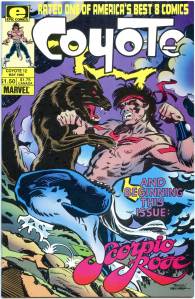
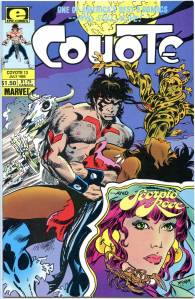
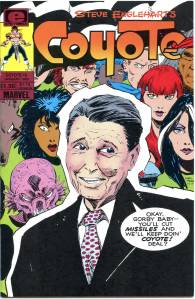
The characters first appeared in Eclipse Magazine #2-8. It would later be reprinted in a color trade paperback, I Am Coyote. Afterwards, a new comic book series started at Marvel Comics Epic Comics line, that ran 16 issues. It was notable for the first published work of Todd McFarlane. According to Epic editor-in-chief Archie Goodwin, artist Steve Leialoha‘s departure after issue #2 caused deadline problems that the series never fully recovered from, leading to its early cancellation.
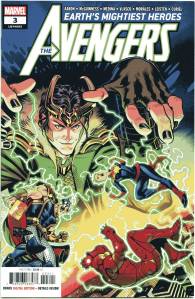
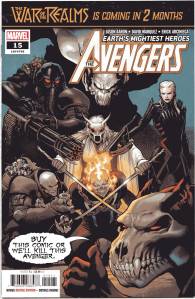
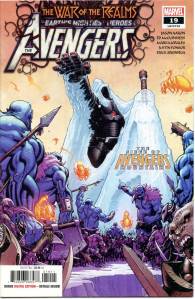
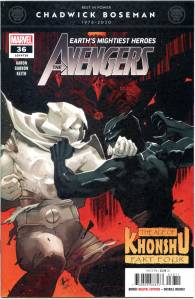
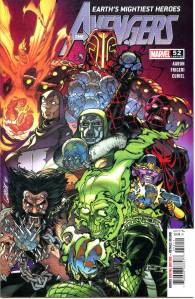
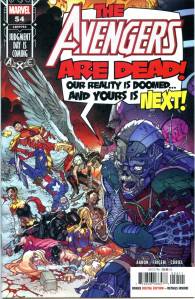
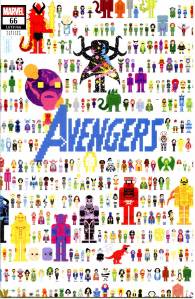
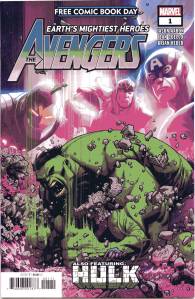
In May 2018, another volume for the series was launched as part of Marvel’s Fresh Start initiative, written by Jason Aaron and drawn by Ed McGuinness. This new volume also saw the return of the main three core members, Steve Rogers and Thor met up with Tony Stark to convince him to reassemble the group with themselves at its core. The reunion was consolidated by the machinations of Loki, who facilitated the arrival of the world-threatening Dark Celestials as a ploy to get the Avengers back in action, resulting in the participation of Black Panther who is appointment as chairperson, Captain Marvel, She-Hulk, Ghost Rider and Blade. In the reformation of the Avengers. After the Dark Celestials were defeated, the Celestials set upright the corpse of the long-time dead Progenitor in the North Pole. The Avengers refurbished the Progenitor’s corpse, transforming it into their base of operations, the Avengers Mountain.





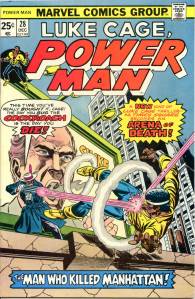
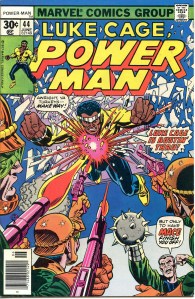
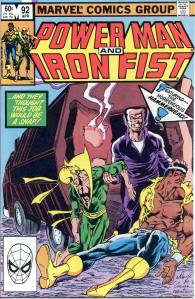
Luke Cage was created by Archie Goodwin and John Romita, Sr. shortly after Blaxploitation films emerged as a popular new genre. He debuted in his own series, Luke Cage, Hero for Hire, which was initially written by Goodwin and pencilled by George Tuska. Cage’s adventures were set in a grungier, more crime-dominated New York City than that inhabited by other Marvel superheroes of the time. The series was retitled Luke Cage, Power Man with issue #17.
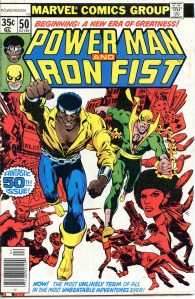
As the Blaxploitation genre’s popularity faded, Cage became unable to support his own series and was paired with another superhero whose popularity was based on a declining film genre, the martial arts hero Iron Fist, in an effort to save both characters from cancellation. Though the series title would remain Power Man in the indicia for a while longer, with issue #50 (April 1978) the cover title became Power Man and Iron Fist. It would remain thus until the series’s cancellation with issue #125 (September 1986). The series’s final writer, James Owsley, attempted to shed Cage’s Blaxploitation roots by giving him a larger vocabulary and reducing usage of his catchphrase, “Sweet Christmas!”.




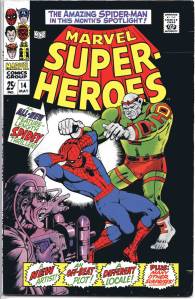
Fantasy Masterpieces, became Marvel Super-Heroes with issue #12 began showcasing a try-out feature as each issue’s lead. This encompassed solo stories of such supporting characters as Medusa of the Inhumans, as well as the debuts of Captain Marvel (#12), the Phantom Eagle (#16) and the Guardians of the Galaxy (#18). The Spider-Man story drawn by Ross Andru in issue #14 was originally planned as a fill-in issue of The Amazing Spider-Man but was used here when that title’s regular artist, John Romita Sr. recovered more quickly than anticipated from a wrist injury. Andru would become the regular artist on The Amazing Spider-Man several years later.
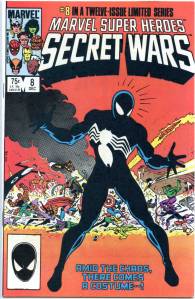
Marvel Super Heroes Secret Wars, commonly known as Secret Wars, is a twelve-issue comic book crossover limited series published from May 1984 to April 1985 by Marvel Comics. The series was written by Jim Shooter with art by Mike Zeck and Bob Layton. It was tied to the same-named toyline from Mattel.
In 2011, IGN listed Secret Wars as one of the best comic book events. Their writers found the action and goofiness of the story to be enjoyable. They also highlighted the impact it had on the Marvel Universe by introducing the symbiote and new characters. In 2011, Alex Zalben of MTV News ranked Secret Wars as the second biggest comic event ever; he praised its story and lasting effect.

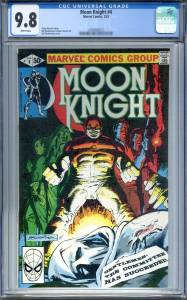
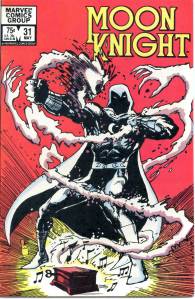
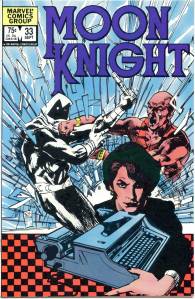
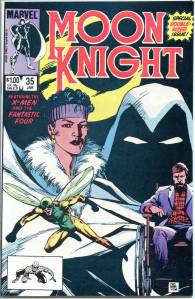
Moon Knight received his first ongoing series in 1980, with Doug Moench and Bill Sienkiewicz as its main creative team. The character received an expanded origin story in issue #1, which also introduced several recurring characters as well as recurring enemy Bushman. The series depicted several characters who doubted the moon god Khonshu was real and believed Marc Spector only experienced a hallucination while near death. It was never explained why other characters, such as Spector’s lover Marlene, concluded this when there was no other explanation for Marc’s spontaneous recovery from his wounds and a death-like state and when it was well known by this time that many gods of myth in the Marvel Universe (such as Thor and Zeus) were real, living entities from other dimensions and planets.
After early sales were good, Marvel made the Moon Knight series a flagship title available in comic shops starting with issue #15. The companion mini-series Moon Knight: Special Edition reprinted the Hulk and Marvel Preview Moon Knight stories in color and standard comic format, as opposed to their original magazine format. Sienkiewicz left the series after issue #30, though he continued to contribute covers until the series ended with issue #38.

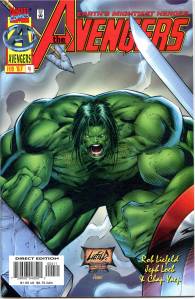
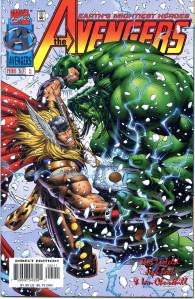
During the “Heroes Reborn” event, many of the Avengers together with the Fantastic Four and others, died trying to stop the psychic entity Onslaught, although it was revealed that Franklin Richards preserved those heroes in a pocket universe. Believing the main team to be gone, the Black Widow disbanded the Avengers, and only butler Edwin Jarvis remained to tend to the Mansion.
The previous continuity of the Marvel Universe was set aside as the heroes were “reborn” in the pocket universe created by Franklin Richards to save his parents and their friends, while the “Heroes Reborn” line ended and the heroes returned to the prime Marvel Universe. This restoration also undid recent changes to the team members such as the Wasp being mutated into an insectoid form, Hawkeye being rendered deaf, and Stark being replaced by his teenage self, attributed to Franklin’s childish perception recreating the heroes in the manner he was more familiar with.
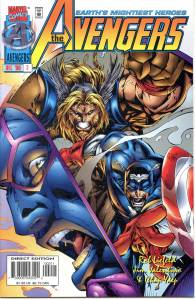
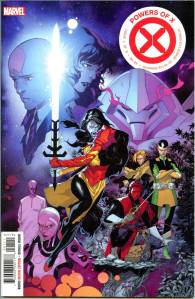
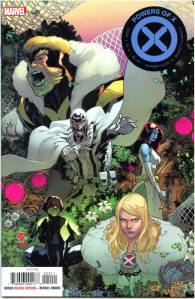
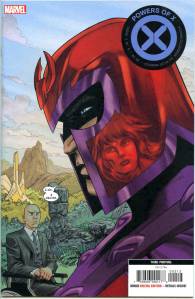
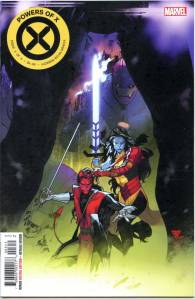
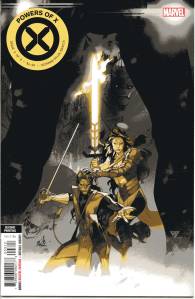
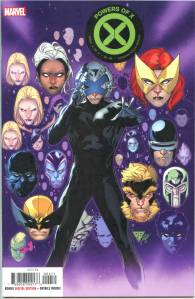
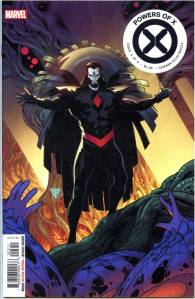
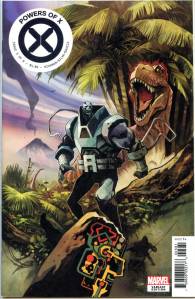
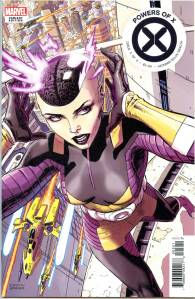
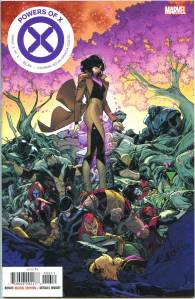
Jonathan Hickman wrote a story arc in the Avengers and New Avengers comic, ending in the 2015 crossover Secret Wars. His return was announced in March 2019. Some days later, it was detailed that he would write two comic books, House of X and Powers of X, with penciling by Pepe Larraz and R.B. Silva. Marvel Editor in Chief C. B. Cebulski said that “We are excited to have Jon back with the Marvel family, and we could not have asked for a better creative team to help usher the X-Men into a whole new era”
Both comics were released as a company wide relaunch of the X-Men. All the ongoing X-Men comics were cancelled: Uncanny X-Men, Mr. and Mrs. X, X-Force, X-23, and the Age of X-Man tie-in miniseries.
Giant size reprint of classic Stan Lee and Jack Kirby backup stories from Journey into Mystery (Issues 97 thru 106).

 EHT Comics