The Power of Warlock (1972)

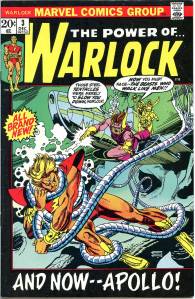
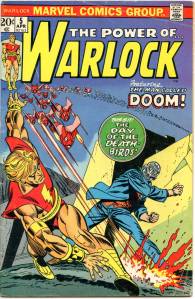
In 2009, Thomas explained he had been a fan of the soundtrack to the musical Jesus Christ Superstar and sought to bring the story to comic books in a superhero context: “Yes, I had some trepidation about the Christ parallels, but I hoped there would be little outcry if I handled it tastefully, since I was not really making any serious statement on religion… at least not overtly.”  Choosing to use a preexisting character while keeping the series locale separate from mainstream Marvel Earth, he created Counter-Earth, a new planet generated from a chunk of Earth and set in orbit on the opposite side of the sun. Thomas and Kane collaborated on the costume, with the red tunic and golden lightning bolt as their homage to Fawcett Comics‘ 1940s-1950s character Captain Marvel. The story continued in the series The Power of Warlock, which ran eight issues (Aug. 1972 – Oct. 1973)

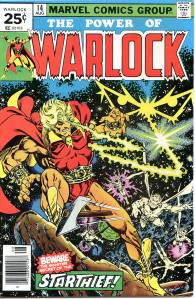
Writer-artist Jim Starlin revived Warlock in Strange Tales #178-181 (Feb.-Aug. 1975). Warlock’s adventures became more cosmic in scope as Starlin took the character through an extended storyline referred to as “The Magus Saga.”

The reimagined title continued the numbering of The Power of Warlock and began with Warlock #9 (Oct. 1975) and ran seven issues. The bimonthly series was initially written and drawn by Starlin, but was eventually co-penciled and inked by Steve Leialoha.

The Dark Crystal (1983)

The Dark Crystal was adapted into comic book form by Marvel Comics. It debuted as a 68 page adaptation in Marvel Super Special #24, in 1982. The story was later re-printed in two issues in April and May, 1983.

This was the first of three Marvel adaptations of Jim Henson movies; it was followed by The Muppets Take Manhattan in 1984, and Labyrinth in 1986.

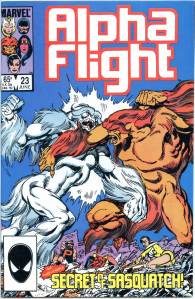
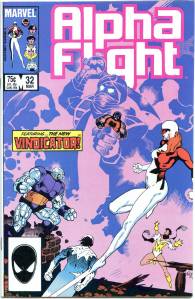
Alpha Flight (1983)

Created by writer and artist John Byrne, the team first appeared in The Uncanny X-Men #120 (April 1979).

Most team members have distinctly Canadian attributes, such as having Inuit/First Nations or French heritage. Throughout most of its history, the team has worked for Department H, a fictional branch of Canada’s Department of National Defence that deals with super-powered villains.

The team was originally merely a part of the backstory of the X-Men‘s Wolverine but, in 1983, Marvel launched an eponymous series featuring the group, which continued until 1994, lasting 130 issues as well as annuals and miniseries.

ROM Spaceknight – Marvel (1979)

To build interest in the ROM toy, Parker Brothers licensed the character to Marvel Comics, which created a comic book featuring Rom. The comic expanded on the premise that Rom was a cyborg and gave him an origin, personality, set of supporting characters and villains, as well as interaction within the Marvel Universe. The comic was written by Bill Mantlo and initially illustrated by artist Sal Buscema. Buscema stated in a 2010 interview, “I liked the character. And I liked what they did with it. I thought the concept was quite good. It was unique. It made it attractive to do. I almost hate to say this, but it was pretty easy to draw, too.” Buscema was the main artist for the series from its creation through 1984. Steve Ditko took over for the final two years of the original run.

Ultimately, the toy failed and only sold 200,000 to 300,000 units in the US, with creator McCoy blaming the failure on poor packaging and marketing. Parker Brothers subsequently abandoned the line.

The comic book outlasted the toy which it was created to support. The series lasted for 75 issues (not including the four annual issues) from December 1979 to February 1986. Rom’s regular encounters with mainstream heroes and villains established him as part of Marvel continuity.


Tomb of Darkness (1974)

Tomb of Darkness, published by Marvel, continues from the “Beware” title with issue #9. The series ran 14 issues from July 1974 to November 1976 and contained various Atlas horror reprints.

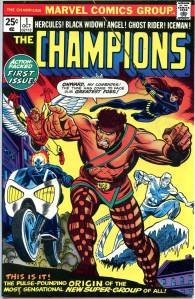
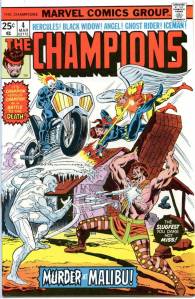
The Champions (1975)

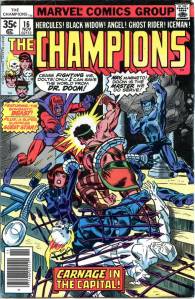
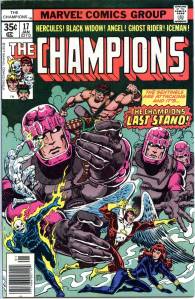
The team first appears in The Champions #1 (October 1975) and was created by writer Tony Isabella and artist Don Heck. The Champions, and ran for seventeen issues from October 1975 to January 1978. In addition to Don Heck, artists who drew the series include George Tuska, Bob Hall, and John Byrne

Heroic Publishing has used the name “The Champions” for a role-playing game series which has been adapted into comic books. The United States Patent and Trademark Office has ruled that Marvel abandoned its trademark of the name and can no longer use “The Champions” as the name of a comic book series. A planned 2007 revival of the series was renamed The Order.

Nick Fury and his Agents of SHIELD (1973)

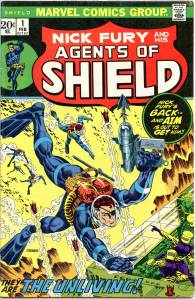
This series inspired the ABC television series Agents of SHIELD! This reprint comic features 2 classic stories from Marvel’s Silver Age. Classic Stan Lee & Jack Kirby stories with covers by Jim Steranko.

Marvel Spotlight V2 (1979)

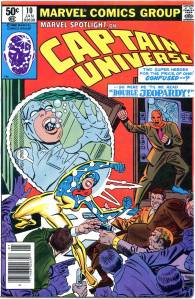
Marvel Spotlight was revived in 1979, initially as simply a place to publish inventory stories from the recently cancelled Captain Marvel. However, once these leftover tales were exhausted, the series went on to feature other characters. Tako Shamara first appeared in Marvel Spotlight vol. 2 #5 (March 1980), in a story by Marv Wolfman and Steve Ditko. In his first appearance the character battled a huge dragon from the past called a Wani, a monster that destroyed his ancestors’ villages in 1582. The creature that Tako battled was intended to be Godzilla but since Marvel no longer had the rights to the character, which lapsed the previous year, the creature was modified to a dragon called The Wani. Issue #8 featured the final Captain Marvel solo story before the character’s death.

Marvel Preview V1 (1977)

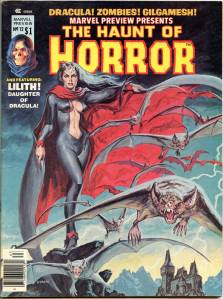
An umbrella title that showcased a different heroic-adventure, science-fiction, or sword-and-sorcery character in virtually every issue. The title introduced the Marvel Comics characters Dominic Fortune in issue #2, Star-Lord in #4,and Rocket Raccoon in #7. The vigilante character the Punisher, introduced as an antagonist in the comic book The Amazing Spider-Man, had his first solo story in issue #2.

Giant-Size Super-Heroes (1974)

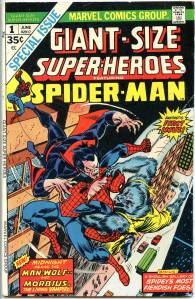
Giant-Size Super-Heroes was intended to be an ongoing series. However, only one issue was published and the series was rennamed Giant-Size Spider-Man with rebooted numbering instead. Morbius the Living Vampire in stalking Manhattan again! His first target is John Jameson, the Man-Wolf; and his second one ? the Amazing Spider-Man! Once Morbius reattaches the moonstone to John Jameson’s neck, the Man-Wolf becomes his to command! Now under the cover of darkness, the deadly duo heads to Empire State University to break into the research laboratory, but the ever-present web-slinger intercepts them along the way! Can Spider-Man defeat these two creatures of the night?