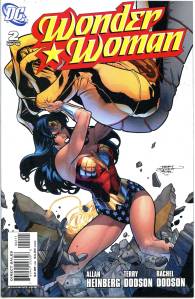
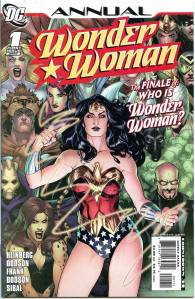
Following Infinite Crisis, Wonder Woman was canceled and relaunched in 2006. It starts with Donna Troy as Wonder Woman and with Diana missing. When Diana returns she takes on the name of Diana Prince and becomes a secret agent for the Department of Metahuman Affairs. Her first assignment is to retrieve her kidnapped sister Donna Troy. After this was accomplished Diana took back the mantle of Wonder Woman.
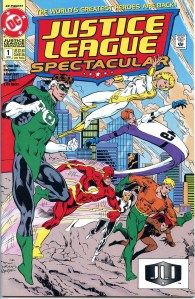
The release of Justice League Spectacular launched the revised Justice League titles with new writers and artists.The Justice League titles expanded to four by June 1993: Justice League America (formerly Justice League International), Justice League Europe (retitled as the second volume of Justice League International), Justice League Quarterly, and Justice League Task Force. In late 1994 Justice League International and Justice League Quarterly were cancelled and replaced by a new monthly title in January 1995, Extreme Justice.
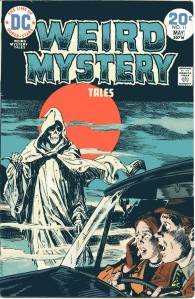
The Weird Mystery Tales ongoing series was launched in July–August 1972 and was originally hosted by Destiny. The hosting role was gradually taken over by Eve, who fully assumed the title with issue #15 (December 1974–January 1975). The title’s name was partially inspired by the sales success of Weird War Tales and Weird Western Tales. Early issues printed material by Jack Kirby that had been intended for his black-and-white, magazine-size DC comic series, Spirit World, which lasted only one issue. These stories featured Dr. E. Leopold Maas as host, sometimes with an appended hosting segment by Destiny.
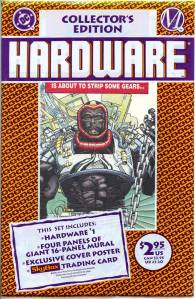
Curtis “Curt” Metcalf is a genius inventor who, in his Hardware identity, uses a variety of high-tech gadgets to fight organised crime. A central irony of the series (of which Metcalf is fully aware) is that Metcalf’s employer, respected businessman Edwin Alva—who provides the resources Metcalf uses to create Hardware’s hardware—is secretly the crime boss whom Hardware is trying to bring down.
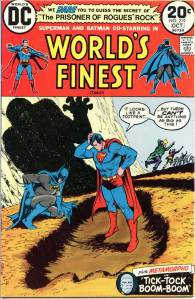
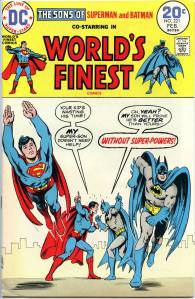
World’s Finest featured Superman and Batman team-ups until issue #197. Noted Batman artist Neal Adams first drew the character in an interior story in “The Superman-Batman Revenge Squads” in issue #175 (May 1968). The title briefly featured Superman teaming with heroes other than Batman in the early 1970s beginning with issue #198 (November 1970). That issue featured the first part of a two-issue team-up with the Flash. The series reverted to Superman and Batman team-ups after issue #214, initially with a unique twist, featuring the children they might one day have, Superman Jr. and Batman Jr. These characters, billed as the Super-Sons, were co-created by writer Bob Haney and artist Dick Dillin in issue #215 (January 1973).
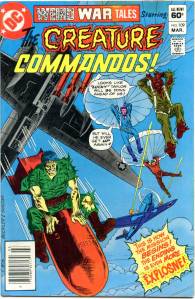
The original title ran for 12 years and 124 issues. It was an anthology series that told war stories with horror, mystery, fantasy and science fiction elements. Changes in the Comics Code Authority made the use of horror elements possible. The first seven issues were reprinted material. Each issue beginning with issue #8 was hosted by Death, usually depicted as a skeleton dressed in a different military uniform each issue. The title’s name was inspired by editor Joe Orlando.Walt Simonson‘s first professional published comic book work appeared in Weird War Tales #10 (January 1973).Roger McKenzie and Frank Miller‘s first collaboration was on a two-page story published in Weird War Tales #68 (October 1978). Recurring characters began to appear late in the series run, notably the G.I. Robot, and the return of “The War that Time Forgot” which originally ran in Star Spangled War Stories. Writer J. M. DeMatteis and penciler Pat Broderick created the Creature Commandos in Weird War Tales #93 (November 1980).
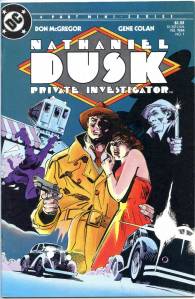
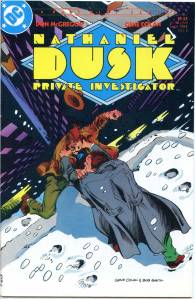
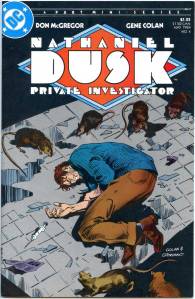
Nathaniel Dusk is a private investigator from New York City whose adventures in the 1930s are portrayed in the stories. He served in the United States armed forces in World War I and was hired by the New York City police force. Dusk fell deeply in love with Joyce Gulino, a beautiful young saleswoman with two children, Jennie and Anthony. Gulino’s ex-husband was a gangster named Joseph Costilino. Costilino later killed his family.
The 2017-2019 miniseries Doomsday Clock, by Geoff Johns and Gary Frank features Nathaniel Dusk in the DC Universe as a noir film character portrayed by a fictional actor named Carver Colman. Colman plays a key role in the story.
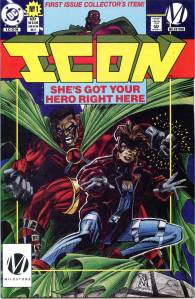
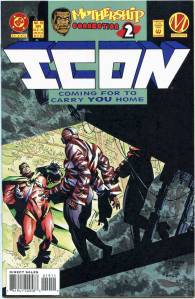
Icon is one of the headline characters introduced by Milestone Media in the 1990s. A being from another planet, he has taken on the form of an African American man, but has abilities such as flight, super-strength, and invulnerability. He uses these in partnership with Rocket, a human teenager using his alien technology, to protect the people of the fictional city of Dakota.
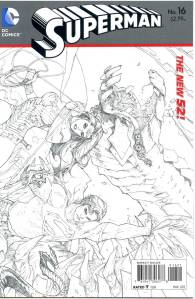
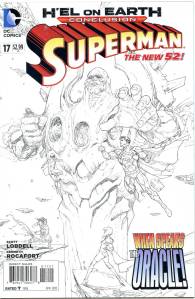
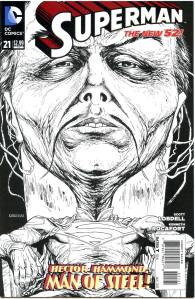
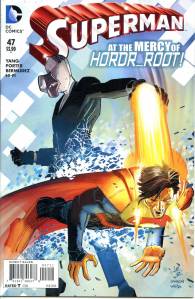
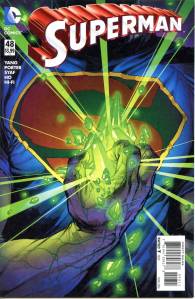
In late July 2011, DC released The New 52, a free preview book giving solicitations and previews of all of the new titles launching from August 31, 2011. Notable continuity changes shown included Superman‘s two new looks: one which consists of jeans, a blue T-shirt with the “S” logo and a cape, the other consisting of Kryptonian battle armor that resembles his classic costume.