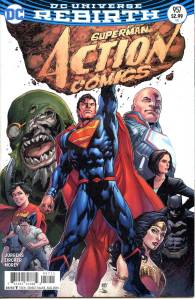
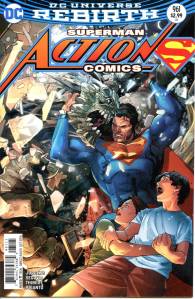
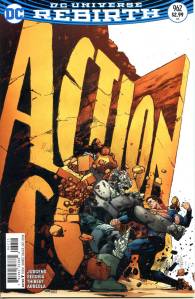
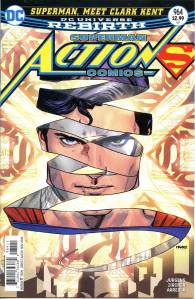
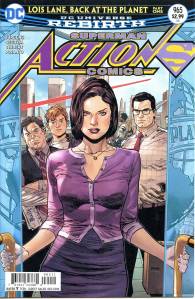
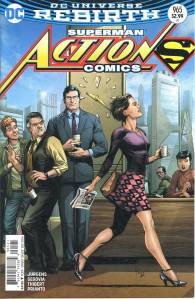
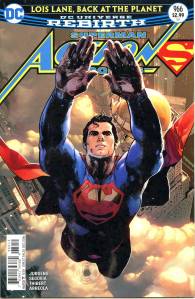
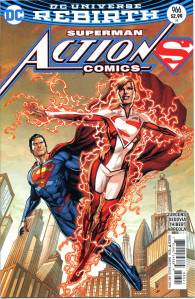
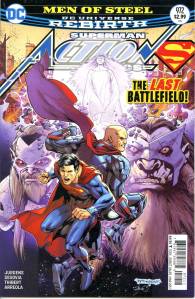
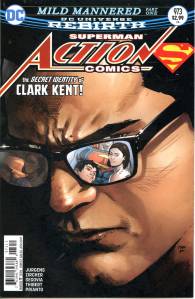
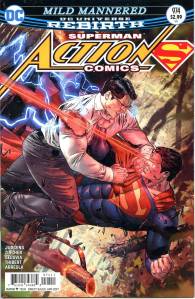
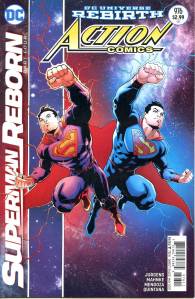
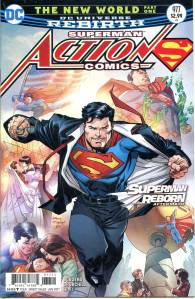
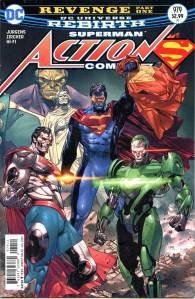
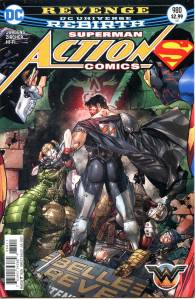
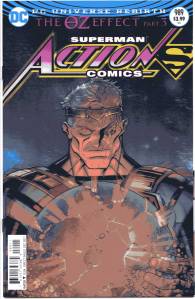
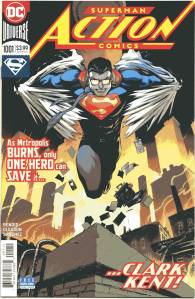
As part of DC Comics’ DC Rebirth relaunch in June 2016, Action Comics reverted to its original numbering beginning with Action Comics #957, with the series shipping twice-monthly. The series, written by Dan Jurgens, serves as a continuation of the comic book series, Superman: Lois and Clark, which featured the pre-Flashpoint Superman alongside his wife, Lois Lane, and their son, Jonathan Kent.
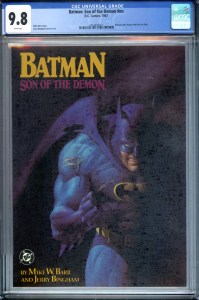
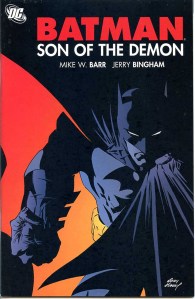
Although it was deemed to be non-canon, Grant Morrison used this story in the 4-issue story “Batman and Son” in 2006. DC Comics published a new printing of Batman: Son of the Demon in 2006 featuring new cover art by Andy Kubert for the first time in standard comic book size with a cover price of $5.99 US, tying in with the “Batman and Son” arc.
Batman Son of the Demon CGC 9.8 White Pages $295Batman Son of the Demon 2006 NM $19
In 2019, Robert Venditti took over from Snyder, relaunching the title, taking place before Snyder’s run and after Metal.
In addition, two more Justice League titles were released. A new volume of Justice League Dark featuring a team led by Wonder Woman and John Constantine. The other, Justice League Odyssey, features Cyborg, Starfire, Green Lantern (Jessica Cruz), Azrael, and Darkseid as they search for answers in the Ghost Sector in one of Brainiac‘s old starships.
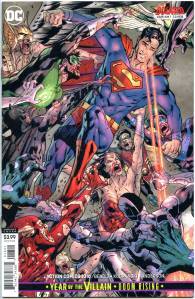
Following Dark Nights: Death Metal, Endless Winter and the beginning of Infinite Frontier, Brian Michael Bendis and David Marquez took over the reins of Justice League from Issue 59. While Superman, Batman, Aquaman, and Hawkgirl remained on the team, the team also includes Green Arrow, Black Canary, Black Adam, Queen Hippolyta and Naomi. It also include a Backstory for Justice League Dark.
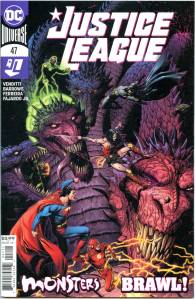
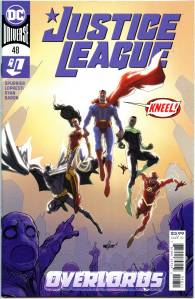
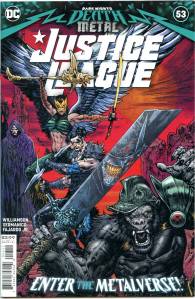
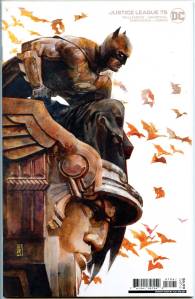
Justice League #35 NM $4Justice League #36 NM $4Justice League #37 NM $4Justice League #38 NM $4Justice League# 39 NM $4Justice League #40 NM $4Justice League V4 #44 NM $4Justice League V4 #45 NM $4Justice League V4 #47 NM $4Justice League V4 #48 NM $4Justice League V4 #53 NM $4Justice League V4 #75 Variant NM $7
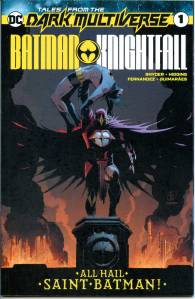
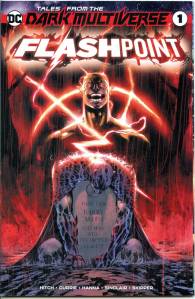
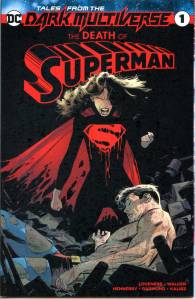
Tales from the Dark Multiverse is an American superhero/anthology comic book limited series published by DC Comics, beginning on October 16, 2019. The series takes some of the most famous events in the DC Universe and puts a twist on them.
Following the Source Wall being shattered at the end of Dark Nights: Metal, the mysterious watcher known as Tempus Fuginaut (introduced in Sideways) begins trying to recruit several “heroes” from across the Dark Multiverse in the wake of a coming crisis.
Tales from the Dark Multiverse – Batman Knightfall NM $6Tales from the Multiverse – Crisis on Infinite Earths NM $6Tales from the Dark Multiverse – Flashpoint NM $6Tales from the Dark Multiverse – Batman Hush NM $6Tales From the Dark Multiverse Infinite Crisis #1 NM $6Tales from the Dark Multiverse – Dark Nights Metal NM $6Tales From the Dark Multiverse The Death of Superman #1 NM $6Tales from the Dark Multiverse – Wonder Woman War of the Gods NM $6
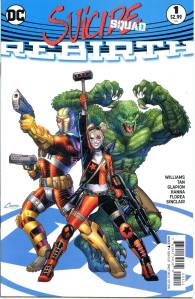
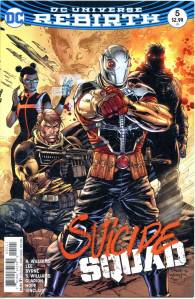
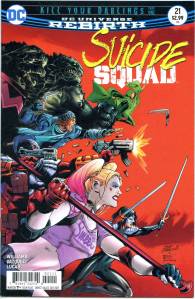
Using the end of the New 52 initiative as a launching point, DC Comics began a second relaunch of its entire line of titles called DC Rebirth in 2016. Suicide Squad (vol. 5) #1 (August 2016) was the debut bimonthly relaunch of the team’s comic book title which consisted of Amanda Waller, Deadshot, Rick Flag, Captain Boomerang, Harley Quinn, Killer Croc, Katana & Enchantress. The Suicide Squad was given a new look, reflecting the team’s appearance in the DC Extended Universe.
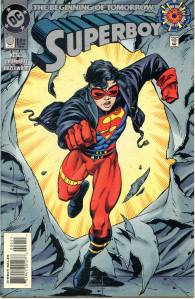
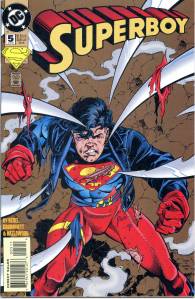
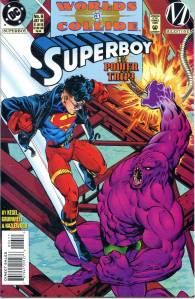
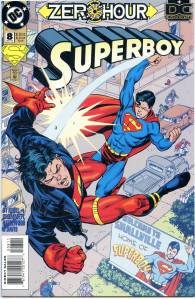
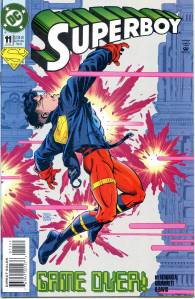
This series featured the clone of Superman and his adventures as part of Cadmus. In Superboy (vol. 4) #1 (February 1994), the new Superboy settled in Hawaii with his supporting cast, becoming Hawaii’s resident superhero for the next four years until Superboy (vol. 4) #48 (February 1998). Starting in Superboy (vol. 4) #56 (November 1998), Superboy returned “home” when he began working for Cadmus. In Superboy (vol. 4) #59 (February 1999), Superman gave Superboy the Kryptonian name of Kon-El. After leaving Cadmus and living on his own for a brief time in Metropolis, Kon-El went to live with Jonathan and Martha Kent in Smallville, where he adopted a secret identity as their nephew (and Clark’s cousin) Conner Kent.
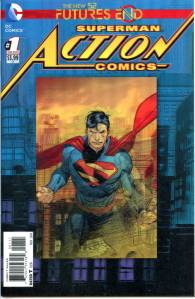
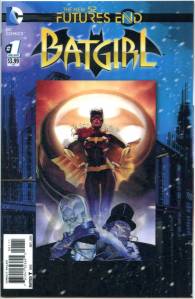
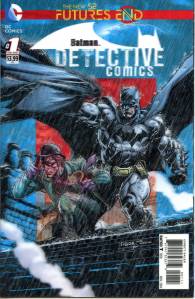
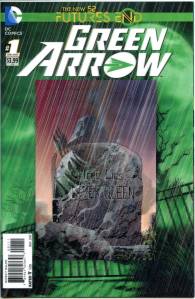
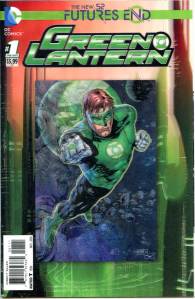
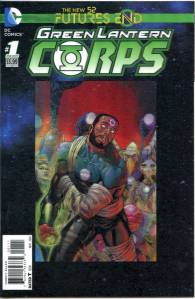
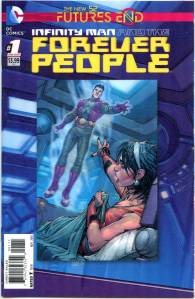
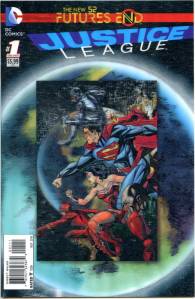
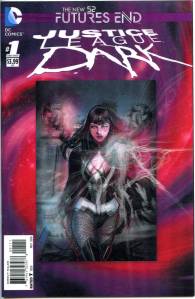
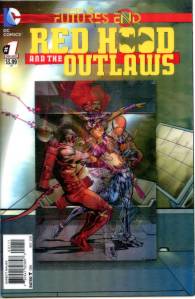
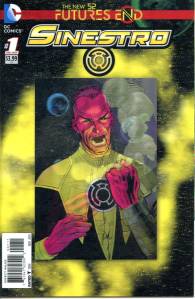
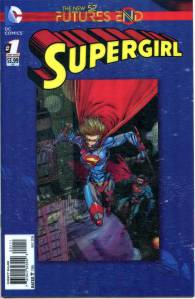
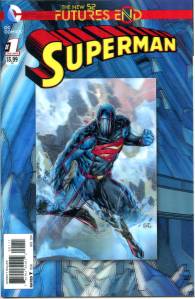
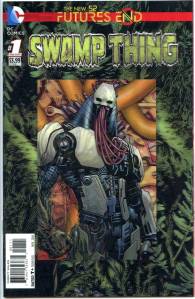
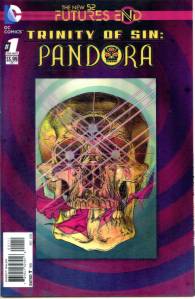
In February 2014, DC announced that as part of the celebration of The New 52’s third anniversary, all ongoing titles published in September 2014 feature stories that tie in to The New 52: Futures End. DiDio stated “One of the things we wanted to do was not just look at it through the lens of the weekly series, but also take a month and flash forward, and see what the potential futures of all our characters might be in that month. So in that month, you’ll get a chance to see where, in the next five years, our characters might finish up or might end up being.” He added that like the “Villains Month” event in September 2013, these titles also feature 3Dlenticular covers, in addition to the 2D ones, saying, “The covers now will also have the ability to have a ‘flicker’ effect. That means that the images change and show the transformation going on… There is a level of change that is taking place with our characters during the course of this story.”
Futures End – Action Comics #1 NM $4
Futures End – Batgirl NM $8
Futures End – Constantine #1 NM $6
Futures End Detective Comics #1 NM $4
Futures End – Green Arrow #1 NM $4
Futures End – Green Lantern #1 NM $4
Futures End – Green Lantern Corps #1 NM $4
Futures End Infinity Man and the Forever People #1 NM $4
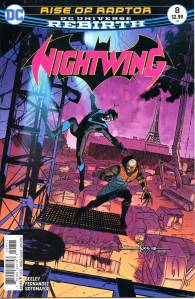
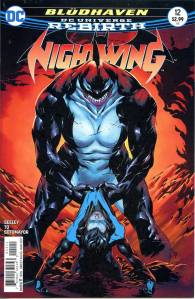
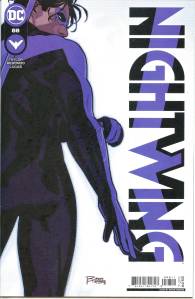
Following the erasure of the knowledge regarding his secret identity from most of the world in the final issue of Grayson, Dick went back to the Nightwing identity in the DC Rebirth era solo series, and the costume’s colors were changed back to the traditional black and blue. At the start of the series (rebirth) Nightwing is still a member of the Court of Owls (after Robin War) and he goes on missions around the world for the Court. They give him a partner named “Raptor” and like Nightwing he wears a costume, but he is much more violent than Dick and multiple times Dick has to try to stop him from killing. Throughout the story arc, Dick must work as an undercover agent but also has to keep his morals and not kill even if the Court tells him to.
The Justice League has long protected Earth from all manner of foreign and alien invaders over the years, always keeping a vigilant eye to the skies for the next threat. But what if the threat was already walking the Earth…hiding in plain sight…watching…waiting for their moment to strike…