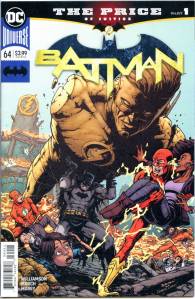
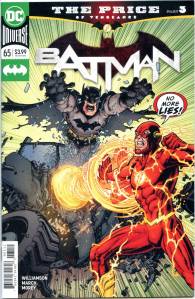
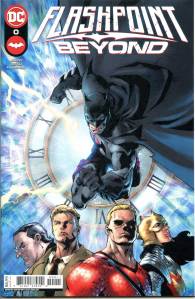
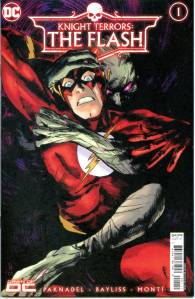
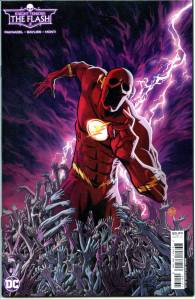
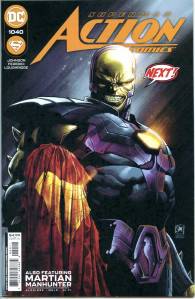
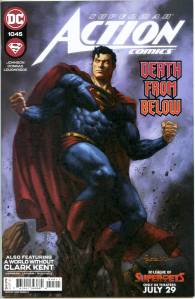
Meet Paradox: a new time-traveling villain with a tragic backstory who poses a big threat–and carries a big grudge against the Flash. He’s determined to destroy the Flash legacy at all costs, and he’s powerful enough to do it! With the Flash about to be erased from time and space, only one ally can help him defeat this seemingly insurmountable foe…Eobard Thawne, the Reverse-Flash? Can Barry Allen really trust his greatest enemy? And does he even have a choice?
Category: DC Iron Age
The Spectre V3 (1992)
In 1992, the Spectre was again given his own series, this time written by writer and former theology student John Ostrander, who chose to re-examine the Spectre in his aspects as both the embodied Avenging Wrath of the Murdered Dead and as a brutal 1930s policeman.
Ostrander placed the Spectre in complex, morally-ambiguous situations that posed certain ethical questions, one example being: What vengeance should be wrought upon a woman who killed her abusive husband in his sleep?
Ostrander also added several new concepts into the Spectre’s history: He revealed that the Spectre was meant to exist as the embodiment of the Wrath of God, and Jim Corrigan was but the latest human spirit assigned to guide him while he existed on Earth. It was also shown that the Spectre was a fallen angel named Aztar who had participated in Lucifer‘s rebellion, but then repented, and that serving as the embodiment of God’s anger was its penance.
Furthermore, the Spectre was not the first embodiment of God’s anger, but was the replacement for the previously-minor DC character Eclipso. Ostrander chose to portray this as a distinction between the Spectre’s pursuit of vengeance and Eclipso’s pursuit of revenge. In a historical context, Eclipso was responsible for the biblical Flood, while the Spectre was the Angel of Death who slew the firstborn Egyptian children. Spectre and Eclipso have battled numerous times through history but neither entity can be fully destroyed.
The Green Lantern: Season Two (2020)
The Green Lantern: Season Two is a continuation of Grant Morrison and Liam Sharp‘s The Green Lantern (Volume 1) and Green Lantern: Blackstars (Volume 1) (the latter with covers by Sharp and interior artwork by Xermanico). As Hal Jordan is honored for saving all of reality and ending the threat of the Blackstars, he continues investigating crimes across Sector 2814 and is appointed with finding new Guardians of the Universe.
The Demon V3 (1990)
Etrigan the Demon first appeared in The Demon #1 (August 1972) and was created by Jack Kirby. He created the Demon when his Fourth World titles were cancelled. According to Mark Evanier, Kirby had no interest in horror comics, but created Etrigan in response to a demand from DC for a horror character. Kirby was annoyed that the first issue sold so well that DC required him to do sixteen issues and abandon the Fourth World titles before he was done with them.
The 1990 series lasted 58 issues, two Annuals and one #0 issue. Garth Ennis took over the title beginning with issue #40. Ennis’ run included the first appearance of his character Hitman.
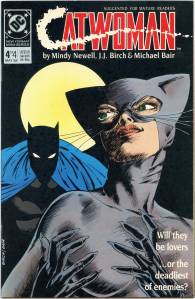
Catwoman – When in Rome (2004)
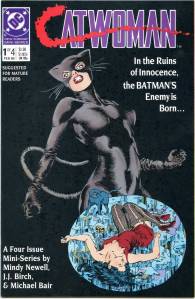
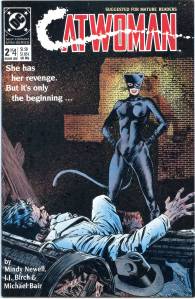
The story features Catwoman, on a trip to Rome to find information concerning her long-lost parents, who she believes to be the crime lord Carmine Falcone and his wife Louisa. The story takes place parallel to the later issues of Batman: Dark Victory.
Batman: The Imposter (2021)
Bruce Wayne’s mission as the Batman has only been under way for a year or so, but he can tell he’s making a difference. Unfortunately, he’s made some powerful enemies. All the traditional power brokers of Gotham resent the disruption the Batman has brought to town…and it seems one of them has a plan to neutralize him. There’s a second Batman haunting Gotham’s rooftops and alleys—and this one has no qualms about murdering criminals, live and on tape.
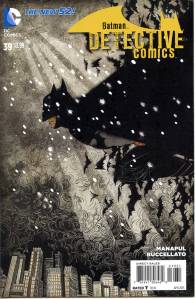
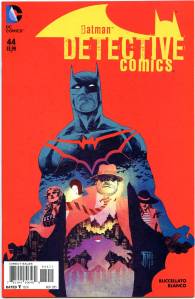
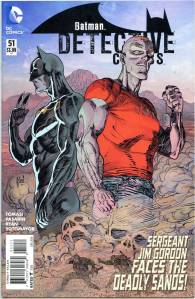
Detective Comics (1990’s)
Chuck Dixon became the writer of the series with issue #644 (May 1992). He and Tom Lyle co-created the Electrocutioner in Detective Comics #644 (May 1992) and Stephanie Brown in Detective Comics #647 (August 1992).
The “Batman: Legacy” storyline began in issue #700 (August 1996). The “No Man’s Land” storyline crossed over into Detective Comics in issues #730–741.
Smax the Adventurer (2003)
The story deals with Smax and Toybox returning, via magical teleportation, to Jeff’s magically enchanted homeworld. Smax, now a city dweller, seems embarrassed by his unsophisticated, sword-and-sorcery roots. They attend Smax’s uncle’s funeral where Jeff introduces Robyn as his wife, though no such relationship exists. At this point Jeff’s sister Rexa Macksun is introduced, dressed in the typical garb of a female fantasy barbarian such as Red Sonja and just as tall and physically impressive as her brother with the same blue skin and white hair.
Adventures of Superman (1986)
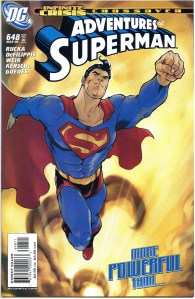
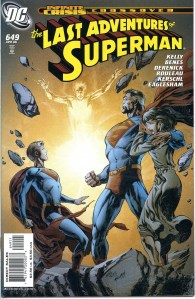
When the series was relaunched in late 1986 under its new title, the creative team initially was writer Marv Wolfman and artist Jerry Ordway. John Byrne replaced Wolfman with issue #436 (January 1988) and Ordway became both writer and artist with issue #445 (October 1988). Writer/artist Dan Jurgens worked on the title from 1989–1991. Hank Henshaw, a character who would later become the Cyborg Superman, first appeared in issue #466 (May 1990). By the late 1980s, the plots of the Superman books were often linked. To coordinate the storyline and sequence of event, from January 1991 to January 2002, “triangle numbers” (or “shield numbers”) appeared on the cover of each Superman comic book. During these years, the Superman storylines ran with the story continuing through the titles Superman, Action Comics and later in two further series, Superman: The Man of Steel and Superman: The Man of Tomorrow.
Batman (1990’s)
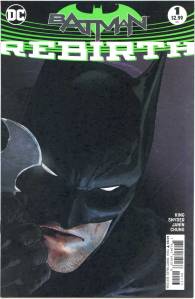
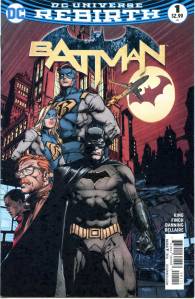
The 1993 “Knightfall” story arc introduced a new villain, Bane, who critically injures Batman. Jean-Paul Valley, known as Azrael, is called upon to wear the Batsuit during Bruce Wayne’s convalescence. Writers Doug Moench,Chuck Dixon, and Alan Grant worked on the Batman titles during “Knightfall”, and would also contribute to other Batman crossovers throughout the 1990s. 1998’s “Cataclysm” storyline served as the precursor to 1999’s “No Man’s Land“, a year-long storyline that ran through all the Batman-related titles dealing with the effects of an earthquake-ravaged Gotham City. At the conclusion of “No Man’s Land”, O’Neil stepped down as editor and was replaced by Bob Schreck.