Amalgam Comics (1996)

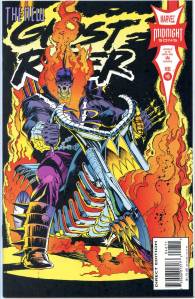
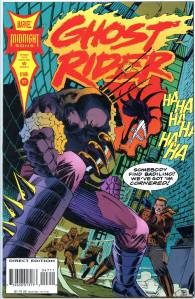
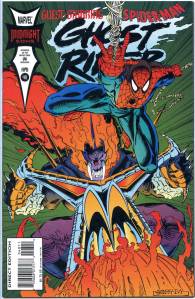
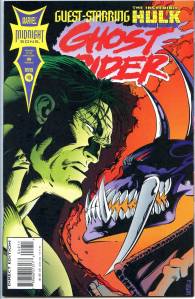
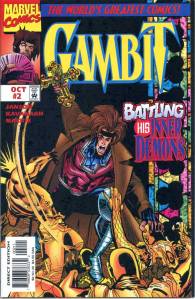
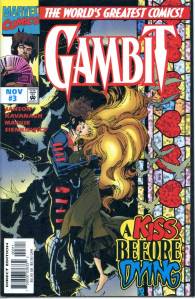
On two separate occasions – April 1996 and June 1997 – Marvel and DC co-published issues under the Amalgam Comics imprint. The issues were presented as if the imprint had existed for decades, with stories and editorial comments referring to a fictional history stretching back to the Golden Age of Comics, including retcons and reboots. For example, they referred to Secret Crisis of the Infinity Hour (an amalgamation of Marvel’s Secret Wars, DC’s Crisis on Infinite Earths, Marvel’s The Infinity Gauntlet, and DC’s Zero Hour), which featured the well-known cover of Crisis on Infinite Earths #7, but with Super-Soldier holding his sidekick’s body, instead of Superman holding Supergirl. Several issues included fake letter columns to provide the illusion of background to the stories, with the “fans'” hometowns formed by amalgamating the names of existing cities.
Agents of Atlas V2 (2009)

The heroes of the 1950s are back with big plans for the 21st Century! When Federal enforcers under the hand of Norman Osborn burst into an armory under the control of the Atlas Foundation, Jimmy Woo’s Agents go head-to-head with the new powers that be. How it all goes down will make the playing field of the modern Marvel Universe more volatile than ever!

New Mutants V1 (1980’s)

The first team of New Mutants characters was created by Chris Claremont and artist Bob McLeod. They first appeared in 1982’s Marvel Graphic Novel #4 and are subsequently featured in their own title from 1983 until 1991. Like its parent title, The New Mutants highlighted interpersonal and group conflict as well as action and adventure, and featured a large ensemble cast, including the introduction of cult figure Deadpool. With the end of the first series, the characters were relaunched as X-Force in a new, eponymous series.

Black Panther V8 (2021)

Fresh from returning from his travels in space, Black Panther receives an unexpected and urgent message from a Wakandan secret agent! Now T’Challa must race the clock not only to save his agent, but also to keep his true agenda under wraps. Because if the truth comes out, it could cost T’Challa everything…

Silver Surfer V8 (2016)

“Fantastic Planet”. The Surfer has taken Dawn Greenwood to the end of the universe, and now he’s going to show her the most fantastic planet of them all: Earth! It’s your homeworld like you’ve never seen it before: with monsters, magic and…a secret that will change everything!

Fantastic Four (1970’s)

Stan Lee said he created a synopsis for the first Fantastic Four story that he gave to penciller Jack Kirby, who then drew the entire story. Kirby turned in his penciled art pages to Lee, who added dialogue and captions. This approach to creating comics, which became known as the “Marvel Method“, worked so well for Lee and Kirby that they used it from then on; the Marvel Method became standard for the company within a year.

Kirby recalled events somewhat differently. Challenged with Lee’s version of events in a 1990 interview, Kirby responded: “I would say that’s an outright lie”, although the interviewer, Gary Groth notes that this statement needs to be viewed with caution. Kirby claims he came up with the idea for the Fantastic Four in Marvel’s offices, and that Lee had merely added the dialogue after the story had been pencilled. Kirby has also sought to establish, more credibly and on numerous occasions, that the visual elements of the strip were his conceptions. He regularly pointed to a team he had created for rival publisher DC Comics in the 1950s, Challengers of the Unknown. “[I]f you notice the uniforms, they’re the same… I always give them a skintight uniform with a belt… the Challengers and the FF have a minimum of decoration. And of course, the Thing’s skin is a kind of decoration, breaking up the monotony of the blue uniform.” The characters wear no uniforms in the first two issues.

Wolverine V2 (1980’s)

In November 1988, Marvel launched an ongoing Wolverine solo book written by Claremont with art by John Buscema. It ran for 189 issues. Larry Hama later took over the series and had an extensive run. Other writers who wrote for the two Wolverine ongoing series include Peter David, Archie Goodwin, Erik Larsen, Frank Tieri, Greg Rucka, Mark Millar, and Gregg Hurwitz. Many artists have also worked on the series, including John Byrne, Gene Colan, Marc Silvestri, Mark Texeira, Adam Kubert, Leinil Francis Yu, Rob Liefeld, Sean Chen,Darick Robertson, John Romita, Jr., and Humberto Ramos. During the 1990s, the character was revealed to have bone claws, after his adamantium is ripped out by Magneto in X-Men #25, which was inspired by a passing joke of Peter David’s.

Strange Academy (2020)

Strange Academy is a fictional school appearing in comics published by Marvel Comics. It was founded by Doctor Strange to train young people from many worlds with magical abilities in the use of sorcery and magical artifacts. The school first appears in Strange Academy #1 (March 2020) and was created by writer Skottie Young and artist Humberto Ramos.

X-Factor V1 (1990’s)

In the last major storyline of the first X-Factor series, published in early 1991, Apocalypse kidnaps Nathan Summers, sensing that he would grow up to be a powerful mutant and possible threat. X-Factor rescue Nathan from Apocalypse’s lunar base, but find him infected with a “techno-organic” virus that cannot be treated. A clan of rebels from the future, known as the Askani, send a representative to the present time to bring Nathan 2,000 years into the future to be treated. Fully grown, he returns to the 20th century as the antihero, Cable.

X-Factor, the X-Men, and several minor characters team up to fight the telepathic Shadow King in another crossover event, The Muir Island Saga. Afterward, the original members of X-Factor rejoin the X-Men and several characters from various X-Men-related series become founding members of a new X-Factor.

Friendly Neighborhood Spider-Man (2005)

The title is derived from a trademark self-referential comment often made by Spider-Man (as in “just another service provided by your friendly neighborhood Spider-Man!”). The series began in October 2005 and was primarily written by Peter DavidFriendly Neighborhood Spider-Man was canceled after issue #24, part 2 of J. Michael Straczynski and Joe Quesada‘s controversial “One More Day” storyline. Kurt Busiek has revealed that in 1995 he originally suggested “Friendly Neighborhood Spider-Man” as the title of the series which was eventually published as Untold Tales of Spider-Man.