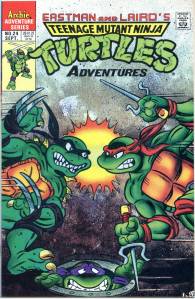
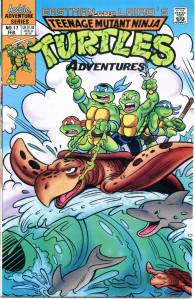
The initial storylines were close adaptations of the 1987 Teenage Mutant Ninja Turtles television series, but by the fifth issue the creators handed the series over to Ryan Brown and Stephen Murphy. In their hands the comic immediately diverged from the cartoon series into unique new story arcs, often incorporating social, environmentalist, and animal-rights themes. It also introduced several new characters of various races and backgrounds, including humans, mutants, aliens, and other anthropomorphic creatures. Additionally, the series added new layers to established players such as April O’Neil, who began training with a katana, and the Shredder, who gradually revealed a sense of honor. The stories were often seen as ‘deeper’ and more ‘serious’ than the cartoon. As the new tales and characters were explored, original antagonists Krang, Bebop and Rocksteady were eventually phased out early, making later appearances during stories involving alien worlds. Shredder would remain a recurring adversary.
Tag: Iron Age
Nightwing – New 52 (2011)
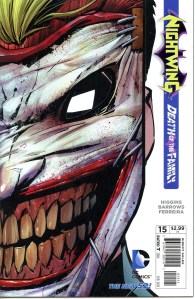
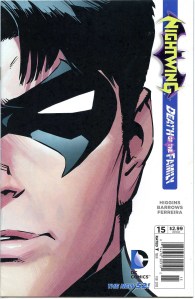
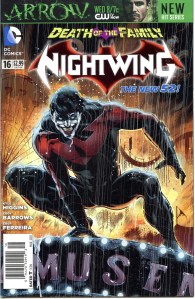
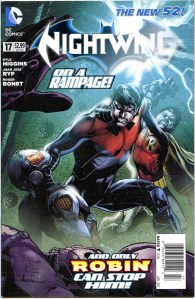
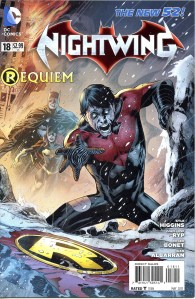
After the events of Flashpoint as part of The New 52, Nightwing was relaunched with issue #1. Grayson resumes the role of Nightwing following the return of Bruce Wayne. The new series, written by Kyle Higgins, opens with Grayson having returned to Gotham, when Haly’s Circus comes to town. Through a series of events, Grayson inherits the circus and is working through internal struggles with his past as he investigates the secrets the circus has brought about.
During the events of Death of the Family (a bat-family crossover) Haly’s circus is targeted by the Joker. As a result, the circus is burnt down and the circus members leave. Dick is left feeling depressed and lost as a result of this and the death of Damian Wayne (Robin) and is at a loss for what to do with his life. However, when Sonia Branch reveals to him that she believes her father, Tony Zucco, is alive and living in Chicago, Dick makes the decision take him down. Therefore, in 2013 Nightwing relocated to Chicago to hunt down Tony Zucco and also take down The Prankster, a new supervillain hacker in Chicago.
The Punisher V2 (1980’s)
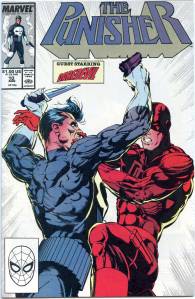
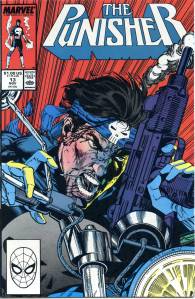
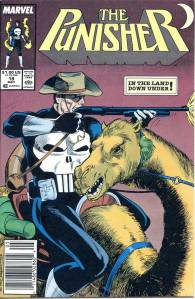
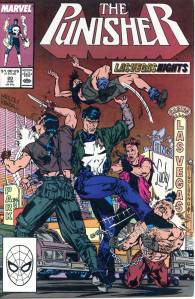
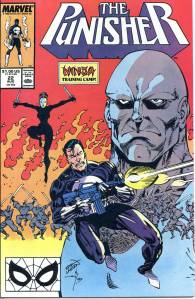
The Punisher ongoing series premiered in 1987. Initially by writer Mike Baron and artist Klaus Janson, it eventually ran 104 issues (July 1987 – July 1995) and spun off two additional ongoing series — The Punisher War Journal (80 issues, November 1988 – July 1995) and The Punisher War Zone (41 issues, March 1992 – July 1995), as well as the black-and-white comics magazine The Punisher Magazine(16 issues, November 1989 – September 1990) and The Punisher Armory (10 issues, no cover dates, starting 1990), a fictional diary detailing “His thoughts! His feelings! His weapons!” (as stated on the cover of issue #1). The Punisher also appeared in numerous one-shots and miniseries, and made frequent guest appearances in other Marvel comics, ranging from superhero series to the Vietnam War-era comic The ‘Nam.
During this era, the Punisher was assisted by his then-partner, Microchip. Serving as a Q type figure, he would supply the Punisher with high-tech vehicles and equipment such as armored combat “battle vans” specially built and customized.
Vengeance of the Moon Knight (2009)
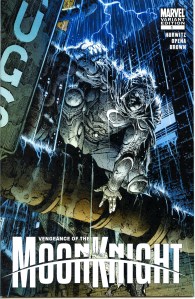
Moon Knight returns to New York after faking his death with Jake Lockley as his dominant personality, but still struggles against his violent nature and is hounded by Khonshu in the form of a small imaginary tormentor resembling a man in the Moon Knight costume with a bird skull who goads him to kill. While trying to walk the path of a hero he makes a bold return taking on many criminals but killing none of them; now the people of New York begin to see him as a hero and not a murderous vigilante much to Norman Osborn’s disdain. Jake’s personality has been one of struggle against the inner demon trying to get him to kill while juggling sobriety.
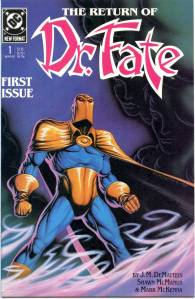
Dr. Fate V2 (1988)
In 1988, DC Comics would release a Doctor Fate ongoing series focusing on 2 characters acting simultaneously as Doctor Fate, the first twenty-four issues written and drawn by J.M. DeMatteis and Shawn McManus. The series focused on magically aged up Eric and Linda acting as Doctor Fate under the guidance of Nabu, whom has inhabited and taken the identity of Kent Nelson. Despite their differences in personality and both Eric’s immaturity and true age, Linda is portrayed as having feelings for Erica which are mutual. The Eric Stauss character was seemingly killed off later in the run, making the Linda Strauss character the sole Doctor Fate for a time.
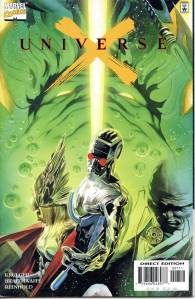
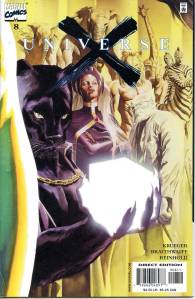
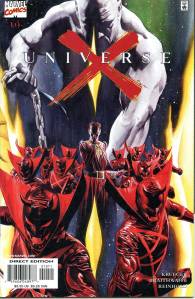
Universe X (2000)
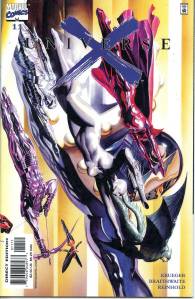
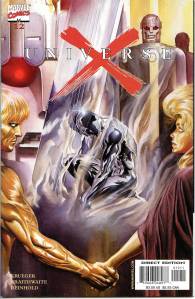
With the Celestial embryo gone, the Earth’s mass is reduced, causing a shift in orbit and polarity as well as drastic worldwide climate changes. One-fourth of New York’s population dies as temperatures plummet. The Tong of Creel, a cult dedicated to reassembling the Absorbing Man, begins killing those who hold his fragments. Under Mephisto‘s influence, Pope Immortus founds a church advocating mutant dominance of the galaxy and the destruction of Reed’s Human Torches. Meanwhile, Mar-Vell is reincarnated as the child of the synthetic Him and Her, though his soul remains in the Realm of the Dead. Captain America becomes the Mar-Vell child’s guardian and embarks on a worldwide quest with his new ward to obtain various items in order to deal with Earth’s restless mutant population and prepare for an impending war in the Realm of the Dead. Arriving at Zero Street, the duo is attacked by the Night People, and Captain America sacrifices his life to save the Mar-Vell child.
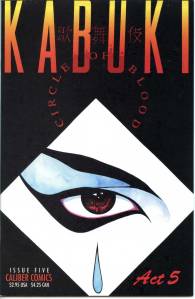
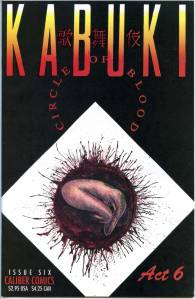
Kabuki – Circle of Blood (1994)
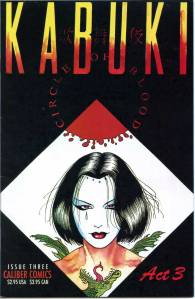
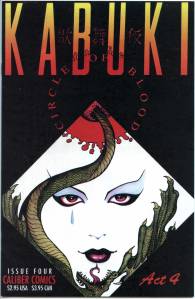
Set in an alternate near-future Japan, a young woman codenamed “Kabuki”, acts as an agent and television law-enforcement personality for a clandestine government body known as “The Noh”. In the first volume of the series, The Noh’s nature and background is explained.
The Noh is controlled by a renowned World War II Japanese military man known as the General, who has achieved much power and status for being a brilliant military tactician during his many years of service. The agency itself exists as part of Japan’s strict police state, which hunts down and brutally executes criminals for their misdeeds under the veil of keeping the peace. Secretly the Noh also acts to maintain the balance of crime and order that ultimately benefits the national economy on both sides of the law and thus targets politicians, businessmen and certain underworld kingpins whose actions threaten this balance. Kabuki herself is one of eight masked assassins whom perform these secret executions under the General’s orders.
Infinity Wars (2018)
The premise involves the heroes and villains of the Marvel Universe deal with the outcome of the search for the new Infinity Gems (now renamed Infinity Stones). In Infinity Wars #3 (“Infinity Warps”), Requiem (Gamora) successfully gathers the Infinity Stones to use them in a more creative fashion than her father Thanos, reducing the universe’s lifeforms in half by combining any two given characters into one new individual. However, the result is unintended: only the reality around the heroes of Earth is warped and transported inside Soulworld where Devondra, a cosmic entity dwelling at the heart of the Soul Stone, waits to feed.
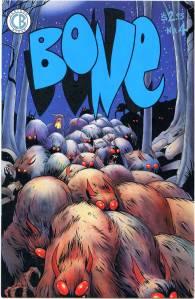
Bone (1991)
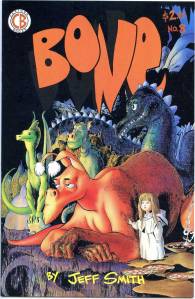
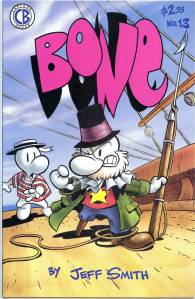
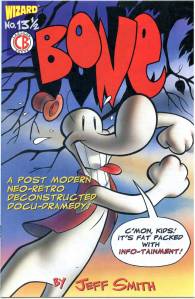
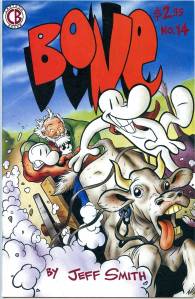
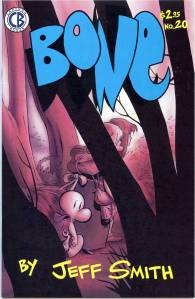
Bone is an independently published comic book series, written and illustrated by Jeff Smith, originally serialized in 55 irregularly released issues from 1991 to 2004.
Smith’s black-and-white drawings were inspired by animated cartoons and comic strips, a notable influence being Walt Kelly‘s Pogo: “I was … a big fan of Carl Barks and Pogo, so it was just natural for me to want to draw that kind of mixture of Walt Kelly and Mœbius.” Accordingly, the story is singularly characterized by a mixture of both light-hearted comedy and dark fantasy thriller: Time has called the series “as sweeping as the Lord of the Rings cycles, but much funnier.” The series was published bimonthly with some delays from June 1991 to June 2004. The series was self-published by Smith’s Cartoon Books for issues #1 to #19, by Image Comics from issues #20 to #28, and back to Cartoon Books for issues #29 to #55.
Bone has received numerous awards, among them ten Eisner Awards and eleven Harvey Awards.
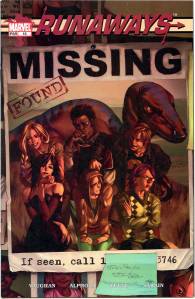
Runaways V1 (2003)
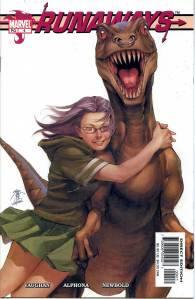
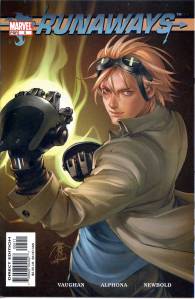
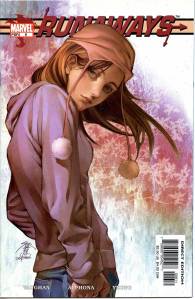
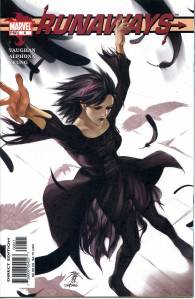
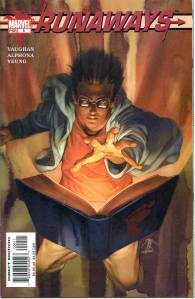
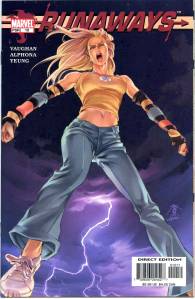
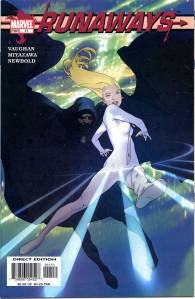
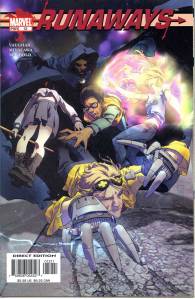
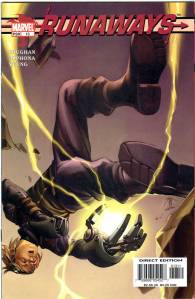
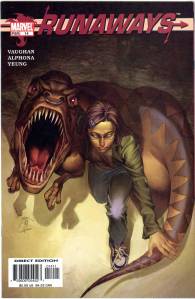
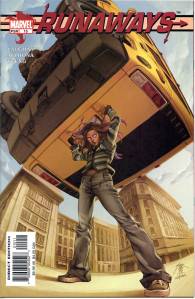
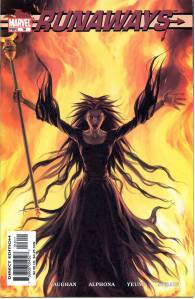
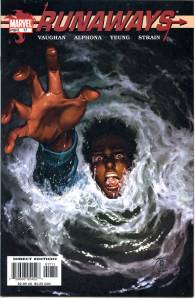
Runaways features a group of teenagers who discover that their parents are part of an evil crime organization known as “The Pride“. Created by Brian K. Vaughan and Adrian Alphona, the series debuted in July of 2003 as part of Marvel Comics’ “Tsunami” imprint. The series had been canceled in September 2004 at issue eighteen, but due to high numbers of trade collection sales, Marvel revived the series in February 2005.
Originally, the series featured a group of six kids whose parents routinely met every year for a charity event. One year, the kids spy on their parents and learn they are “the Pride”, a criminal group of mob bosses, time-travelers, dark wizards, mad scientists, alien invaders and telepathic mutants. The kids steal weapons and resources from their parents, and learn they themselves inherited their parents’ powers; Alex Wilder, a prodigy, leads the team while Nico Minoru learns she is a powerful witch, Karolina Dean discovers she is an alien, Gertrude Yorkes learns of her telepathic link to a dinosaur, Chase Steinsteals his father’s futuristic gloves, while young Molly Hayes learns she is a mutant with incredible strength. The kids band together and defeat their parents, and atone for the sins of their parents by fighting the new threats trying to fill in the Pride’s void. After being betrayed by Alex who was killed by the Gibborim (The Pride’s God) they are later joined by cyborg Victor Mancha, shape-shifting SkrullXavin, and plant-manipulator Klara Prast.