Ghost (1990’s)

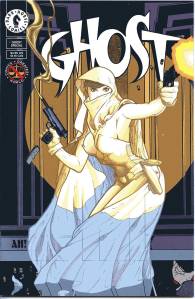
Ghost first appeared in Comics’ Greatest World, week three, in 1993. After a popular special in 1994, a monthly title devoted to the character began publication in 1995. It ran for 36 issues, followed by a six-month break and a second series of 22 issues. The second series was a continuation of the first with a number of changes, including new details about Ghost’s origin. The stories in both series were based in (and around) the city of Arcadia, in a self-contained fictional universe outlined in Dark Horse’s Comics’ Greatest World.

Ghost continued appearing in her own titles (and others) into the 2000s, including several crossovers unrelated to Comics’ Greatest World. Most notable among these were a two-issue crossover with Dark Horse’s Hellboy (Ghost/Hellboy), and a four-issue crossover with DC Comics’ Batgirl (Ghost/Batgirl: The Resurrection Machine). Ghost was ranked 15th on the Comics Buyer’s Guide‘s “100 Sexiest Women in Comics” list.

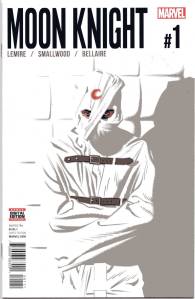
Moon Knight V8 (2016)

Marc Spector wakes up in a mental institute with no recollection of his past or how he got there. The staff, led by Dr. Emmet, seems to have supernatural powers and thwart Marc’s attempts to recover his past. Marc is shown evidence that he is a mentally ill man who has convinced himself he is also Moon Knight, a vigilante he’s seen on the news. Khonshu contacts Marc and explains that Emmet is an avatar like him, one who is connected to the Othervoid god Ammit. Khonshu decides it is now time for him to completely dominate Marc Spector’s body. Marc denies Khonshu and fights him with the help of all of his alters. Marc accepts that whether they are the result of childhood trauma or Khonshu’s interference, his alters are a part of him and have been for most of his life. After defeating Emmet and Khonshu, Marc resumes his life as Moon Knight, determined to be a protector and crime-fighter on his own terms rather than as a tool of anyone else. Later, Marc and Khonshu resume their bond.
Batgirl V4 – New 52 (2011)

In September, 2011, following the company-wide relaunch, Barbara Gordon stars in a new Batgirl series—one of The New 52 titles featuring the company’s most iconic characters. The conclusion of the limited series Flashpoint (2011) establishes a new continuity within the DC Universe, with all characters regressing to an earlier age and stage in their careers, while remaining in a modern timeline. DC Senior VP of Sales, Bob Wayne, explained that with each of their titles reverting to issue #1, “our creative teams have the ability to take a more modern approach—not only with each character, but with how the characters interact with one another and the universe as a whole, and focus on the earlier part of the careers of each of our iconic characters.” Wayne also stated that “The Killing Joke” still happened and she was Oracle. Now she will go through physical rehabilitation and become a more seasoned and nuanced character because she had these incredible and diverse experiences.

John Byrne’s 2112 (1991)

The Next Men characters made a prototypical appearance as “Freaks” in a lithography plate that was published within the History of the DC Universe Portfolio in 1986. Byrne had originally pitched the series to DC Comics, but the series never surfaced there. With some changes, Byrne changed the concept to fit in with his work on the graphic novel 2112, to become the John Byrne’s Next Men series. Two characters from the “Freaks” artwork somewhat retained their physical looks and became the lead characters of the Next Men series: heroine Jasmine and villain Aldus Hilltop.

The Next Men officially debuted in a four-part storyline in Dark Horse Presents #54-57 (later reprinted, in color, as John Byrne’s Next Men #0). The series ran until issue #30 and ended with a cliffhanger. According to Byrne, he intended the series to be science-fiction that had a “sort of smell” of being a super-hero book. In addition to exploring mature topics such as sex, abortion, and child abuse, Byrne also set aside some of the more-traditional conventions of the medium, such as “thought-bubbles” and sound-effects.

Byrne had intended to conclude the story in a second series after a six-month hiatus, but the collapse of the American comic-book industry in the mid-1990s made it financially unfeasible for him to do so, and he returned to working for hire at DC Comics and Marvel Comics.

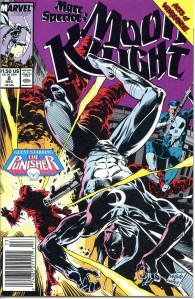
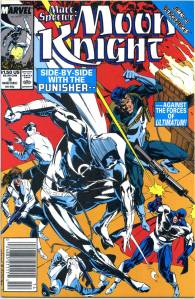
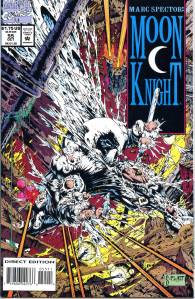
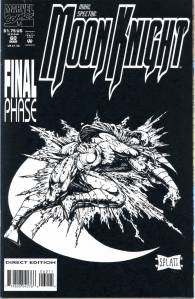
Marc Spector: Moon Knight V1 (1989)

Moon Knight was created by Doug Moench and Don Perlin. He first appeared in Werewolf by Night #32 (August 1975).

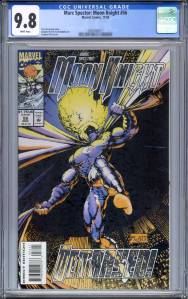
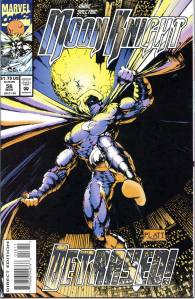
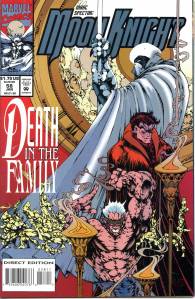
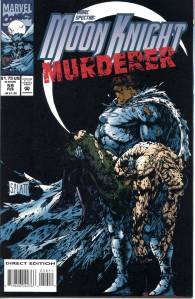
 In 1989, a third Moon Knight volume, titled Marc Spector: Moon Knight was published. It was the longest-running series, lasting sixty issues. This volume introduces Moon Knight’s teenage sidekick Jeff Wilde, also known as “Midnight,” the son of Midnight Man, a villain from the first volume of the series. At this time, Moon Knight first encounters the Black Cat. Turned into a cyborg by the Secret Empire, Midnight is seemingly killed in the “Round Robin” story arc of Amazing Spider-Man, spanning issues #353-#358.

 The series was canceled with issue #60 (March 1994), with four of the last six issues drawn by Stephen Platt, who was hired by Image Comics based on the strength of his work on the series.

X-Force V5 (2020)

X-Force is the CIA of the mutant world-one half intelligence branch, one half special ops. Beast, Jean Grey and Sage on one side, Wolverine, Kid Omega and Domino on the other.

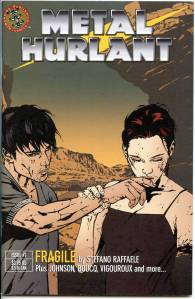
Métal Hurlant (2002)

Métal Hurlant began publishing again in July 2002 by Humanoids Publishing, with a French, English, Spanish and Portuguese version, under the French name. As a “two-headed”, transatlantic (France-US) magazine, led by Fabrice Giger in Los Angeles, it published original short stories, sometimes related to existing or to be published comic books. Its aim was to discover young creators and promote the products from the publisher. This incarnation of the magazine ceased publication with issue No. 14, dated November/December 2004.

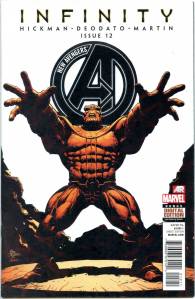
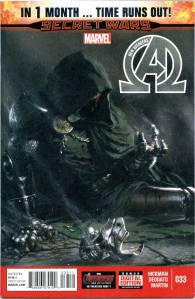
New Avengers V3 (2013)

New Avengers was renumbered as a new volume in January 2013, written by Jonathan Hickman and originally drawn by Steve Epting. The new volume shifted its focus to the powerful group known as the Illuminati, which includes Black BoltCaptain AmericaDoctor StrangeIron ManMister Fantastic, and Namor, who reassembled to confront the threat of incursions. Black Panther and Reed Richards discovered that universal decay centered on Earth was causing universes to collide with one another, with Earth at the focal point. In issue #3, Black Panther, who had previously opposed the existence of the Illuminati, joined the group, and the Beast was brought in to fill the spot vacated by the death of Professor X. In the same issue, Captain America leaves. In issue #12, after having helped the Illuminati to defeat Thanos‘s army, Black Bolt’s brother Maximus joined the team. Bruce Banner joined the team in Avengers Vol. 5 #28 after discovering the universal decay on his own.

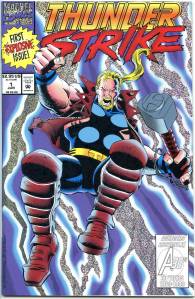
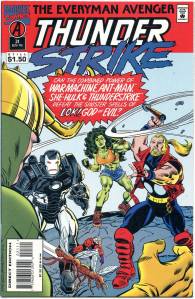
Thunderstrike (1993)

Following Thor #459, Masterson was introduced as “Thunderstrike” in the eponymous series starting in June 1993. The series lasted approximately two years. Thunderstrike ran for 24 issues, the series canceled in September 1995. Creator Tom DeFalco has often claimed that the book outsold Thor and The Avengers combined at the time of its cancellation; although this has been shown to be extremely unlikely.

Poison Elves – Mulehide Graphics (1990’s)

I, Lusiphur (December 1991-December 1992) – Poison Elves (February 1993-February 1995) Hayes originally self-published the series during the early 90s under his company Mulehide Graphics under the title of I, Lusiphur. The title was changed to Poison Elves because the similarity of Lusiphur to Lucifer led to the misconception that the series was Satanic in nature. Sales were reported to have increased significantly after the name change. Drew claimed in one of his Starting Notes that the name change was prompted by a letter from a teen-aged fan whose mother had thrown out his comics after finding I, Lusiphur comics amongst his collection.

The first ten issues of the Mulehide series were published in a larger magazine size format. In 1995, Drew Hayes signed on with Sirius Entertainment, a move that increased his exposure, fan base, and publishing rate. To date, ten trade paperbacks have been released, but the last issue of the main series published by Sirius was #79. Hayes died in 2007, thus bringing the series to an abrupt end. A commemorative issue #80 was released to give fans a look at sketches and plans Drew Hayes had for the future of the series before his death.