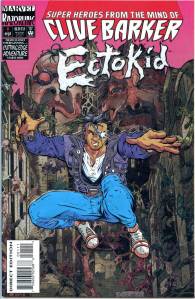
Ectokid is a fantasy series published by Marvel Comics‘ Razorlineimprint that ran from 1993 to 1994. Created by filmmaker and horror/fantasy novelist Clive Barker as one of the imprint’s four interconnected series, it starred teenaged Dexter Mungo, the child of a mortal and a ghost, who is able to see and interact with the dangerous, interdimensional Ectosphere.
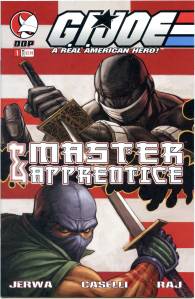
G.I. Joe: Master and Apprentice was a mini-series published in 2004 by Devil’s Due. The story chronicles how the destinies of Snake-Eyes and Kamakura become entwined, providing part of the untold story of how things came to be in the main series.
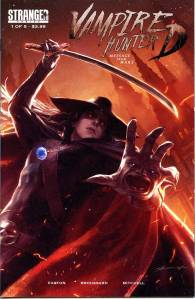
Drawn to Mars by an ancient message from Cecile, a girl who could see the future, D arrives to find a colony that is little more than a blood farm. With Left Hand by his side, D sets out to cleanse Mars of the vampire scourge.
He’s arguably one of the most influential men in America today. He’s inarguably the evilest. His name is Lex Luthor…and whatever Luthor wants, Luthor gets – even if it’s the life of a man who threatens his privacy. But it’s Clark Kent who’s arrested for the brutal murder of down-and-out biographer Peter Sands, a man who hoped to climb back to the top with THE UNAUTHORIZED BIOGRAPHY OF LEX LUTHOR. All it got him was dead. What are the secrets of his past that Luthor is willing to kill for…secrets that the merciless criminal mastermind wants kept dead and buried?
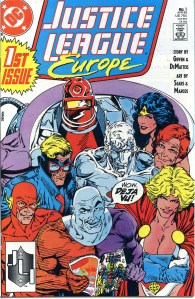
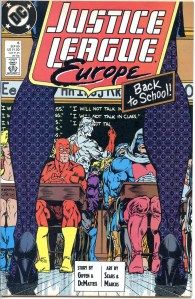
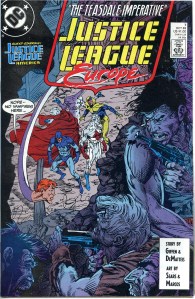
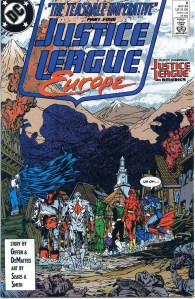
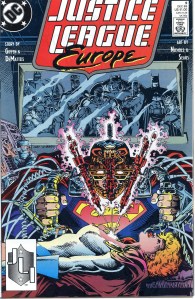
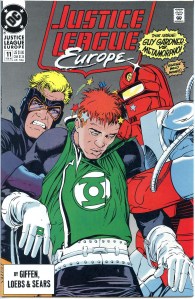
Justice League Europe was published for 68 issues (plus five annuals) from 1989 to 1994. Starting with issue #51 the title was renamed Justice League International (vol. 2). Like Justice League America, the series featured tongue-in-cheek humor but was a much more action-centric series than Justice League America. The action-themed nature of the series was most overt with the series’ most famous arc “The Extremists”. The arc featured the JLE fighting The Extremists, a cadre of psychopathic villains patterned after Marvel Comics villains Doctor Doom, Magneto, Doctor Octopus, Sabretooth and Dormammu.
The team was originally headquartered in Paris, France but later moved to an abandoned castle in Great Britain.
The new series was launched in August 1984, with a five-part story featuring the Legion of Super-Villains. Giffen left in the middle of the story and was replaced by Steve Lightle, who stayed on the book for a year. The debut story arc saw the death of Karate Kid in issue #4. Levitz and Lightle co-created two Legionnaires, Tellus and Quislet, whose unusual appearances contrasted with the humanoid appearances of the other Legionnaires. Greg LaRocque began a lengthy run in #16, including a crossover with John Byrne‘s recently rebootedSuperman titles in #37 and #38. The crossover was the first of several attempts by DC editors to explain the origins and fate of Superboy and his history with the Legion, in light of the revisions to the DC Universe caused by Crisis on Infinite Earths that removed Superman’s career as Superboy from his personal history. In the crossover, the Legion’s Superboy was revealed to have come from a parallel “pocket universe” created by the Time Trapper. The crossover ended with Superboy’s death. Levitz’s run ended with the return of Giffen and a four-part story “The Magic Wars”, concluding in #63 (August 1989).
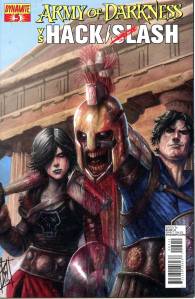
After a painful personal tragedy, Cassie Hack — the killer of supernatural serial killers — is doing her best to live a normal life. But an attack by the demonic Deadites forces the butt-kickin’ heroine back into action… and this time, she’s not alone! Meet Cassie’s new partner: Ashley J. Williams! Can this volatile pair keep from killing each other long enough to find the mystical Book of the Dead’s stolen pages? Will Ash get some sugar? Or will Cassie make him kiss her bat?
Bartman was a short-lived series that told the tale of Bart Simpson’s superhero alter-ego, Bartman. It was one of the four ‘premiere’ series released by Bongo Comics in late 1993. The Bartman series lasted only six issues, and was canceled in 1995. Many smaller Bartman stories have since been published in Simpsons Comics and Bart Simpson comics.
The main writers and artists for the first three issues were Steve Vance and Bill Morrison, who were behind the creation of Bongo Comics itself. In late 1994, Steve Vance and his wife Cindy left Bongo Comics. The Bartman comic was put on hold and there was a gap of 9 months between Bartman #3 and #4. #4-6 contained a three-issue story arc written by Gary Glasberg and Bill Morrison, and with issue 6, Bartman was discontinued.
With the original creative team (Dan Slott and Juan Bobillo) from the previous series, the book returned eight months later as promised in October 2005. The third issue was billed as the 100th issue of a She-Hulk comic book, and had story art by numerous artists, including Vosburg. There was no new artwork by Buscema or Byrne, who were represented by reprints of Sensational She-Hulk #1 and Savage She-Hulk #1.
Dan Slott’s last issue is #21; with 33 issues, Slott has written the most solo issues of She-Hulk. Peter David became the new writer with She-Hulk #22. Marvel Comics announced that She-Hulk #38 (February 2009) would be the final issue of the series. Peter David commented on his blog that sales of the book were hurt due to discrepancies between his book and Jeph Loeb‘s Hulk series, caused by editorial error.