
Legion of Super-Heroes V3 (1984)

The new series was launched in August 1984, with a five-part story featuring the Legion of Super-Villains. Giffen left in the middle of the story and was replaced by Steve Lightle, who stayed on the book for a year. The debut story arc saw the death of Karate Kid in issue #4. Levitz and Lightle co-created two Legionnaires, Tellus and Quislet, whose unusual appearances contrasted with the humanoid appearances of the other Legionnaires. Greg LaRocque began a lengthy run in #16, including a crossover with John Byrne‘s recently rebooted Superman titles in #37 and #38. The crossover was the first of several attempts by DC editors to explain the origins and fate of Superboy and his history with the Legion, in light of the revisions to the DC Universe caused by Crisis on Infinite Earths that removed Superman’s career as Superboy from his personal history. In the crossover, the Legion’s Superboy was revealed to have come from a parallel “pocket universe” created by the Time Trapper. The crossover ended with Superboy’s death. Levitz’s run ended with the return of Giffen and a four-part story “The Magic Wars”, concluding in #63 (August 1989).

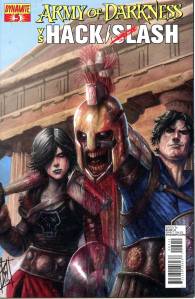
Army of Darkness Vs. Hack/Slash (2014)

After a painful personal tragedy, Cassie Hack — the killer of supernatural serial killers — is doing her best to live a normal life. But an attack by the demonic Deadites forces the butt-kickin’ heroine back into action… and this time, she’s not alone! Meet Cassie’s new partner: Ashley J. Williams! Can this volatile pair keep from killing each other long enough to find the mystical Book of the Dead’s stolen pages? Will Ash get some sugar? Or will Cassie make him kiss her bat?

Army of Darkness Vs Hack-Slash #5A NM- $3

Bartman(1993)

Bartman was a short-lived series that told the tale of Bart Simpson’s superhero alter-ego, Bartman. It was one of the four ‘premiere’ series released by Bongo Comics in late 1993. The Bartman series lasted only six issues, and was canceled in 1995. Many smaller Bartman stories have since been published in Simpsons Comics and Bart Simpson comics.

The main writers and artists for the first three issues were Steve Vance and Bill Morrison, who were behind the creation of Bongo Comics itself. In late 1994, Steve Vance and his wife Cindy left Bongo Comics. The Bartman comic was put on hold and there was a gap of 9 months between Bartman #3 and #4. #4-6 contained a three-issue story arc written by Gary Glasberg and Bill Morrison, and with issue 6, Bartman was discontinued.

She Hulk V2 (2005)

With the original creative team (Dan Slott and Juan Bobillo) from the previous series, the book returned eight months later as promised in October 2005. The third issue was billed as the 100th issue of a She-Hulk comic book, and had story art by numerous artists, including Vosburg. There was no new artwork by Buscema or Byrne, who were represented by reprints of Sensational She-Hulk #1 and Savage She-Hulk #1.

Dan Slott’s last issue is #21; with 33 issues, Slott has written the most solo issues of She-Hulk. Peter David became the new writer with She-Hulk #22. Marvel Comics announced that She-Hulk #38 (February 2009) would be the final issue of the series. Peter David commented on his blog that sales of the book were hurt due to discrepancies between his book and Jeph Loeb‘s Hulk series, caused by editorial error.

Next Men V1 (1992)

The Next Men characters made a prototypical appearance as “Freaks” in a lithography plate that was published within the History of the DC Universe Portfolio in 1986. Byrne had originally pitched the series to DC Comics, but the series never surfaced there. With some changes, Byrne changed the concept to fit in with his work on the graphic novel 2112, to become the John Byrne’s Next Men series. Two characters from the “Freaks” artwork somewhat retained their physical looks and became the lead characters of the Next Men series: heroine Jasmine and villain Aldus Hilltop.

The Infinity Crusade (1993)

Infinity Crusade is a six-issue limited series published by Marvel Comics in 1993. The series was written by Jim Starlin and penciled by Ron Lim, Ian Laughlin, Al Milgrom and Jack Morelli.

It is a sequel to Infinity Gauntlet and Infinity War, both from the same creative team.

When hero Adam Warlock takes possession of the artifact the Infinity Gauntlet, he expels the good and evil aspects of his being to become a totally logical being, who can therefore use the Gauntlet wisely. This act not only freed the incarnation of his evil aspects, Warlock’s old foe the Magus, but also created an incarnation of his good aspects, the Goddess. During the events of the Infinity War, the Goddess steals the five cosmic containment units (also known as Cosmic Cubes) collected by the Magus. She eventually collects a total of thirty, and uses these to form a “Cosmic Egg” capable of fulfilling wishes.

Venom: First Host (2018)

Tel-Kar first appeared in Venom: First Host #1. During the Kree-Skrull War, the Kree, desiring to replicate the Skrull‘s shape-shifting abilities, they obtain the newborn Venom, which had been outcast from the other symbiotes, on Gorr‘s planet where Knull had created the symbiotes. Tel-Kar is recruited to be bonded to the newborn symbiote in order to infiltrate the Skrull army. Tel-Kar’s body is biologically altered so he can have full control over the symbiote’s mind to the point of erasing its memories. He successfully infiltrated the Skrull army discovering various secrets. However he blew his cover up in order to save some Kree refugees and handed the symbiote to them to return it to Hala. Then Tel-Kar was betrayed by Ronan the Accuser who used a Kree Sentry to capture Tel-Kar and was given to the Skrulls as a war criminal. Separated from Tel-Kar after his capture, the symbiote goes on to be bonded to Spider-Man.

The Son of Satan (1975)

The character Daimon Hellstrom first appeared in Ghost Rider #1 (Sept. 1973), then was spun off into a feature, “Son of Satan”, in Marvel Spotlight #12–24 (Oct. 1973 – Oct. 1975). During the “Son of Satan” run, Marvel Spotlight was a controversial series, with numerous readers writing to object to the depictions of Satanism and wiccanism as being either inaccurate or furthering the cause of evil. Nonetheless, sales were strong, prompting Marvel to launch the character into his own series, Son of Satan, written by John Warner. The character’s success faded soon after the series launch, and Son of Satan was cancelled with issue #7, though an unused fill-in was published as Son of Satan #8 (Feb. 1977).

Origin (2001)

Origin (alternatively known as Wolverine: Origin or Origin: The True Story of Wolverine) is a six-issue comic book limited series published by Marvel Comics from November 2001 to March 2002, written by Bill JemasJoe Quesada and Paul Jenkins, and illustrated by Andy Kubert (pencils) and Richard Isanove (color).

Origin tells the story of the superhero Wolverine, best known as a member of the X-Men. Since the character first appeared in the early 1970s his history had often been shrouded in mystery, with bits of information revealed piecemeal over time (notably in Weapon X), but this series was the first to reveal Wolverine’s early days and his original background. In their introductions, some of those who worked on the series express their reluctance to reveal the actual origins of one of the comic world’s most popular and mysterious characters. Even Wolverine himself has few recollections of where he came from and this was an essential part of his appeal.


Venom Vs. Carnage (2004)

In Venom vs. Carnage #1-4, the Carnage symbiote reproduces, with Kasady implanting a spawn of it into Patrick “Paddy” Mulligan, an Irish-American police officer who was recently married and expecting a child. Mulligan became Toxin—who single-handedly overpowered both Venom and Carnage. Nevertheless, Mulligan remained determined to use his new-found powers for good—learning as much as he can from Spider-Man—while leaving behind his wife and newborn son in order to protect them from danger.