Captain Marvel Adventures (1946)

Whiz Comics #2 (cover-dated Feb. 1940) was published in late 1939. The comic’s lead feature introduced audiences to Billy Batson, an orphaned boy who, by speaking the name of the ancient wizard Shazam, is struck by a magic lightning bolt and transformed into the adult superhero Captain Marvel. Shazam’s name was an acronym derived from  the six immortal elders who grant Captain Marvel his superpowers: Solomon, Hercules, Atlas, Zeus, Achilles and Mercury.

In addition to introducing the main character, his alter ego, and his mentor, Captain Marvel’s first adventure in Whiz Comics #2 also introduced his archenemy, the evil Doctor Sivana, and found Billy Batson talking his way into a job as an on-air radio reporter with station WHIZ. Captain Marvel was an instant success, with Whiz Comics #2 selling over 500,000 copies. By 1941, he had his own solo series, Captain Marvel Adventures, while he continued to appear in Whiz Comics, as well as periodic appearances in other Fawcett books, including Master Comics.

Planet Comics (1940)

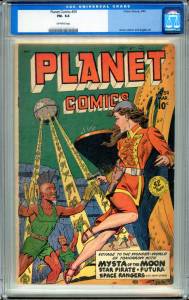
Planet Comics was a science fiction comic book title published by Fiction House from January 1940 to Winter 1953. It was the first comic book dedicated wholly to science fiction. Like most of Fiction House’s early comics titles, Planet Comics was a spinoff of a pulp magazine, in this case Planet Stories. Like the magazine before it, Planet Comics features space operatic tales of muscular, heroic space adventurers who are quick with their “ray pistols” and always running into gorgeous women who need rescuing from bug-eyed space aliens or fiendish interstellar bad guys.

Real Heroes & True Comics (1941)

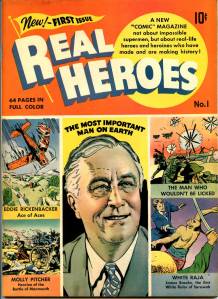
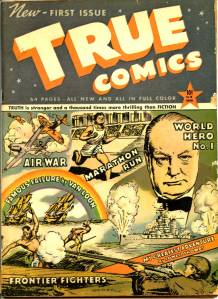
One of the first series of comics dedicated to educational topics was True Comics, published by Gworge J. Hecht’s Parents’ Magazine Press, beginning in 1941. Designed to convey not only information but also wholesome attitudes, the series covered a variety of materials, but many issues were devoted to patriotic stories from American history or to biographies of famous American (and occasionally non-Americans, such as Winston Churchill) from the past. The series also included stories of the exploits of the FBI, designed to heroize law enforcers and demonize criminal. These fact-based comics were enough of a commercial success that the series ran until 1950.

Web of Evil (1952)

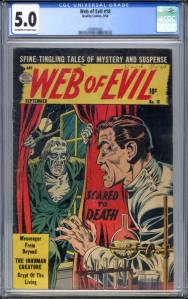
From the people who brought you Captain Marvel comes horror. Web of Evil was an anthology horror comic published by Quality Comics, and was acquired by DC Comics when DC bought Quality in 1956. It rivaled EC’s horror comics, often considered the measuring stick for greatness in this genre. With its smart writing, consistently high-end artwork, and willingness to push-the-envelope with its, violent, graphic depiction of scenes of the macabre, Web Of Evil, as with several EC horror titles, ended up getting Quality Comics in hot water, metaphorically.


Superman (Golden Age)

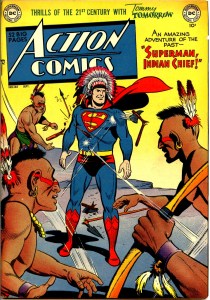
The major event many cite as marking the beginning of the Golden Age was the 1938 debut of Superman in Action Comics #1, published by the predecessor of modern-day DC Comics. The creation of Superman made comic books into a major industry. Some date the start to earlier events in the 1930s: The Overstreet Comic Book Price Guide‘s regular publication The Golden Age Quarterly lists comic books from 1933 onwards (1933 saw the publication of the first comic book in the size that would subsequently define the format); some historians, such Roger Sabin, date it to the publication of the first comic books featuring entirely original stories rather than re-prints of comic strips from newspapers (1935) by the company that would become DC Comics.
Chamber of Chills (1951)

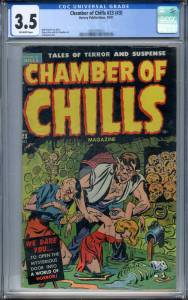
The first Chamber of Chills was a 10-cent horror anthology published bimonthly by Harvey Publications that ran 26 issues (cover-dated June 1951 – Dec. 1954).

Artists included Bob PowellLee Elias, Rudy Palais, Howard Nostrand, and Warren Kremer. Issue #7 is mentioned in Dr. Fredric Wertham‘s 1954 indictment of comic books Seduction of the Innocent (p. 389). Chamber ceased publication following the Senate Subcommittee on Juvenile Delinquency hearings of 1954. Harvey Comics then began concentrating on titles for young children, including Little Dot and Richie Rich.

Chamber of Chills was formerly Blondie Comics, taking over that comic’s numbering with issue #21. After issue #24 (Dec. 1951), the numbering was reset to #1. Chamber of Chills became Chamber of Clues with the February 1955 issue, and ceased publication two issues later, the last cover-dated April 1955.

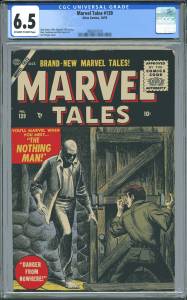
Marvel Tales – Atlas (1949)

The first Marvel Tales was the direct continuation of the superhero anthology Marvel Mystery Comics, published by Marvel Comics‘ initial iteration, Timely Comics. This series ran through issue #92 (cover-dated June 1949). Beginning with issue #93 (Aug. 1949), it became Marvel Tales, an anthology of horror, fantasy, and science fiction stories. The bulk of this series was published under the company name Atlas Comics.

Marvel Tales included among its contributors writer and editor-in-chief Stan Lee and such comics artists as Golden Age veterans Harry Anderson, Carl BurgosBill EverettFred KidaMike SekowskySyd Shores, and Ogden Whitney, and, early in their careers, Dick AyersGene ColanTony DiPretaMort DruckerRuss HeathBernard KrigsteinJoe ManeelyJoe Sinnott, and Basil Wolverton, among others. Issue #147 featured one of Steve Ditko‘s first stories for Marvel, “The Vanishing Martians”. The series ran 67 issues under the new title, through #159 (Aug. 1957). It ended because of the collapse of Atlas’s distributor, American News Company, and the subsequent restructuring that limited the number of comics the company could publish in a month.

An issue of Marvel Tales was included in a display of covers representative of the “Crime, Horror & Weird Variety” at the April 1954 hearings of the United States Senate Subcommittee on Juvenile Delinquency.

Weird Science (1950)

As with other EC Comics, Gaines and Feldstein used some Weird Science stories to teach moral lessons. “The Probers” (#8) features a space shuttle doctor who pays no mind to dissecting various animals, only to end up on an alien planet where aliens plan to dissect him. In “The Worm Turns” (#11) astronauts have fun with Mexican jumping beans but face a similar situation when they hide in a piece of fruit on an alien world and are found by a giant alien. “He Walked Among Us” (#13) was a take on organized religion in which a Christ-like astronaut helps the impoverished populace of an alien world but is killed by those in power, prompting the birth of a religion.

Gaines and Feldstein made cameo appearances in “Chewed Out” (#12), and other EC staffers were drawn into “EC Confidential” (#21).

Batman (1940’s)

In early 1939, the success of Superman in Action Comics prompted editors at National Comics Publications (the future DC Comics) to request more superheroes for its titles. In response, Bob Kane created “the Bat-Man”. Collaborator Bill Finger recalled that “Kane had an idea for a character called ‘Batman,’ and he’d like me to see the drawings. I went over to Kane’s, and he had drawn a character who looked very much like Superman with kind of … reddish tights, I believe, with boots … no gloves, no gauntlets … with a small domino mask, swinging on a rope. He had two stiff wings that were sticking out, looking like bat wings. And under it was a big sign … BATMAN”. The bat-wing-like cape was suggested by Bob Kane, inspired by Leonardo Da Vinci‘s sketch of an ornithopter flying device as a child.

Finger suggested giving the character a cowl instead of a simple domino mask, a cape instead of wings, and gloves; he also recommended removing the red sections from the original costume. Finger said he devised the name Bruce Wayne for the character’s secret identity: “Bruce Wayne’s first name came from Robert Bruce, the Scottish patriot. Wayne, being a playboy, was a man of gentry. I searched for a name that would suggest colonialism. I tried Adams, Hancock … then I thought of Mad Anthony Wayne.” He later said his suggestions were influenced by Lee Falk‘s popular The Phantom, a syndicated newspaper comic-strip character with which Kane was also familiar.

Joker V1 – Timely Comics (1941)

Stan Lee makes an appearance in the one-shot digest Joker, on three separate pages. (The only person to sign their text material.) This title would re-start shortly after as a large bedsheet (Life Magazine size) and run 4 more issues as Volume #1-4 on a quarterly basis.  It will also concurrently become a comic book at the same time.