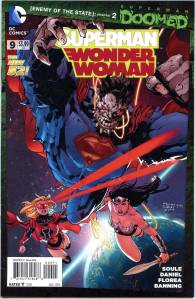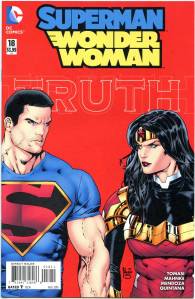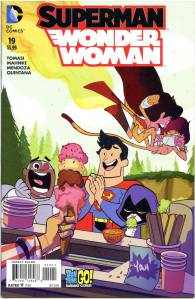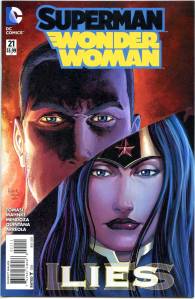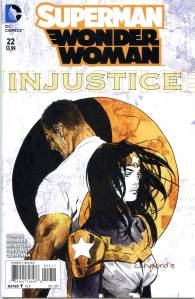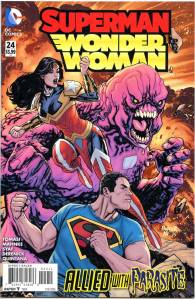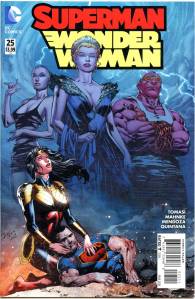
In July 2013, DC Comics announced the launch of Superman/Wonder Woman in October 2013. The series written by Charles Soule, best known for his work on Swamp Thing, and drawn by Tony Daniel (Action Comics, Detective Comics). It was to explore the budding relationship between Superman and Wonder Woman, the DC Universe‘s most powerful heroes. About the series Soule said, “Obviously, the idea of Superman and Wonder Woman being romantic with each other is not brand new. That concept has been around for a long time. It was addressed in Kingdom Come, the great Mark Waid book. Most recently, in Justice League #12 (October 2012), they had the kiss heard ’round the world… They’re arguably two of the most powerful beings in the whole DC Universe and they’re romantic together so just imagine the adventures and excitement that can come from that.”
Tag: DC
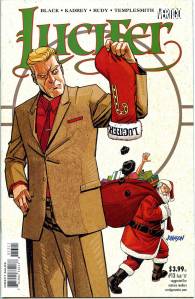
Lucifer V2 (2015)
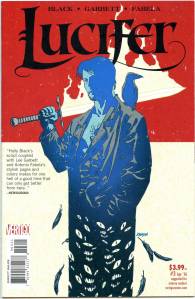
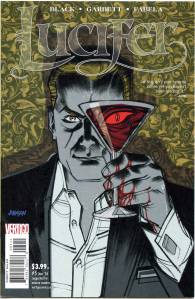
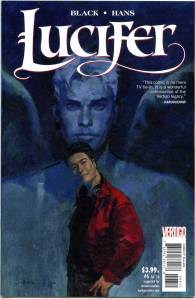
This volume continues from where Lucifer left off before New 52 (the New 52 version not being canon to this continuity). As this series begins, God is dead and Gabriel has accused Lucifer of His murder. Lucifer had motive and opportunity, but claims he can prove his innocence. If Gabriel finds the killer and takes the culprit into custody, his sins will be forgotten, and he will be welcomed back into the Silver City. Despite the fact that Lucifer has just opened a nightclub on Earth and is hiding a mysterious wound, the two brothers set off to solve their Father’s murder.
Green Lantern V5 (2011) New 52
In September 2011, The New 52 rebooted DC’s continuity. In this new timeline, DC Comics relaunched Green Lantern with a new issue #1, written again by Geoff Johns and penciled by Doug Mahnke. As with all of the books associated with the DC relaunch, Hal Jordan appears to be about five years younger than the previous incarnation of the character. Superheroes at large have appeared only in the past five years, and are viewed with at best, suspicion, and at worst, outright hostility.
DC Comics editorial confirmed that the entire history of Johns’ previous run on the Green Lantern title is still a part of the continuity of The New 52, with major storylines “Rebirth“, “Sinestro Corps War“, “Blackest Night“, and “Brightest Day” all still forming the backbone of the recent history of the characters.[60] As a result, the new volume of Green Lantern continues directly from the events of War of the Green Lanterns, with Sinestro serving as a Green Lantern and Hal Jordan beginning the series powerless on Earth.
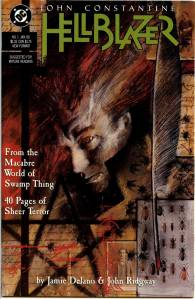
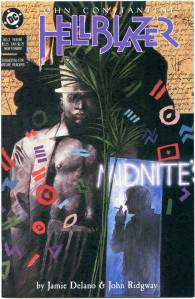
Hellblazer (1988)
After favorable reader reaction to John Constantine‘s appearances in the comic book series Swamp Thing, where he had been introduced by Alan Moore during his authorship of the title, the character was given his own comic book series in 1988. The series was intended to bear the title Hellraiser, but this title was revised before publication due to the contemporaneous release of Clive Barker‘s unrelated film of the same name. Initial writer Jamie Delano was, in his own words, “fairly ambivalent” about the change of title.
The initial creative team was writer Jamie Delano and artist John Ridgway, with Dave McKean supplying distinctive painted and collage covers. Delano introduced a political aspect to the character, about which he stated: “…generally I was interested in commenting on 1980s Britain. That was where I was living, it was shit, and I wanted to tell everybody.” The book, originally published as a regular DC Comics title, became a Vertigo title with the imprint’s launch in March 1993 (issue #63 of the series). In October 2011, it was announced that this would join DC titles in being published digitally on the same day as its physical release, starting in January 2012.
The Dark Knight Returns: The Last Crusade (2016)
Frank Miller, along with co-writer Brian Azarrello and artist John Romita Jr., revisit the gritty world of to the best-selling and genre-defining graphic novel, The Dark Knight Returns, with this time telling prequel, The Dark Knight Returns: The Last Crusade, The tale of Batman’s last adventure before his retirement and eventual return years later.
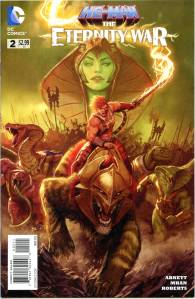
He-Man: The Eternity War (2014)
A second ongoing series, that continues from Volume two, started publishing in December 2014, and ended in February 2016, after 15 issues.
Klarion (2005)
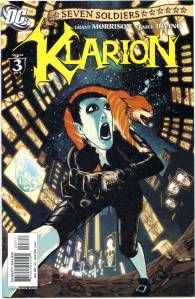
Grant Morrison is joined by artist Frazer Irving for the tale of Klarion! Deep in the bowels of a subterranean city, young dissenter Klarion has been handpicked to join the Submissionary Order, a group made up of brutal lawgivers who maintain order with the help of their familiars.
History of the DC Universe – Hardcover (1988)
History of the DC Universe is a two-issue limited series created by Marv Wolfman and George Pérez, and published by DC Comics following the end of Crisis on Infinite Earths.
History of the DC Universe was an attempt to summarize the new history of the DC Universe to establish what was canonical after Crisis reformed the multiverse into a single universe. In the original planning of Crisis on Infinite Earths, the History would have formed the final two issues, following the destruction of the Multiverse at the Beginning of Time, but this was changed. History of the DC Universe had been one of the working titles for Crisis on Infinite Earths.
The loose plotline of the series involves the character Harbinger chronicling the past, present, and future of the post-Crisis DC Universe. The history is mostly told through one- and two-page splash pages, accompanied by brief prose. At the end of the series, Harbinger places the history in a capsule and launches it into space. In the subsequent series Millennium, this history is intercepted by the Manhunters and used against Earth’s superheroes.
The series was reprinted in hardcover by Graphitti Designs in 1988 with a painted cover by Bill Sienkiewicz. It featured additional material not included in the original series including an introduction by Wolfman and the following:
- essay and Superman illustration by Neal Adams
- essay by Julius Schwartz
- essay by Jerry Siegel with Superman illustration by Joe Shuster
- essay by Bob Kane with Batman illustration by Dick Sprang
- essay and Sgt. Rock illustration by Joe Kubert
- essay by Roy Thomas with Marvel Family illustration by Kurt Schaffenberger
- essay by Paul Levitz with Legion of Super-Heroes illustration by Steve Lightle
- essay by Len Wein with Swamp Thing illustration by Stephen R. Bissette and John Totleben
- essay by Jack Kirby with New Gods illustration by Kirby and Steve Rude
- essay and Aquaman illustration by Ramona Fradon
- essay by George Pérez with Wonder Woman illustration by Trina Robbins and Pérez
- an afterword by Frank Miller
- a gatefold poster
The series was reprinted as a trade paperback in 2002. It had a new cover painting by Alex Ross but did not include the bonus material from the 1988 hardcover edition.
The Prisoner (1988)
The Prisoner: Shattered Visage is a four-issue mini-series published in 1988 and based on The Prisoner, the 1967 television series starring Patrick McGoohan. The name is a reference to Percy Shelley‘s famous poem Ozymandias, which forms part of the introduction.
Set twenty years after the final episode of the television series, Shattered Visage follows former secret agent Alice Drake as she is shipwrecked on the shores of the Village and encounters an aged, psychologically scarred Number Six. While the decades-old conflict unfolds between Six and Number Two (as played by Leo McKern in the TV series), secret agents in London have their own plans regarding the intelligence mine that is The Village, as well as the secret lying at its very core.
Batman Movie Special (1989)
The comic adaptation of the Hollywood movie by Dennis O’Neil, Jerry Ordway & Steve Oliff.