Lucifer V1 (2000’s)

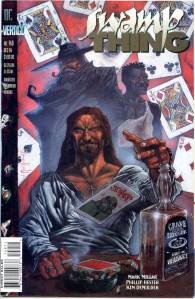
Lucifer was the main character in an eponymous series that ran for 75 issues and the Lucifer: Nirvana one-shot, from June 2000 to August 2006, the entire run of which was written by Mike Carey (this series was preceded by Carey’s work in 1999, The Sandman Presents: Lucifer mini-series). To Carey, the essence of the character was:
We play safe. Most of us do, most of the time… but Lucifer doesn’t know the meaning of safe, and he never bothers to look down at the tramlines. He goes wherever the hell he likes, picks his fights where he finds them and generally wins… following [his] own will and [his] own instincts to the very end of the line, no matter what the obstacles are star.
In the series, Lucifer runs a piano bar (an element introduced in the Sandman story “The Kindly Ones”) called “Lux” in Los Angeles, with the assistance of his mistress, Mazikeen who is a Lilim, one of the race descended from Lilith. Lucifer is portrayed as a sophisticated and charming man, in accordance with the stereotypical gentleman-devil.

DC House of Horror (2017)

An all-new, all-creepy one-shot set in the DC Universe! Martha Kent fights for her life against a creature from a spacecraft that lands in front of her farmhouse. A young woman is possessed by the spirit of a murderous Amazon warrior. The last surviving member of the Justice League faces down a horror beyond imagining. All these and more are what happens when the most exciting new voices in contemporary horror fiction are paired with the talents of some of the greatest artists in the DC firmament! And if that isn’t enough to scare you, there’s Keith Giffen, too.

Gotham by Gaslight (1989)

Gotham by Gaslight is a DC Comics one-shot by Brian Augustyn and Mike Mignola, with inks by P. Craig Russell. The story revolves around a 19th-century version of Bruce Wayne making his debut as Batman just as Jack the Ripper has arrived in Gotham City.

Although it was not initially labeled as such, Gotham by Gaslight is considered to be the first Elseworlds story in which DC Comics characters from alternate timelines or realities are featured in stories outside of the DC Universe canon. While not originally labelled as such, subsequent printings of Gotham by Gaslight have incorporated the Elseworlds logo. It spawned one sequel, Batman: Master of the Future (1991), also written by Augustyn, with art by Eduardo Barreto.

Boy Commandos (1942)

Boy Commandos spun off into their own title with a ‘Winter 1942’ date. The title sold “over a million copies each month”, and was one of DC’s “three biggest hits” alongside Superman and Batman. Jack Kirby drew around five pages a day of the title, but Jack Liebowitz requested an even faster turn-around – fearing (as happened) that the two would be drafted, as had many other industry professionals. Simon & Kirby hired “inkers, [letterers], colorists, and writers, striving to create a year’s worth of tales” (Boy Commandos was also a quarterly title until Winter, 1945). Among those hired was a young Gil Kane.

Boy Commandos ran until issue #36 (Nov/Dec 1949), and was edited throughout by Jack Schiff. Among the individuals who assisted Simon and Kirby on the title (and its covers) were future-Superman legend Curt Swan, as well as Steve Brodie, Louis Cazeneuve and Carmine Infantino.

Sensation Comics Featuring Wonder Woman (2014)

DC Comics revived the Sensation Comics series in August 2014 as a “Digital First” series featuring Wonder Woman. The print edition debuted with an October 2014 cover date. This series was cancelled in December 2015. The final issue was #17 (cover dated Feb. 2016).

Countdown to Mystery (2007)

Countdown to Mystery is an eight-issue limited series published from November 2007 to June 2008. The series is a dual feature, with two separate stories. One story focuses on Dr. Kent V. Nelson, the new Doctor Fate, while the other focuses on the actions of Eclipso, and the new SpectreCrispus Allen.

Strange Adventures (2020) – Black Label

This new science fiction epic written by bestselling author Tom King reinvents one of DC’s classic adventure characters, Adam Strange. Born on Earth and hero of the distant planet Rann, Adam Strange is famous throughout the galaxy for his bravery and honor. After leading his adopted home to victory in a great planetary war, Adam and his wife, Alanna, retire to Earth, where they are greeted with cheers, awards, and parades. But not all is as it seems, as the decisions Adam made during battles on Rann come back to haunt his family. It will take an investigation by one of the most brilliant heroes in the DC Universe, Mr. Terrific, to uncover the truth and reveal whether Adam Strange is a hero or a disgrace.

Zatanna: Come Together (1993)

A 4 part mini-series from writer Lee Marrs and illustrated by Spanish artist Esteban Maroto. The series introduced a new costume for Zatanna which she briefly wore during the 1990’s. Zatanna is constantly haunted by bad dreams of her mother, pleading for help and she wonders if the dreams have any connection with her decision to stop using magic and start living as a regular person.

Super Powers V1 (1984)

Once the line was on the market, a vigorous merchandising campaign took place, with DC Comics and Kenner striving for the Super Powers logo to become ubiquitous. DC Comics produced three comic book mini-series featuring characters from the toyline, one during each year of the toyline’s existence. The first series of comics in 1984 was plotted by Jack Kirby, who also provided covers, and went on to pencil the second series. (These two series were collected and reprinted in 2013 in The Jack Kirby Omnibus Vol. 2, in 2018 in Super Powers by Jack Kirby, and in 2019 in DC Universe: Bronze Age Omnibus by Jack Kirby). The third and final series was penciled by Carmine Infantino.

The Sandman – The Dream Hunters (2009)

In 1999, Gaiman wrote The Sandman: The Dream Hunters, a novella illustrated by Yoshitaka Amano. As in many of the single-issue stories throughout The Sandman, Morpheus appears in Dream Hunters, but only as a supporting character. In Gaiman’s afterword to the book, he describes the story as a retelling of an existing Japanese legend. There is no trace of it in the primary source he cites, and when asked, Gaiman has stated that he made up the “legend”. The novel was later adapted into a four-issue miniseries by P. Craig Russell and released by Vertigo from January 2009 to April 2009.