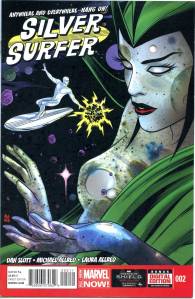
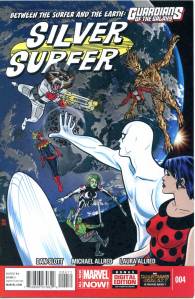
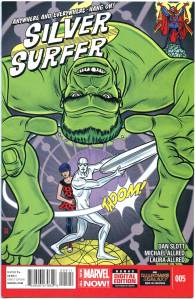
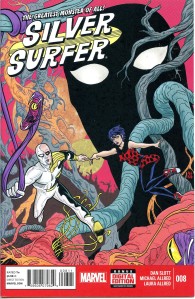
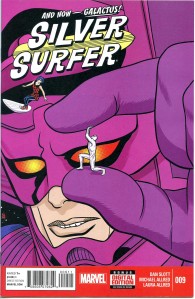
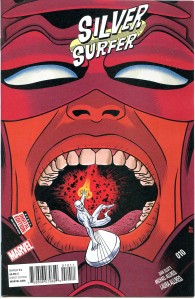
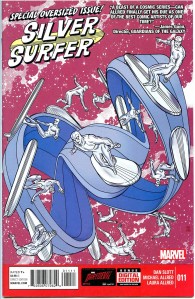
The series sees Norrin Rad severed from Galactus and free to explore the universe with a human friend named Dawn Greenwood. Slott said, “The way I look at the Surfer is that he’s the embodiment of freedom. The character has really been two things since he became the Silver Surfer. He’s been a slave to Galactus, and he’s been a prisoner of Earth, trapped beyond that great barrier. There’s something about him where, the minute you take that barrier away, and the minute you take him away from Galactus, he’s the guy with the board who can go anywhere and do anything. It really is that kind of joy and freedom like you’re 16 and you just got the keys to the car. But imagine not just driving near your home – you can go anywhere in the universe. There’s something very exciting about that.”
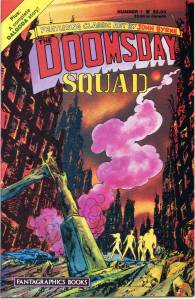
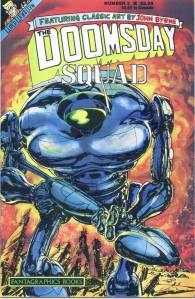
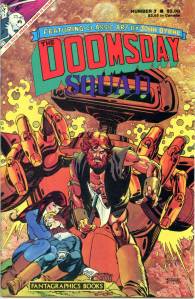
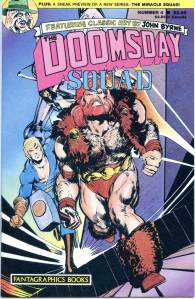
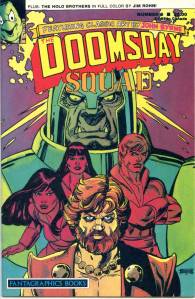
All six original Doomsday + 1 stories plus the two-part Charlton Bullseye story were reprinted as the Fantagraphics comic-book series The Doomsday Squad #1–7 (Aug. 1986 – June 1987), with new covers by Byrne (#1–2), Neal Adams (#4), and Gil Kane (the remainder). This series included a new backup feature each issue, including “Dalgoda” by writer Jan Strnad and artist Dennis Fujitake, “Keif Llama” by writer-artist Matt Howarth, “Captain Jack” by writer Mike Kazaleh and artist Marc Schirmeister as well as Usagi Yojimbo by Stan Sakai and Lloyd Llewellyn by Daniel Clowes.
Moloch, alias Edgar William Jacobi, was an ex-nemesis of the Minutemen who played a macguffin role in the original series. This story reveals engrossing information about Moloch’s childhood, his turn to villainy, and new details surrounding his death.
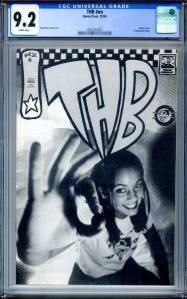
Paul Pope introduced THB in 1994, the same year he began work for Kodansha, Japan’s best-known manga publisher. Pope eventually developed the mangaSupertrouble for Kodansha, which mined the “cutie-pie” girl adventure vein that THB exists in. Pope has self-published some of his work through his own Horse Press, with other work such as One-Trick Ripoff coming from Dark Horse Comics and Heavy Liquid and 100%published under DC Comics‘ Vertigo imprint.
Pope’s work combines the precision and romance of the European artists he studies with the energy and page design of the manga tradition. His storytelling narratives continue to mature with well-paced, deftly-shaded combinations of science fiction, hardboiled crime stories and the Romeo and Juliet archetype. Pope’s two protagonist types are the silent, lanky outsider male of One-Trick Ripoff, Escapo and Heavy Liquid, or the resourceful, aggressive, humorous young teenage girls of THB.
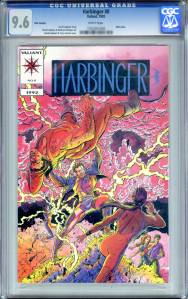
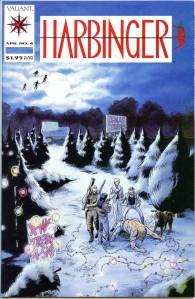
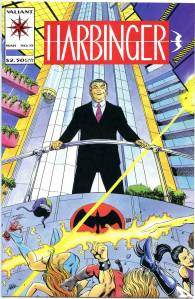
Harbinger is a series published by Valiant Comics about a group of teenage super-powered outcasts known as Harbingers.
Harbinger initially featured writing and art by Jim Shooter and David Lapham. After Acclaim Entertainment purchased the rights to the Valiant catalog for $65 million in 1994, the characters were rebooted in Harbinger: Acts of God to make them more easily adaptable to video games. They continued to appear in many Valiant titles, most prominently the Unity 2000 series. Harbinger was one of the best selling Valiant titles with total sales in all languages of over five million comics.
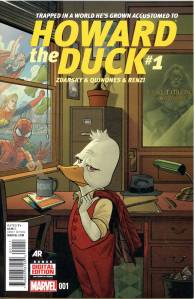
Join him as he takes on the weird cases that only a talking duck can crack as the Marvel Universe’s resident private investigator! Let Sex Criminals’ CHIP ZDARSKY (a writer known mostly as an artist) and JOE QUINONES (an artist known mostly as a lover) guide you through his new world as he takes on THE BLACK CAT and MYSTERIOUS FORCES FROM OUTER SPACE! WAUGH!
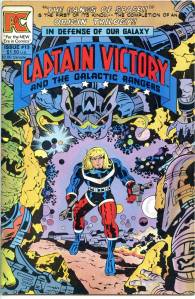
One of Pacific Comics first titles, the original run of Captain Victory and the Galactic Rangers lasted thirteen issues, plus a special, through January, 1984. All were written, illustrated, and edited by Jack Kirby.
In the last issues of the Pacific series, Kirby crafted an origin story for Captain Victory which he tied into the New Gods comic book that he had written and drawn for DC Comics in the 1970s. It was suggested that Captain Victory was the son of Orion, of the New Gods. Orion was not specifically named, but a number of clues were planted, including equipment said to belong to Captain Victory’s father that was identical to the astro-harness ridden by Orion in the earlier series. Additionally, Captain Victory’s grandfather, Blackmaas, was illustrated only as a cast shadow, but a shadow that to many readers bore a resemblance to Orion’s father, Darkseid.
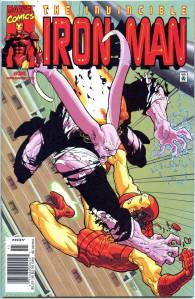
Volume 3, whose first 25 issues were written by Kurt Busiek and then by Busiek and Roger Stern, ran 89 issues (Feb. 1998 – Dec. 2004). Later writers included Joe Quesada, Frank Tieri, Mike Grell, and John Jackson Miller. Issue #41 (June 2001) was additionally numbered #386, reflecting the start of dual numbering starting from the premiere issue of volume one in 1968. The final issue was dual-numbered as #434.
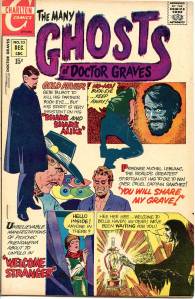
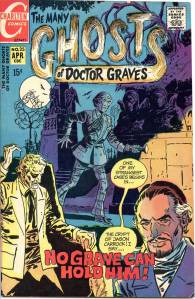
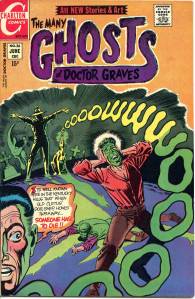
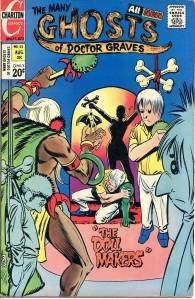
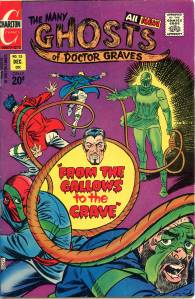
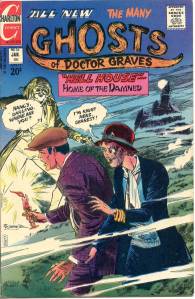
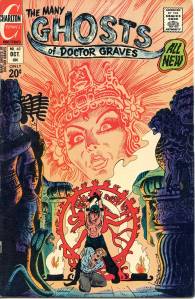
Following his introduction as Dr. M. T. Graves in Charlton Comics‘ Ghostly Tales #55 (cover-dated May 1966) in the three-page story “The Ghost Fighter” by writer-artist Ernie Bache, the character went on to host his own anthology title, The Many Ghosts of Doctor Graves. The series ran 72 issues (May 1967 – May 1982), generally published bimonthly. Following issue #60 (Jan. 1977), the title went on hiatus for seven months until issue #61 (Aug. 1977) before being canceled with #65 (May 1978). Charlton revived the title three years later with #66 (May 1981) before canceling it once more six issues later.
The Many Ghosts of Doctor Graves#54 (Dec. 1973). The cover art is among the earliest professional works of John Byrne. Three additional issues consisting solely of reprints, and titled simply Dr. Graves, were published as issues #73-75 (Sept. 1985 – Jan. 1986).
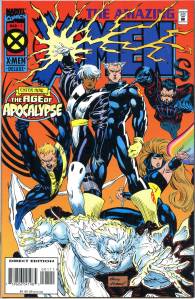
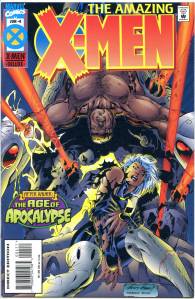
The original Amazing X-Men was a four-issue limited series that replaced X-Men during the 1995alternate universe storyline Age of Apocalypse, in which all X-titles were given new names and issue numbers. The Amazing X-Men consisted of team leader Quicksilver and Storm, Dazzler,Banshee, Iceman, and Exodus. The team is sent to Maine by Magneto to aid in the evacuation of humanity to Europe. During this mission, the team fights Apocalypse’s Brotherhood of Chaos, as well as the HorsemanAbyss, who is defeated (but not killed) by Banshee. During their absence from the Xavier Mansion, Magneto and Bishop are attacked by Apocalypse himself, who captures them both. Fulfilling their mission, Quicksilver splits up his team to help the other X-Men: sending Iceman to rendezvous with Rogue‘s team (the Astonishing X-Men) and Dazzler and Exodus to find Magneto’s son, Charles. Finally, Quicksilver, Storm, and Banshee go to rescue Bishop, who is in the hands of the Madri, Apocalypse’s priests.



















 EHT Comics