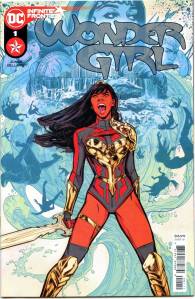
Wonder Girl (2021)

Yara Flor is the daughter of an Amazon and a Brazilian river god, who becomes the defender of Themyscira. The character debuted in January 2021 as part of DC Comic’s “Future State” storyline, in which she is shown to be the Wonder Woman of the future. In the present day DC Comics narrative, Yara is introduced as part of the Infinite Frontier publishing event. She is unaware of her Amazon heritage, but, responding to a prophecy, the Olympian Gods and the Amazons of ThemiscyraBana-Mighdall, and a third tribe in the Amazon rainforest separately begin to converge on her location as she makes a trip from the US to Brazil, the country of her birth. Queen Hippolyta sends Wonder Girl Cassie Sandsmark to protect Yara, where she encounters Artemis of Bana-Mighdall.

As an Amazon-Guarani demigoddess, Yara inherits abilities the average Amazon does not. Tara has superhuman strength, speed, reflexes, durability, agility and senses. Yara also has the ability of hydrokinesis (manipulating water), which she discovers after she gets her golden bolas. Yara also rides a white winged horse from Olympus named Jerry.

According to the character’s creator, Joëlle Jones, Yara’s appearance was inspired by the Brazilian model Suyane Moreira.
Deadpool: The Circle Chase (1993)

In 1993, Deadpool received his own miniseries, titled The Circle Chase, written by Fabian Nicieza and penciled by Joe Madureira. It was a relative success and Deadpool starred in a second, self-titled miniseries written in 1994 by Mark Waid, pencilled by Ian Churchill, and inked by Jason Temujin Minorand Bud LaRosa. Waid later commented, “Frankly, if I’d known Deadpool was such a creep when I agreed to write the mini-series, I wouldn’t have done it. Someone who hasn’t paid for their crimes presents a problem for me.”
In The Circle Chase, Deadpool must make his way through a battalion of mercenaries in Sarajevo, Yugoslavia. Little does he know that Weapon X is lying in wait to take him down!

Thundercats (2002)

Reclaiming Thundera (written by Ford Gilmore with various artists contributing), published between 2002 and 2003, formed a series of loosely connected “episodes” that saw Lion-O continue his struggle against Mumm-Ra and The Mutants.[8] A major plot point was the slow corruption of WilyKat by Mumm-Ra, which would play a major role in later storylines. After another fateful battle with Grune, Lion-O entered the Book of Omens to begin his training and claim his rightful place as Lord of the ThunderCats, but Mumm-Ra uses a powerful spell to keep Lion-O trapped in the book for several years in real time, not “Book” time, and seizes control of Thundera afterwards.

Supergirl V4 (1996)

Beginning in September 1996, DC published Supergirl (vol. 4) written by Peter David. The 1996 Supergirl comic book revamped the previous Matrix Supergirl by merging her with a human being, resulting in a new Supergirl. Many elements of the Pre-Crisis Supergirl were incorporated in new ways. The woman that the Matrix merges with has the same name as the Pre-Crisis Supergirl’s secret identity, Linda Danvers. The series is set in the town of Leesburg, named after Danvers’ pre-adoption surname. Linda’s father is named Fred Danvers, the same as the Pre-Crisis Supergirl’s adopted father. Furthermore, new versions of Dick Malverne and Comet appear as part of the supporting cast.

As the series begins, the Matrix sacrifices herself to save a dying Linda Danvers and their bodies, minds and souls merge to become an “Earth-Born Angel“, a being created when one being selflessly sacrifices him or herself to save another who is beyond saving. As the angel, Supergirl loses some of her powers, but gains others, including fiery angel wings and a “shunt” ability that allows her to teleport to any place she has been before.

Wonder Woman – V5 Rebirth (2016)

In 2016, DC Comics once again relaunched all of its publications as part of the “DC Rebirth” continuity reboot, and new fifth volume of Wonder Woman was released bi-monthly with writer Greg Rucka. This fifth volume of Wonder Woman is part of the “DC Universe”, the current continuity established after Rebirth. The new series does not use a regular storyline that exists between each issue; instead two separate storylines share the book, with an installment of one story published every other issue, and those of the other storyline published in between those. This practice began with the storyline “The Lies” for the odd numbered issues, and “Year One” for the even numbered issues. The new storyline as presented in these issues effectively retcons the events from the previous New 52 series. “The Lies” storyline reveals that a number of events from the previous Wonder Woman series in which Diana was made the Queen of the Amazons and the God of War, was in fact all an illusion created by a mysterious villain, and she had never once been back to Themyscira ever since she left, nor is she capable of returning there. The “Year One” story is presented as an all-new origin story for Diana, which reveals how she received her powers from the Olympian Gods, which was intended to bring her back to her classical DC roots. Wonder Woman appears in DC Rebirth with a revised look, which includes a red cape and light armor fittings. Along with her lasso and bracelets, she now regularly utilizes her sword and shield. Wonder Woman: Rebirth artist Liam Sharp described the new armor as a utilitarian piece which allows her to move more freely.

X-23 V4 (2018)

In July 2018, Laura to returned her to original moniker in a fourth volume of X-23 by writer Mariko Tamaki and artist Juann Cabal. Tamaki said, “This is a story about being in the very weird kind of family that someone like Laura/X-23 finds herself in. It’s about what it means to wrestle with legacy and identity when you were created to be a weapon and not someone with a birthday and a sister.”

Space Usagi SDCC Exclusive (2022)

SDCC 2022 Exclusive celebrating the 30th anniversary of Space Usagi.

Reprinting Space Usagi #1 in color for the first time.

Each cover limited to 500 copies.

Space Usagi featured characters similar to those in the original series, including a descendant of Miyamoto Usagi, but set in a futuristic setting that also emulated feudal Japan in political and stylistic ways. Three mini-series of three issues each and two short stories featuring the characters were produced.

House of M (2005)

House of M is a follow-up to the events of the “Planet X” and “Avengers Disassembled” storylines, in which the superhero Scarlet Witch suffered a mental breakdown and tried to alter the fabric of reality to recreate her lost children. Scarlet Witch’s father, Magneto, and her twin brother, Quicksilver, played major roles in the series. Like the 1995–1996 “Age of Apocalypse” storyline, “House of M” replaced the Earth-616 as the main reality for a brief time until Scarlet Witch reverted it to normal. The events of the storyline were later indicated to have occurred on Earth-58163.


Dark Avengers (2009)

The series debuted with issue #1, dated January 2009, as part of a multi-series story arc entitled “Dark Reign.” In the premiere, writer Brian Michael Bendis and artist Mike Deodato (working from a continuity begun in a previous, company-wide story arc, “Secret Invasion,” involving an infiltration of Earth by the shape-shifting alien Skrulls and that race’s eventual defeat) chronicled the aftermath of the U.S. government’s disbanding of the federally sanctioned superhero team, the Avengers. Bendis described the thinking behind the team: “These are bad-ass, hardcore get-it-done types. They’ll close the door and take care of business and he’s dressing them up to make them something that the people want. This is in contrast to the changes Norman Osborn is shown making to the Thunderbolts, where, according to writer Andy Diggle, he turns that team into “something much more covert and much more lethal: his own personal hit squad”.

The series ended with Dark Avengers #16, at the culmination of the Siege storyline.

The Thunderbolts comic book was renamed Dark Avengers beginning with issue #175, but the creative team remained unchanged. Dark Avengers ended with issue #190.

Black Flag (1994)

The setup of the series is that a para-military group called Black Flag is formed and funded by April Imoto, aka Geisha, who inherited her father’s billion dollar empire after he was executed. One of the members of Black Flag is Raiden, a master of mysticism. Using his powers, he sees a young boy in trouble, fighting to escape Hades, and a purple gorilla who was the subject of numerous experiments to make him a genius fighting machine. Raiden senses and imbalance in the universe due to these events and Black Flag rescues both of these characters and begin their adventure together as a team.