Daredevil (1964)

Daredevil debuted in Marvel ComicsDaredevil #1 (cover date April 1964), created by writer-editor Stan Lee and artist Bill Everett, with character design input from Jack Kirby, who devised Daredevil’s billy club. When Everett turned in his first-issue pencils extremely late, Marvel production manager Sol Brodsky and Spider-Man co-creator Steve Ditko inked a large variety of different backgrounds, a “lot of backgrounds and secondary figures on the fly and cobbled the cover and the splash page together from Kirby’s original concept drawing”.

Writer and comics historian Mark Evanier has concluded (but cannot confirm) that Kirby designed the basic image of Daredevil’s costume, though Everett modified it. The character’s original costume design was a combination of black, yellow, and red, reminiscent of acrobat tights. Wally Wood, known for his 1950s EC Comics stories, penciled and inked issues #5–10, introducing Daredevil’s modern red costume in issue #7.

The Dark Tower: The Gunslinger Born (2007)

The Gunslinger Born is an expansion and interpretation of events covered in The Dark Tower series, beginning with Roland Deschain‘s manhood test against Cort and ending with the last events of the flashback sequences in Wizard and Glass. Later arcs will “cover the time period between Roland leaving Hambry and the fall of Gilead“. The Gunslinger Born is followed by The Long Road Home, whose first issue was released on March 5, 2008.

Elektra: Black, White and Blood (2021)

It’s an undisputed fact: Elektra Natchios is the best assassin in the Marvel Universe! And a murderers’ row of all-star Marvel creators are here to present the proof, in glorious black and white…with lashings of blood! Trained by both the vicious Hand and the benevolent Chaste, Elektra walks the line between good and evil — with style! And now, a dozen astonishing tales set throughout her long and lethal life illustrate her fighting skills, ninja training and sheer determination! Prepare to see Elektra in a whole new light…

Where Monsters Dwell (1970)

One of Marvel’s revival Horror and Monster comics. It lasted for 38 issues, making it one of the longest running Monster Mags from Marvel in the 1970’s. The series contains stories from many comic legends including Jack Kirby, Steve Ditko, Gil Kane and Bernie Wrightson. Issues #6 contains a reprint of  Tales to Astonish #13, which is the 1st appearance of Groot from Guardians of the Galaxy.

Silver Surfer: Black (2019)

In 2019, a 5 part mini-series titled Silver Surfer: Black was released featuring art from Tradd Moore in collaboration with writing from Donny Cates. The series is an extension of a Guardians of the Galaxy storyline which the Surfer was sucked into a black hole and ejected into unfamiliar space territory. This run follows the Surfer as he traverses the spaceways on a journey back home.

Weirdworld (2015)

As part of the 2015 Secret Wars storyline, a series titled Weirdworld starring Arkon was released in June 2015 which featured other characters like Morgan le Fay of Earth-15238, Skull the Slayer, a variation of Jennifer Kale from Earth-11234 that is the Queen of Weirdworld’s Man-Things, and characters from The Saga of Crystar. Weirdworld is featured on the map of the storyline’s version of Battleworld as a floating island composed of fragments from many alternate reality magical realms like Polemachus, Crystalium, Klarn, and the original Weirdworld. By the end of the miniseries, Weirdworld manifested on Earth-616 in the Bermuda Triangle.

Incredible Hulk V1 (1990’s)

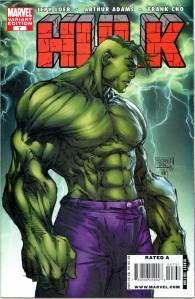
The 1990s saw the Green Hulk return. In issue #377 (Jan. 1991), the Hulk was revamped in a storyline that saw the personalities of Banner, Grey Hulk, and Savage Hulk confront Banner’s past abuse at the hands of his father Brian and a new “Guilt Hulk” persona. Overcoming the trauma, the intelligent Banner, cunning Grey Hulk, and powerful Savage Hulk personalities merge into a new single entity possessing the traits of all three. The Hulk also joined the Pantheon, a secretive organization of superpowered individuals. His tenure with the organization brought the Hulk into conflict with a tyrannical alternate future version of himself called the Maestro in the 1993 Future Imperfect miniseries, who rules over a world where many heroes are dead.

Conan (1970)

Marvel Comics introduced a fairly faithful version of Conan in 1970 with Conan the Barbarian, written by Roy Thomas with art initially by Barry Windsor-Smith, then John Buscema and Ernie Chan (aka Ernie Chua). The highly successful Conan the Barbarian series spawned the more adult, black-and-white Savage Sword of Conan in 1974, by Thomas, Buscema, and Alfredo AlcalaSavage Sword of Conan soon became one of the most popular comic series in the 1970s.

The Marvel Conan stories were also adapted as a newspaper comic strip which appeared daily and Sunday from September 4, 1978, to April 12, 1981. Originally written by Roy Thomas and illustrated by John Buscema, the strip was continued by several different Marvel artists and writers.

The Incredible Hulk V1 (1968)

The Hulk first appeared in The Incredible Hulk #1 (cover dated May 1962), written by writer-editor Stan Lee, penciled and co-plotted by Jack Kirby, and inked by Paul Reinman. Lee cites influence from Frankenstein and Dr. Jekyll and Mr. Hyde in the Hulk’s creation. The Hulk’s original series was canceled with issue #6 (March 1963).

In the debut, Lee chose gray for the Hulk because he wanted a color that did not suggest any particular ethnic group. Colorist Stan Goldberg, however, had problems with the gray coloring, resulting in different shades of grey, and even green, in the issue. After seeing the first published issue, Lee chose to change the skin color to green. Green was used in retellings of the origin, with even reprints of the original story being recolored for the next two decades, until The Incredible Hulk vol. 2, #302 (December 1984) reintroduced the gray Hulk in flashbacks set close to the origin story. Since then, reprints of the first issue have displayed the original gray coloring, with the fictional canon specifying that the Hulk’s skin had initially been grey. An exception is the early trade paperback, Origins of Marvel Comics, from 1974, which explains the difficulties in keeping the gray color consistent in a Stan Lee written prologue, and reprints the origin story keeping the gray coloration.

Lee gave the Hulk’s alter ego the alliterative name Bruce Banner because he found he had less difficulty remembering alliterative names. Despite this, in later stories he misremembered the character’s name and referred to him as “Bob Banner”, an error which readers quickly picked up on. The discrepancy was resolved by giving the character the official full name of Robert Bruce Banner.

The Stand (2008)

based on Stephen King’s 1978 novel of the same name. Based on the 1990 Complete & Uncut version of the novel, the comic adaptation was written by Roberto Aguirre-Sacasa with art by Mike Perkins and Laura Martin. Its thirty-one issues, divided into six story arcs, completed the telling of the unabridged novel. Stephen King served as Creative and Executive Director of the project.