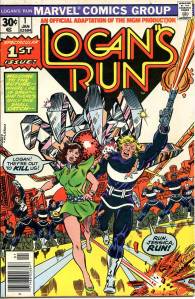
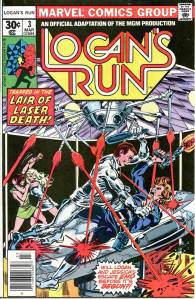
Marvel Comics published Logan’s Run in 1977, with George Pérez drawing five issues between January and May 1977, with “acceptable” sales. The comics adapted the film’s story in five issues and briefly continued beyond. In his art, Pérez sought to follow the art direction of the film. The book was cancelled after issue #7 in July 1977.
In February 2005, Marvel published a further six issues of What If. They were all in the “one-shot” format. The editor, Justin Gabrie, attributed the publication of Volume 3 to a suggestion from C. B. Cebulski. Uatu the Watcher narrates some issues and there is a cameo by Brian Michael Bendis as narrator (see “The narrator” above). In Volume 3, there is a “nod” to a Volume 1 story, What if Uncle Ben had lived? In a conversation between a comic shop customer and an attendant, the customer asks,”What if Aunt May had died instead of Uncle Ben?” Leading to another alternative plot. Marvel published a single parody edition called Wha… Huh?!? in August 2005.
The team is seen living a fairly peaceful life in the Battlezone called Westchester. The baron of this region is Senator Kelly. He has little difficulty since most of the villains were wiped out in a previous war and the remaining villains were sent to “Bureau of Super-Powers” run by Cassandra Nova for rehabilitation. After a rogue Sentinel attack the X-Men are invited to the facility to learn about process. The X-Men are then put into the virtual training pods, but were really sent into the Astral Plane, since Nova was actually possessed by the Shadow King. The team is saved by Jubilee, who Nova didn’t consider a big enough threat and didn’t put into the VR pod and by the X-Force, who assault the facility. Xavier is able to repel the Shadow King and the X-Men save Baron Kelly, but a mega-Sentinel is released against the X-Mansion. The X-Men and X-Force combine to defeat the machine before it causes too much damage.
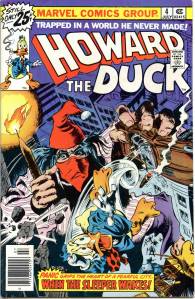
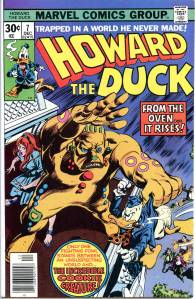
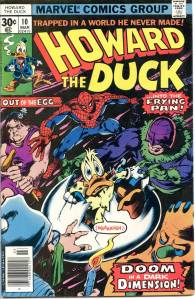
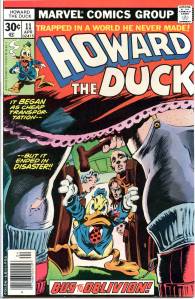
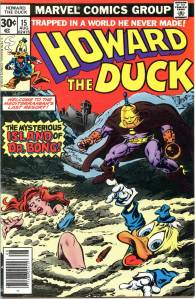
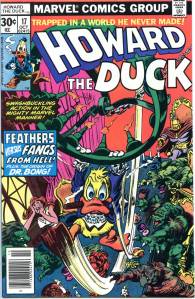
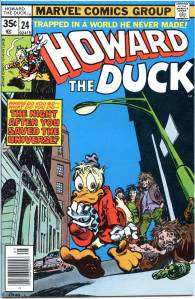
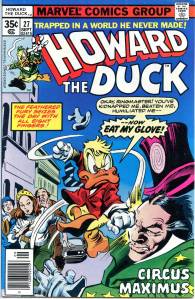
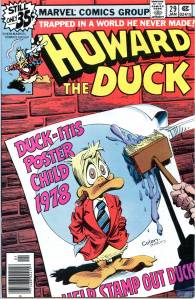
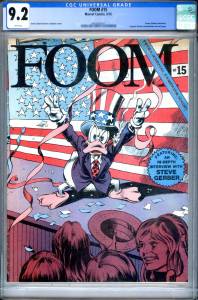
Howard the Duck, was created by Steve Gerber and artist Val Mayerik. The character first appeared in Adventure into Fear #19 (Dec. 1973). He graduated to his own backup feature in Giant-Size Man-Thing, confronting such bizarre horror-parody characters as Hellcow and the Man-Frog, before acquiring his own comic book title with Howard the Duck #1 in 1976.
Larry Hama returns with a story set before his original run on Wolverine! The mutant known as Logan has made a name for himself on the mysterious island of Madripoor, where the locals know him as Patch. From their haunt at the Princess Bar, what starts as a simple recon mission lands Patch and Archie knee-deep in a paramilitary struggle that will surface some surprise revelations and characters!
Loki has now claimed leadership of Asgard, and all must recognize that fact, even Thor. Finally winning the throne after a long sought out fight is not as sweet as he thought it would be. The ones that helped him now demand their due and the favors he promised them, including the death goddess Hela and seductress Lorelei. While he goes about his kingdom, he continually turns to his prisoners, Thor and Sif. Sif berates him for being jealous of her, and of cutting off her golden hair, only to bring about a greater love between her and Thor. While Balder reminds him that he has died and gone to Hel, while there, sees that there are parallel dimension incarnations of Thor, Loki, and Balder: Some different, yet all play the same roles. And Loki’s role is never to rule. Loki then turns to Karnilla, and agrees to free Balder into her care, in exchange for her to peer into a myriad other dimensions. There he sees confirmation of Balder’s words, all with Thor triumphant. Loki decides that Thor will indeed die at dawn by beheading. As he’s walking out of the dungeons, he runs into Fárbauti, his birth father. Loki decides to go against fate, and spare his brother as well as free him and Hela is revealed to be a failed illusion cast by Loki to convince him to kill his brother. Thor decides that when breaking free from his prison, he defeats his brother.
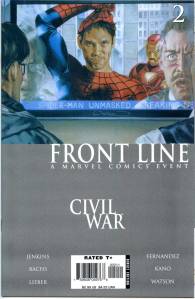
Part of the story is told from the perspective of two reporters embedded in the opposite camps of the war.Ben Urich follows the stories on Iron Man‘s side with the pro-registration heroes, while Sally Floyd investigates the anti-registration faction headed by Captain America. Writer Paul Jenkins was given carte blanche to have the stories reflect the current political landscape in the United States.
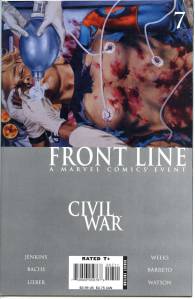
The other half of the series is told from the perspective of Speedball of the New Warriors. It shows Speedball’s struggles with survivor guilt, imprisonment, and relations to the victims of the Stamford disaster.
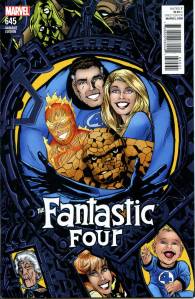
In the storyline “Three”, which concluded in Fantastic Four #587 (cover date March 2011, published January 26, 2011), the Human Torch appears to die stopping a horde of monsters from the other-dimensional Negative Zone. The series ended with the following issue, #588, and relaunched in March 2011 as simply FF. The relaunch saw the team assume a new name, the Future Foundation, adopt new black-and-white costumes, and accept longtime ally Spider-Man as a member. In October 2011, with the publication of FF #11 (cover-dated Dec. 2011), the Fantastic Four series reached its 599th issue.
In November 2011, to commemorate the 50th anniversary of the Fantastic Four and of Marvel Comics, the company published the 100-page Fantastic Four #600 (cover-dated Jan. 2012), which returned the title to its original numbering and featured the return of the Human Torch. It revealed the fate of the character of Johnny Storm after issue #587, showing that while he did in fact die, he was resurrected to fight as a gladiator for the entertainment of Annihilus. Storm later formed a resistance force called Light Brigade and defeated Annihilus.
As part of Marvel NOW!Fantastic Four ended with #611, ending Jonathan Hickman’s long run on FF titles, and the title was relaunched in November 2012 with the creative team of writer Matt Fraction and artist Mark Bagley. In the new title with its numbering starting at #1, the entire Fantastic Four family explore space together, with the hidden intent for Reed Richards to discover why his powers are fading.
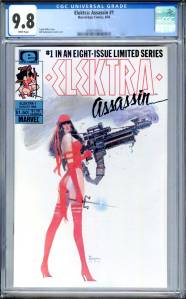
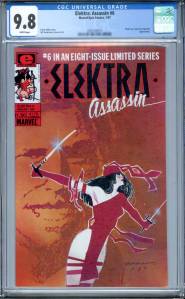
As with Daredevil: Love and War, Sienkiewicz illustrated Elektra: Assassin using watercolors as opposed to the traditional pencilling/inking method. His exaggerated art was unique amongst mainstream comics of the time, bringing to mind the illustration style of adult-oriented comics magazines like Heavy Metal.
Jim Steranko, in his first-issue introduction, wrote that he had “dropped in at the Marvel bullpen to rap with [publisher] Stan Lee about the current comic scene” and that Lee told him about plans to start an in-house fan club. EC Comics had had its “EC Fan-Addict” club in the 1950s, and Marvel the Merry Marvel Marching Society beginning 1964; after the MMMS had run its course by 1969, Marvel licensed a small company in Culver City, California to produce the fanzine/product catalog Marvelmania, which lasted a year. Steranko, writing that he nostalgically “recalled the days of radio, with all the clubs and super-premiums that were perpetually offered over the air”, volunteered “my services as a designer, writer and comic historian”. Ken Bruzenak served as associate editor, with Marvel editor-in-chief Roy Thomas as consulting editor and Ed Noonchester, Joel Thingvall, and Gary Brown as staff.