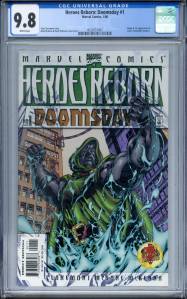
In the years after the Heroes Reborn event, Marvel published a series of one-shots that revisit the pocket universe created by Franklin Richards. These can be read in any order and even touch on some characters who were not featured in the original storyline.
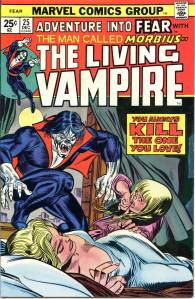
Morbius, the Living Vampire, introduced in The Amazing Spider-Man #101 (Oct. 1971), became the starring feature with Adventure into Fear #20 (Feb. 1974), and continued through the rest of the run. After a single issue by writer Mike Friedrich and penciler Paul Gulacy, Steve Gerber wrote several issues in which Morbius went on a picaresque interdimensional journey and fought the Caretakers of Arcturus and was advised by the eyeball-headed character I. Doug Moench and Bill Mantlo followed, successively, as the feature’s writers. Its round-robin of artists included Gil Kane, P. Craig Russell, Frank Robbins, George Evans, and Don Heck. Back up reprints shortly resumed in issue #20. Morbius would receive his own short-lived comic-book series in the 1990s.
Avengers A.I. was an ongoingcomic book series published by Marvel Comics that was released in July 2013, as part of the company’s Marvel NOW! initiative. The series takes place after the events of Age of Ultron, where the world has been colonized by A.I.s “who may or may not have positive feelings about the way humanity has been treating them for the past 100 years.” The series ended in April 2014.
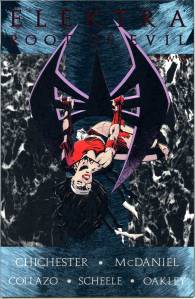
Created by Frank Miller, Elektra first appeared in Daredevil #168 (January 1981). Miller originally intended this issue, which was essentially a filler story, to be Elektra’s only appearance, but she instead became a frequently appearing villain in Daredevil until her death in issue #181 (April 1982). She was resurrected shortly after, but the story contained a narrative note which indicated that Daredevil would never encounter her again.
After over a decade’s absence, she reappeared in Daredevil #324-327 (January–April 1994), and went on to a brief stint as a supporting character in Wolverine (in #100-106). Daredevil writer D. G. Chichester recounted that he and editor Ralph Macchio had
bandied about the idea [of bringing back Elektra] in a casual fashion now and again, but neither of us wanted to do it as a gimmick. On the rare occasion I thought I had a legitimate angle to use her, Ralph was cool to the idea. But as we geared up for what would become Fall From Grace, Ralph out of the blue said, “What about bringing back Elektra?” — and it was really the missing piece that clicked together all the loose pieces of the story in my head, and became the nexus for everything tying together as well as it did. In my mind, it’s always been her to whom the title refers.
This upset Frank Miller, who claimed that Marvel had previously promised him that the character would not be used in any publication.She has since appeared in two eponymous ongoing series and several mini-series.
Every thousand years, Dracula enters a chrysalis state for four days, leaving him in a vulnerable state. During this time the most powerful vampires from around the world gather in Transylvania to protect him. Now they are about to be joined by an eclectic team of vampire slayers that have gathered to take down the legendary Vampire King – including the best and most dangerous slayer of them all – Blade!
This film adaptation includes one possible explanation of the title’s significance in story context: the narrative line, “Blade runner. You’re always movin’ on the edge.”
This was a reprint of issue 22 of the Marvel Comics Super Special series of titles, which by this time only printed Marvel’s movie adaptations, but without the feature content contained in the special.
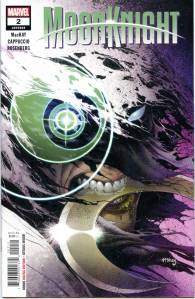
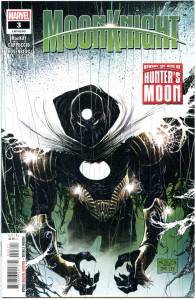
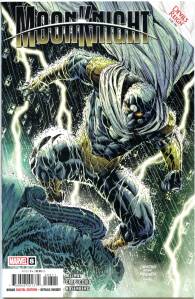
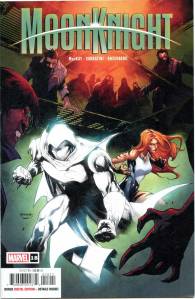
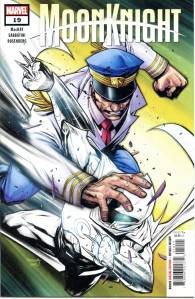
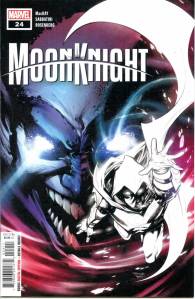
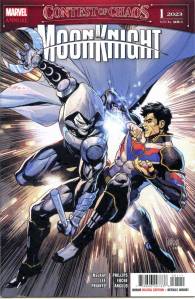
In 2021, the series Moon Knight vol. 10 launched under writer Jed MacKay, and artists Alessandro Capuccio and Rachelle Rosenberg. The new series has Marc Spector not only acting as the crimefighter Moon Knight but also (despite his Jewish background) adopting the role of high priest of “the Midnight Mission,” a congregation dedicated to Khonshu. In discussing his connection to Khonshu, Marc Spector now describes his four aspects as “the traveler”, “the pathfinder”, “the embracer”, “the defender of those who travel at night.” Once again, Marc Spector is depicted as being in regular therapy with a psychologist in order to help manage his psychological issues. The series also offers that Marc Spector may be immortal, as he has now been literally resurrected on multiple occasions and could be resurrected again in the future.
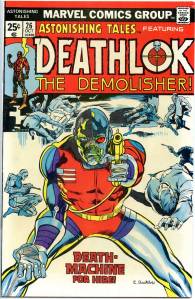
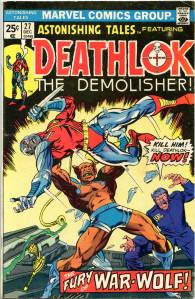
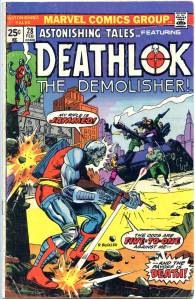
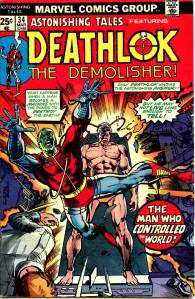
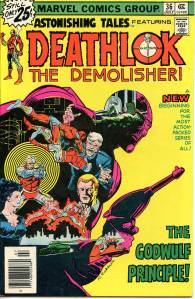
The final feature in Astonishing Tales starred and introduced Deathlok, a conflicted cyborg who predated the popular movie character RoboCop by several years and has become one of the most enduring Marvel characters among those introduced in the 1970s; at least two major iterations of the character, featuring different individuals, starred in series in the 1990s and 2000s. Created by artist Rich Buckler, who devised the initial concept, and writer Doug Moench, the feature ran from #25-28 and 30-36 (Aug. 1974 – Feb. 1975 and June 1975 – July 1976), the final issue. Bill Mantlo scripted issues #32-35, with Buckler himself scripting the finale. Buckler described Deathlok as “an extension of a paranoid fantasy. He was a representation of part of my outlook and world view. He was a culmination of many of the messages in some of the music of the time. He was part of some of the things going wrong in our country at the time. Maybe he was the science that was going wrong.Artist George Pérez made his professional comics debut with a two-page backup feature in issue #25.
Victor Von Doom – scientist, sorcerer, disfigured face, twisted soul – has been spending much of his time warning against a trillion-dollar global effort to create the first “artificial” black hole. Wrestling with visions of an entirely different life…a better future…DOCTOR DOOM finds himself at a crossroads. (what is he questioning?) A catastrophic act of terrorism kills thousands, and the prime suspect is… DOOM? Victor will have to push his unexplained thoughts aside and focus on remaining alive as the title of “Most Wanted Man” is thrust upon him….
Left with no homeland, no armies, no allies, indeed, nothing at all, will the reign of Doctor Doom come to an abrupt halt?
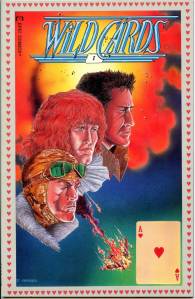
Wild Cards is a four-part comic book series covering events in the Wild Cards anthology. It recounts events previously published in print in novel format, and ties them all together in a story pitting Jay Ackroyd against the machinations of a mystery bomber.
First published in 1990 by Marvel Comics under the Epic Comics imprint Wild Cards ran from September to December of 1990.














 EHT Comics