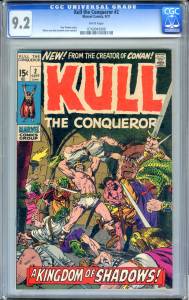
Kull has been adapted to comics by Marvel Comics with three series between 1971 and 1985. The first was drawn by Marie Severin and her brother John Severin. He also appeared several times in The Savage Sword of Conan series and other anthology books. Another graphic novel, Kull: The Vale of Shadow, was published in 1989.
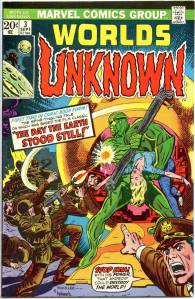
Worlds Unknown ran eight issues, cover-dated May 1973 to August 1974. The title was one of four launched by Marvel Comics editor-in-chief Roy Thomas to form a line of science fiction and horroranthologies with more thematic cohesiveness than the company’s earlier attempts that decade, which had included such series as Chamber of Darkness and Tower of Shadows. Whereas those titles generally presented original stories, these new books would instead adapt genre classics and other works.
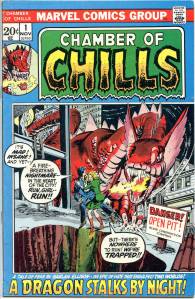
The title was one of four launched by Marvel Comics editor-in-chief Roy Thomas to form a line of science fiction and horror anthologies with more thematic cohesiveness than the company’s earlier attempts that decade, which had included such series as Chamber of Darkness and Tower of Shadows. Whereas those titles generally presented original stories, these new books would instead adapt genre classics and other works.
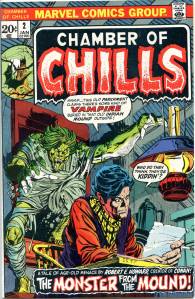
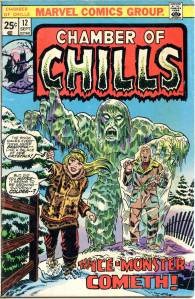
With the four titles’ debuts set to be staggered over the course of four months, Marvel premiered Journey into Mystery vol. 2 (Oct. 1972),Chamber of Chills (Nov. 1972), Supernatural Thrillers (Dec. 1972), and, with a late start, Worlds Unknown (May 1973). The first issue features an original six-page story by science fiction novelist George Alec Effinger, “Moon of Madness, Moon of Fear”, penciled by P. Craig Russell (then credited as Craig Russell), and a slightly retitled adaptation of the Harlan Ellison short story “Delusions for a Dragon Slayer”, by writer Gerry Conway and artist Syd Shores; in-between was a story by writer Stan Lee and artist Russ Heath, “They Wait in Their … Dungeon”, reprinted from Menace #1 (March 1953), from Marvel’s 1950s forerunner, Atlas Comics.
The bimonthly series ran exclusively new material through issue #4, with one reprinted story added to the mix for the following two issues, and only one new story in issue #7, after which the series became all-reprint. Most of the reprinted stories were 1950s “pre-Code” horror stories, which the industry self-censorship organization the Comics Code Authority had forbidden on Code-approved comics until a loosening of the Code in 1971.
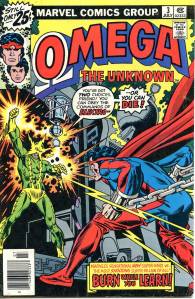
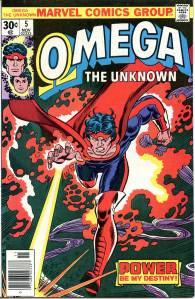
Omega the Unknown was published by Marvel Comics from 1976 to 1977, featuring the eponymous fictional character. The series, written by Steve Gerber and Mary Skrenes and illustrated by Jim Mooney, ran for 10 issues before cancellation for low sales. Despite its short run, it has remained as a cult classic due to its intriguing characters and unusual storytelling. A 10-issue series revamping the character was published from 2007 to 2008, written by novelist Jonathan Lethem and illustrated by Farel Dalrymple.
The series began by introducing Shang-Chi as a man raised by his father Fu Manchu to be the ultimate assassin for the would-be world conqueror. In Shang-Chi’s first mission, he kills one of his father’s old enemies, Dr. Petrie, and learns of Fu Manchu’s true, evil nature. Disillusioned, Shang-Chi swears eternal opposition to his father’s ambitions and fights him as an agent of British intelligence, under the orders of Sir Denis Nayland Smith.
The series was an instant sales success. However, Englehart and Starlin would depart the series after their third issue, Master of Kung Fu # 17; Englehart over editorial disputes with then Marvel editor Roy Thomas while Starlin, who was unfamiliar with Fu Manchu up until working on the second issue of the series, left out of embarrassment over the racist nature of the Rohmer novels. Despite the title’s co-creators’ early departure, its success grew once writer Doug Moench and artist Paul Gulacy, began collaborating in issues #22. Comics historian Les Daniels observed that “Ingenious writing by Doug Moench and energetic art by Paul Gulacy brought Master of Kung Fu new life.” Their critically acclaimed run continued, with short gaps, until #51 when Gulacy was replaced by artist Jim Craig. Craig was later succeeded by Mike Zeck who became the regular penciller in issue #64 (1978).
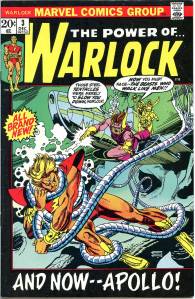
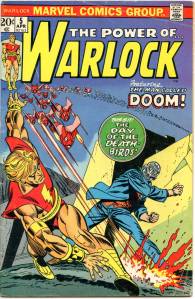
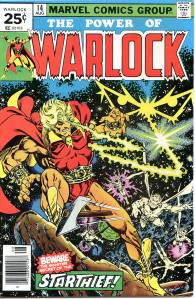
In 2009, Thomas explained he had been a fan of the soundtrack to the musical Jesus Christ Superstar and sought to bring the story to comic books in a superhero context: “Yes, I had some trepidation about the Christ parallels, but I hoped there would be little outcry if I handled it tastefully, since I was not really making any serious statement on religion… at least not overtly.” Choosing to use a preexisting character while keeping the series locale separate from mainstream Marvel Earth, he created Counter-Earth, a new planet generated from a chunk of Earth and set in orbit on the opposite side of the sun. Thomas and Kane collaborated on the costume, with the red tunic and golden lightning bolt as their homage to Fawcett Comics‘ 1940s-1950s character Captain Marvel. The story continued in the series The Power of Warlock, which ran eight issues (Aug. 1972 – Oct. 1973)
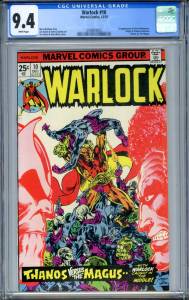
Writer-artist Jim Starlin revived Warlock in Strange Tales #178-181 (Feb.-Aug. 1975). Warlock’s adventures became more cosmic in scope as Starlin took the character through an extended storyline referred to as “The Magus Saga.”
The reimagined title continued the numbering of The Power of Warlock and began with Warlock #9 (Oct. 1975) and ran seven issues. The bimonthly series was initially written and drawn by Starlin, but was eventually co-penciled and inked by Steve Leialoha.
The Dark Crystal was adapted into comic book form by Marvel Comics. It debuted as a 68 page adaptation in Marvel Super Special #24, in 1982. The story was later re-printed in two issues in April and May, 1983.
This was the first of three Marvel adaptations of Jim Henson movies; it was followed by The Muppets Take Manhattan in 1984, and Labyrinth in 1986.
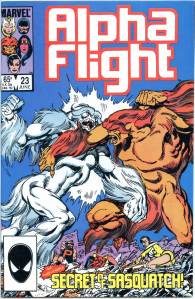
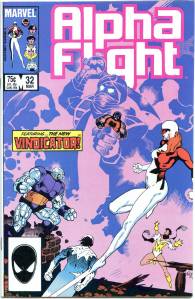
Most team members have distinctly Canadian attributes, such as having Inuit/First Nations or French heritage. Throughout most of its history, the team has worked for Department H, a fictional branch of Canada’s Department of National Defence that deals with super-powered villains.
The team was originally merely a part of the backstory of the X-Men‘s Wolverine but, in 1983, Marvel launched an eponymous series featuring the group, which continued until 1994, lasting 130 issues as well as annuals and miniseries.
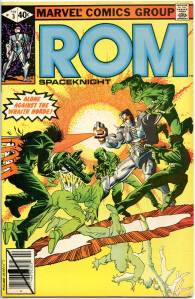
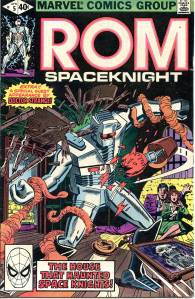
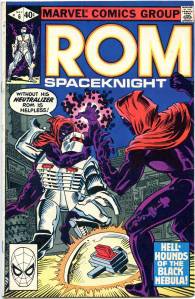
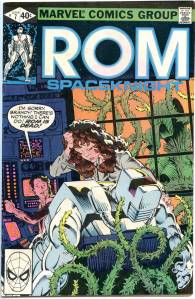
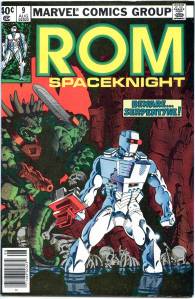
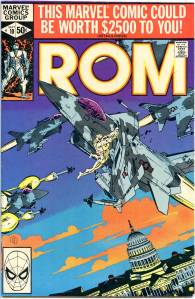
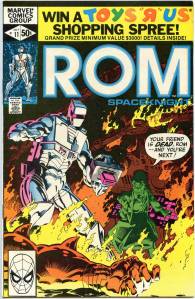
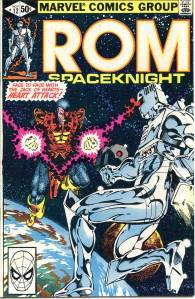
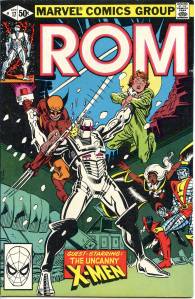
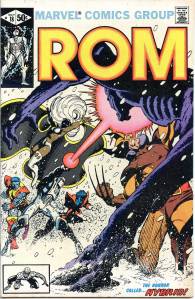
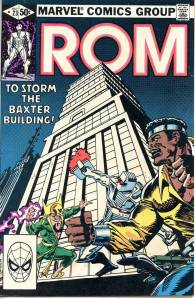
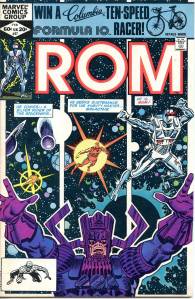
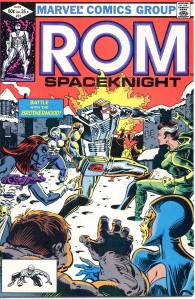
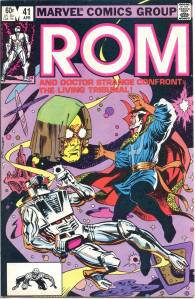
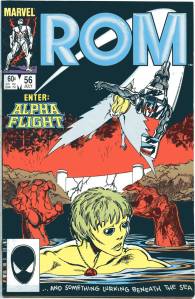
To build interest in the ROM toy, Parker Brothers licensed the character to Marvel Comics, which created a comic book featuring Rom. The comic expanded on the premise that Rom was a cyborg and gave him an origin, personality, set of supporting characters and villains, as well as interaction within the Marvel Universe. The comic was written by Bill Mantlo and initially illustrated by artist Sal Buscema. Buscema stated in a 2010 interview, “I liked the character. And I liked what they did with it. I thought the concept was quite good. It was unique. It made it attractive to do. I almost hate to say this, but it was pretty easy to draw, too.” Buscema was the main artist for the series from its creation through 1984. Steve Ditko took over for the final two years of the original run.
Ultimately, the toy failed and only sold 200,000 to 300,000 units in the US, with creator McCoy blaming the failure on poor packaging and marketing. Parker Brothers subsequently abandoned the line.
The comic book outlasted the toy which it was created to support. The series lasted for 75 issues (not including the four annual issues) from December 1979 to February 1986. Rom’s regular encounters with mainstream heroes and villains established him as part of Marvel continuity.




















 EHT Comics