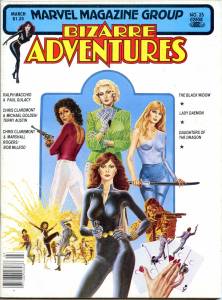
With #25 (March 1981) the title Marvel Preview was changed to Bizarre Adventures, which ran for an additional ten issues before ceasing publication. To offset the dark tone of most of the stories, editor Denny O’Neil had writer Steve Skeates produce a humor feature called Bucky Bizarre to close out each issue. A story originally prepared for Marvel’s Logan’s Run comic book series was published in Bizarre Adventures #28 (Oct. 1981). The final issue, #34, was a standard-sized color comic book, featuring the cover-blurb, “Special Hate the Holidays Issue”, with anthological Christmas-related stories, including one starring Howard the Duck.
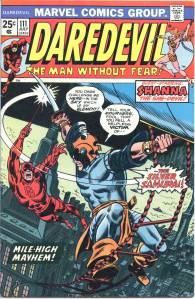
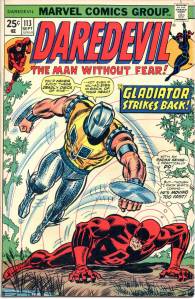
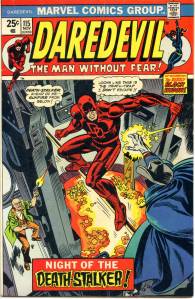
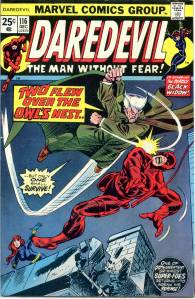
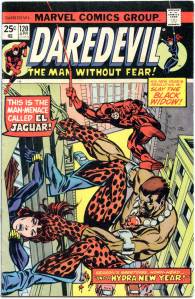
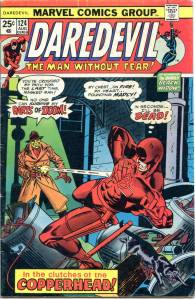
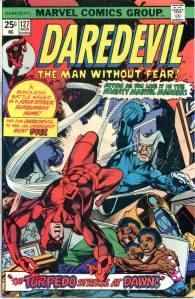
Gerry Conway took over as writer with issue #72, and turned the series in a pulp science fiction direction: a lengthy story arc centered on a robot from thousands of years in the future trying to change history. Even long-standing arch-villain the Owl was outfitted with futuristic weaponry and vehicles. Conway also moved Daredevil to San Francisco beginning with Daredevil #86, and simultaneously brought on the Black Widow as a co-star for the series. The Black Widow served as Daredevil’s crime-fighting ally as well as his love interest from issue #81–124 (Nov. 1971–Aug. 1975), of which #93-108 were titled Daredevil and the Black Widow.
In a story arc overlapping Wolfman, Shooter, and McKenzie’s runs on the series, Daredevil reveals his identity to Heather Glenn and becomes partially responsible for the suicide of her father; their relationship would persist but would prove increasingly harmful to both of them. Though the Black Widow returned for a dozen issues (#155–166) and attempted to rekindle her romance with Daredevil, he ultimately rejects her in favor of Glenn.
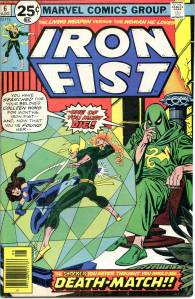
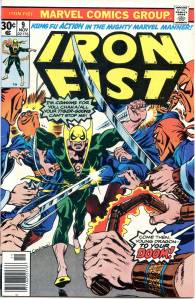
Iron Fist was spun off from Marvel Premiere into the solo series Iron Fist, which ran 15 issues (November 1975 – September 1977). The solo series was written by Claremont and pencilled by Byrne. A subplot involving the Steel Serpent left unresolved by the cancellation of the series was wrapped up in issues #63–64 of Marvel Team-Up, the latter of which featured Rand kiss Misty Knight, marking the first interracial kiss and first long-term interracial couple in Marvel Comics history, as well as the first couple with an age difference in which the woman was older than her man.
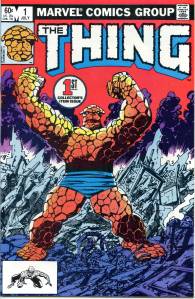
The cancellation of Marvel Two-in-One led to the Thing’s first completely solo series, which ran for 36 issues. The Thing was originally written by John Byrne and later, Mike Carlin. The series also featured art by Ron Wilson and later by Paul Neary. It elaborated on Ben Grimm’s poor childhood on Yancy Street in its early issues, and chronicled the Thing’s later foray into the world of professional wrestling. It also featured a major storyline offshoot from Marvel’s Secret Wars event, in which the Thing elects to remain on the Beyonder‘s Battleworld after discovering that the planet enables him to return to human form at will. A full third of the series’ stories take place on Battleworld.
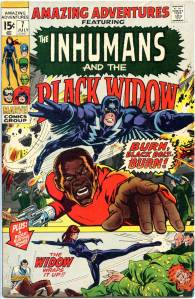
Amazing Adventures was a split title featuring the Inhumans (initially both written and drawn by Jack Kirby, later drawn by Neal Adams) and the Black Widow (initially by writer Gary Friedrich and pencilerJohn Buscema). The Widow was dropped after vol. 2, #8, and full-length Inhumans stories ran for two issues before that feature, too, was dropped.
Vol. 2, #11 (March 1972) introduced solo stories of erstwhile X-Men member the Beast, in which he was mutated into his modern-day blue-furred (originally grey-furred) form. The initial story was by writer Gerry Conway, penciler Tom Sutton, and inkerSyd Shores. Steve Englehart became the feature’s writer with issue #12 and added Patsy Walker and her then-husband, “Buzz” Baxter, to the Beast’s supporting cast in issue #13.
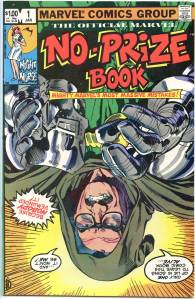
In late 1982 (cover dated January 1983), Marvel published a humorous one-shot comic featuring some of their most notorious goofs. Subtitled “Mighty Marvel’s Most Massive Mistakes”, the book was organized and spearheaded by Jim Owsley and had a cover which was deliberately printed upside-down. In the comic’s story Lee, with the help of artists Bob Camp and Vince Colletta, exposes and pokes fun at typos, misspellings and other errors.
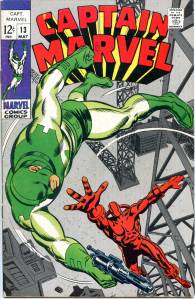
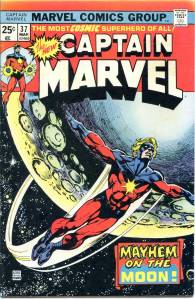
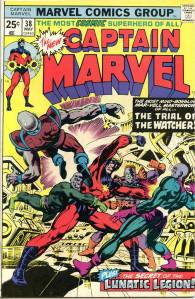
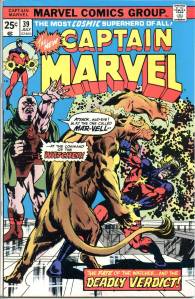
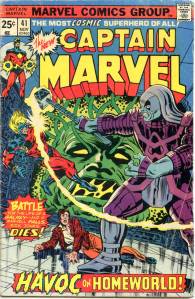
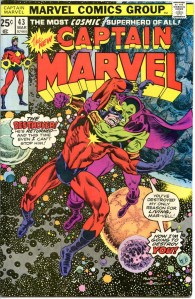
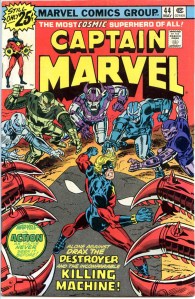
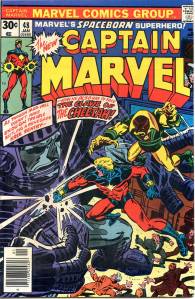
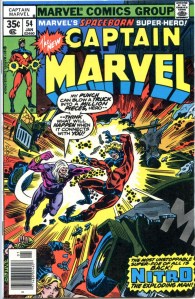
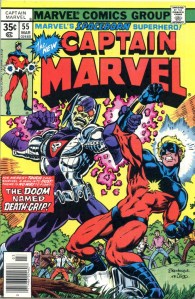
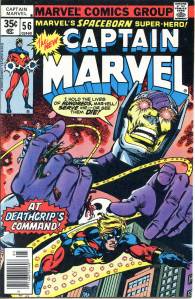
The first Captain Marvel was created by Stan Lee and Gene Colan in Marvel Super-Heroes #12 (December 1967). This character is an alien military officer, Captain Mar-Vell of the Kree Imperial Militia, who is sent to observe the planet Earth as it is developing technology to travel into space. Mar-Vell eventually wearies of his superiors’ malign intent and allies himself with Earth, and the Kree Empire brands him a traitor. From then on, Mar-Vell fights to protect Earth from all threats.
He was later revamped by Roy Thomas and Gil Kane. Having been exiled to the Negative Zone by the Supreme Intelligence, the only way Mar-Vell can temporarily escape is to exchange atoms with Rick Jones by means of special wristbands called Nega-Bands. He is also given superpowers and his Kree military uniform is replaced with a form fitting costume.
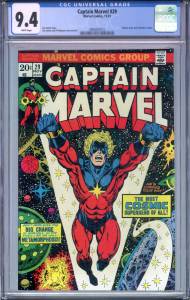
With the title’s sales still flagging, Marvel allowed Jim Starlin to conceptually revamp the character, although his appearance was little changed. Mar-Vell is freed from the Negative Zone and becomes a cosmic champion, the “Protector of the Universe” appointed by the cosmic entity Eon. Together, Mar-Vell and Rick continue to battle against evil, most notably battling the Death-worshipping Thanos. Mar-Vell became a close ally of the Titans, and one of their number, Elysius, became his lover.
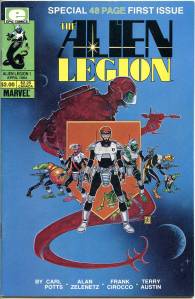
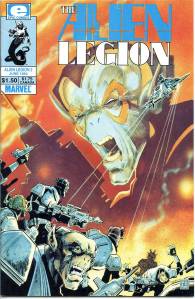
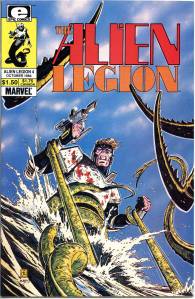
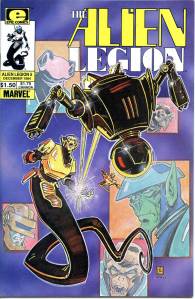
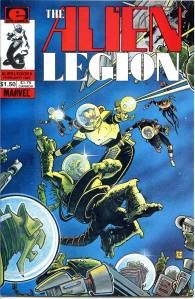
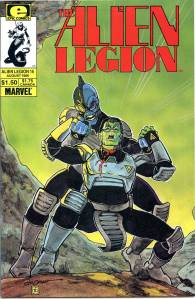
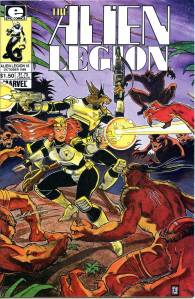
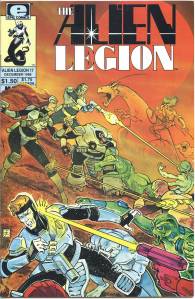
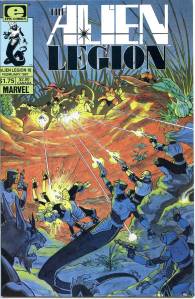
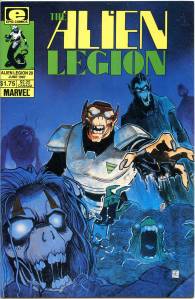
The franchise debuted with Marvel/Epic Comics’ The Alien Legion #1-20 (cover-dated April 1984 – June 1987). The 18-issue Alien Legion (Oct. 1987 – Aug. 1990), minus the “The”, followed, generally scripted by Chuck Dixon and penciled by Larry Stroman. Afterward came the three-issue Dixon-Stroman miniseries Alien Legion: On The Edge (Nov. 1990 – Jan. 1991); the two-issue Dixon-Stroman Alien Legion: Tenants of Hell (1991); the one-shot cover-titled Alien Legion: Grimrod and copyrighted Alien Legion: Jugger Grimrod (Aug. 1992), by Dixon and artist Mike McMahon; the single-issue Alien Legion: Binary Deep (Sept. 1993), by Dixon and Argentine artist Enrique Alcatena; and the three-issue miniseries Alien Legion: One Planet at a Time (April–July 1993), by Dixon and penciler Hoang Nguyen.
Additionally, Marvel/Epic published two spinoffs: Marvel Graphic Novel #25 (cover-titled Marvel Graphic Novel: The Alien Legion), released in 1986 and containing the story “A Grey Day To Die” by writers Potts and Zelenetz, penciler Cirocco, and the first series’ regular inker, Terry Austin; and the one-shot crossover with another series Law Dog and Grimrod: Terror at the Crossroads (1993)
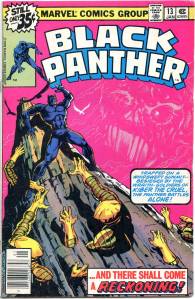
Though popular with college students, the overall sales of Jungle Action were low, and Marvel relaunched the Black Panther in a self-titled series, bringing in the character’s co-creator Jack Kirby—newly returned to Marvel after having decamped to rival DC Comics for a time— as writer, penciler, and editor. However, Kirby wanted to work on new characters and was unhappy at being assigned a series starring a character he had already worked with extensively. He left the series after only 12 issues and was replaced by Ed Hannigan (writer), Jerry Bingham (penciler), and Roger Stern(editor). Black Panther ran 15 issues (Jan. 1977 – May 1979). Due to the series’s cancellation, the contents of what would have been Black Panther#16-18 were published in Marvel Premiere #51-53.
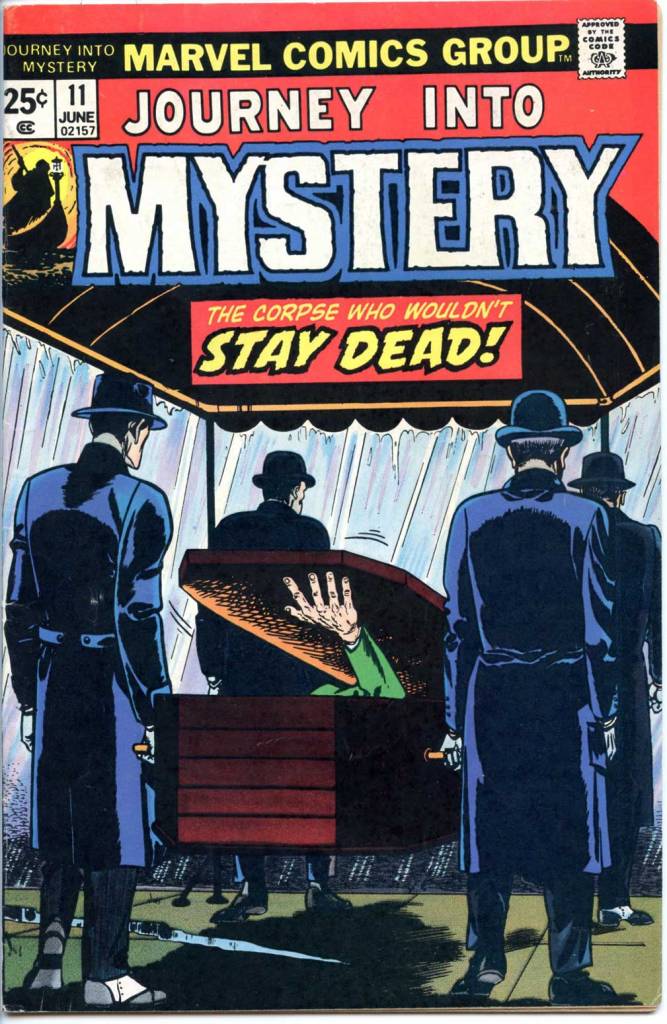
A second Journey into Mystery ran 19 issues (October 1972 – October 1975). The title was one of four launched by Marvel Comics editor-in-chief Roy Thomas to form a line of science fiction and horroranthologies with more thematic cohesiveness than the company’s earlier attempts that decade,which had included the series Chamber of Darkness and Tower of Shadows. Whereas those titles generally presented original stories, these new books would instead adapt genre classics and other stories. With the four titles’ debuts set to be staggered over the course of four months, Marvel premiered Journey into Mystery vol. 2 (October 1972), Chamber of Chills (November 1972), Supernatural Thrillers (December 1972), and, with a late start, Worlds Unknown (May 1973).























 EHT Comics