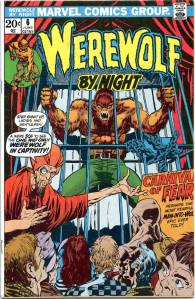
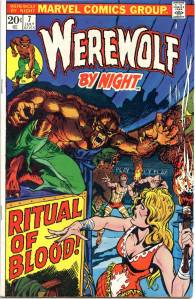
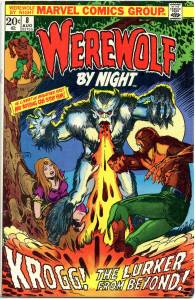
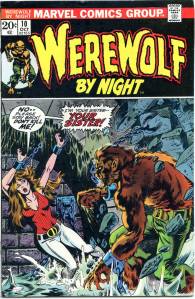
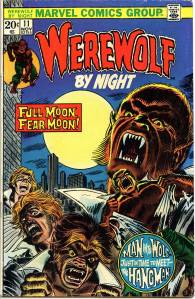
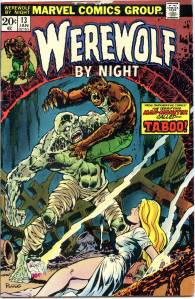
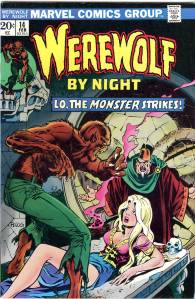
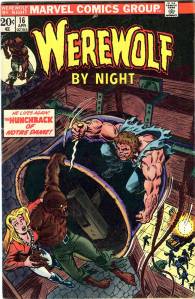
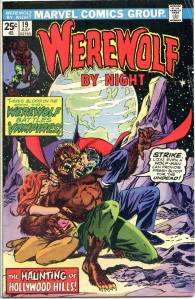
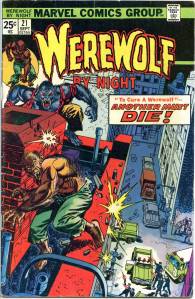
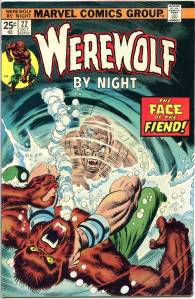
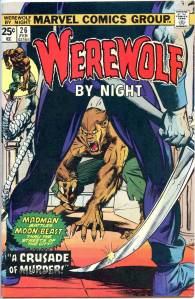
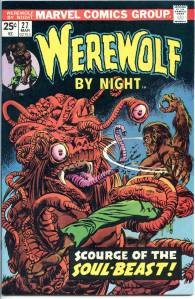
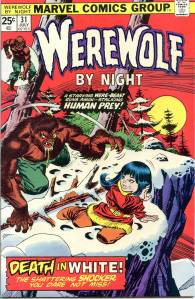
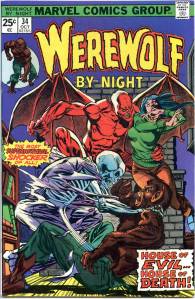
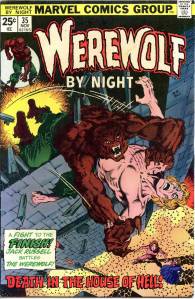
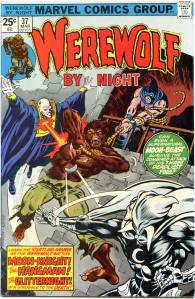
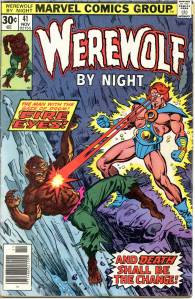
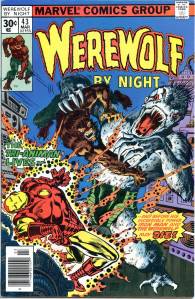
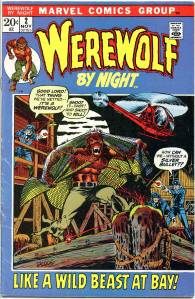
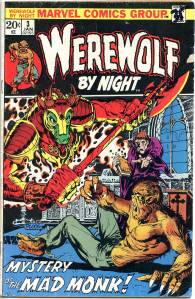
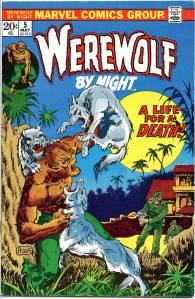
The Werewolf by Night character (birth name Jacob Russoff, legal name Jacob Russell, nicknamed Jack) first appeared in Marvel Spotlight #2 (Feb. 1972) and was based on an idea by Roy Thomas. The series name was suggested by Stan Lee and the debut story was crafted by Gerry Conway and Mike Ploog. The character made additional appearances in Marvel Spotlight #3 and #4 and then graduated to his own eponymous series in September 1972. Jack Russell co-starred with Tigra in Giant Size Creatures #1 (July 1974), which was the first appearance of Greer Grant as Tigra instead of the Cat. That series was retitled Giant-Size Werewolf with its second issue.
Category: Marvel Bronze Age
Adventure into Fear (1974)
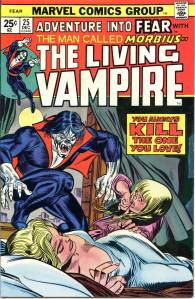
Morbius, the Living Vampire, introduced in The Amazing Spider-Man #101 (Oct. 1971), became the starring feature with Adventure into Fear #20 (Feb. 1974), and continued through the rest of the run. After a single issue by writer Mike Friedrich and penciler Paul Gulacy, Steve Gerber wrote several issues in which Morbius went on a picaresque interdimensional journey and fought the Caretakers of Arcturus and was advised by the eyeball-headed character I. Doug Moench and Bill Mantlo followed, successively, as the feature’s writers. Its round-robin of artists included Gil Kane, P. Craig Russell, Frank Robbins, George Evans, and Don Heck. Back up reprints shortly resumed in issue #20. Morbius would receive his own short-lived comic-book series in the 1990s.
Blade Runner (1982)
Blade Runner is a comic book adaptation of the film Blade Runner, published by Marvel Comics in 1982. It was written by Archie Goodwin with art by Al Williamson, Carlos Garzon with Dan Green and Ralph Reese.
This film adaptation includes one possible explanation of the title’s significance in story context: the narrative line, “Blade runner. You’re always movin’ on the edge.”
This was a reprint of issue 22 of the Marvel Comics Super Special series of titles, which by this time only printed Marvel’s movie adaptations, but without the feature content contained in the special.
Where Monsters Dwell (1970)
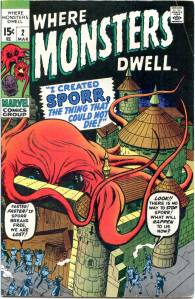
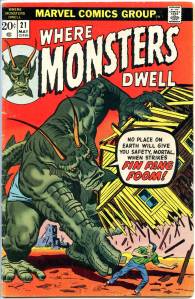
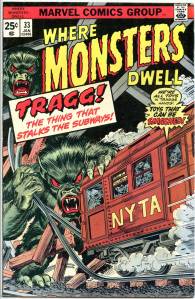
One of Marvel’s revival Horror and Monster comics. It lasted for 38 issues, making it one of the longest running Monster Mags from Marvel in the 1970’s. The series contains stories from many comic legends including Jack Kirby, Steve Ditko, Gil Kane and Bernie Wrightson. Issues #6 contains a reprint of Tales to Astonish #13, which is the 1st appearance of Groot from Guardians of the Galaxy.
Conan (1970)
Marvel Comics introduced a fairly faithful version of Conan in 1970 with Conan the Barbarian, written by Roy Thomas with art initially by Barry Windsor-Smith, then John Buscema and Ernie Chan (aka Ernie Chua). The highly successful Conan the Barbarian series spawned the more adult, black-and-white Savage Sword of Conan in 1974, by Thomas, Buscema, and Alfredo Alcala. Savage Sword of Conan soon became one of the most popular comic series in the 1970s.
The Marvel Conan stories were also adapted as a newspaper comic strip which appeared daily and Sunday from September 4, 1978, to April 12, 1981. Originally written by Roy Thomas and illustrated by John Buscema, the strip was continued by several different Marvel artists and writers.
Web of Spider-Man (1980’s)
The series was launched with an April 1985 cover dated issue by writer Louise Simonson and penciller Greg LaRocque and featured the return of Spider-Man’s alien black costume, which attempted to rebond with Peter Parker. Peter managed to rid himself of the costume again using church bells and the alien was presumed to have died after that. The first issue featured a cover painting by artist Charles Vess.
In issue #18 (September 1986), Peter Parker is pushed in front of an oncoming train. He thinks to himself that this should not have happened, as his spider-sense would have warned him of the danger. Writer David Michelinie has said that he wrote this as the first “teaser” appearance of the characterVenom, whom he was planning to introduce at a later date. Venom is an amalgam of reporter Eddie Brock and the alien costume. The costume could nullify Spider-Man’s spider-sense, and this was the first clue of a puzzle that Michelinie was planning to weave to introduce Venom.
Web of Spider-Man Annual #2 (1986) featured stories drawn by Arthur Adams and Mike Mignola. A followup to the Spider-Man vs. Wolverine one-shot appeared in issue #29. The “Kraven’s Last Hunt” storyline by writer J.M. DeMatteis and artists Mike Zeck and Bob McLeod began in issue #31 (October 1987).
Spectacular Spider-Man V1 (1976)
Peter Parker, The Spectacular Spider-Man debuted on December 1976. Shortened to simply The Spectacular Spider-Man with #134 (Jan. 1988), this was the second Amazing Spider-Man monthly comic-book spin-off series, after Marvel Team-Up, which also featured Spider-Man. The monthly title ran 264 issues (including a #-1 issue) until November 1998.
The series was launched by writer/editor Gerry Conway and artist Sal Buscema and Mike Esposito. Buscema drew the title until mid-1978. After Buscema’s departure, a succession of artists (including Mike Zeck, Jim Mooney, Ed Hannigan and Greg LaRocque) penciled the series for approximately five years. Frank Miller, who would later become the artist on Daredevil, first drew the character in Peter Parker, The Spectacular Spider-Man #27.
Star Wars – Marvel V1(1977)
Charles Lippincott, Lucasfilm‘s publicity supervisor, initially approached Stan Lee in 1975 about publishing a Star Wars comic book prior to the film’s release to appeal to the film’s most likely audience. However, Lee declined to consider such a proposal until the film was completed, and was only persuaded otherwise in a second meeting arranged by Roy Thomas, who wanted to edit the series. Considering movie tie-in comics rarely sold well at that time, Lee negotiated a publishing arrangement with no royalties to Lucasfilm until sales exceeded 100,000 at which point legal arrangements could be revisited.
Marvel Comics Group published a series of Star Wars comic books from 1977 to 1986, lasting 107 issues and 3 annuals. According to former Marvel Editor-In-Chief Jim Shooter, the strong sales of Star Wars comics saved Marvel financially in 1977 and 1978. Marvel’s Star Wars series was one of the industry’s top selling titles in 1979 and 1980.The only downside for Marvel was that the 100,000 copy sales quota was surpassed quickly, allowing Lippincott to renegotiate the royalty arrangements from a position of strength.
Marvel Fanfare (1982)
The series began with a Spider-Man/Angel team-up story by Chris Claremont and Michael Golden. Other Spider-Man appearances in the title included team-ups with the Scarlet Witch in issue #6 (Jan. 1983) and the Hulk in issue #47 (Nov. 1989). Several characters appeared in multiple issues including Doctor Strange, Weirdworld, the Warriors Three, the Black Knight,[ and Shanna the She-Devil. Writer Roger McKenzie wrote several stories for Marvel Fanfare including a two-part Iron Man vs. Doctor Octopus tale drawn by Ken Steacy. A Captain America backup story in issue #29 (Nov. 1986) featured early work by artist Norm Breyfogle.
Marvel Fanfare was envisioned as a showcase of the comics industry’s best talent. Each issue featured 36 pages of material with no advertisements and it was printed on magazine-style slick paper. It was more than twice as expensive as standard comic books ($1.25 in 1982 when most titles were 60 cents and $2.25 in 1991 when most were $1).
Godzilla: King of the Monsters (1977)
From 1977-79, Godzilla starred in a 24-issue run of comics written by Doug Moench, drawn by Herb Trimpe and published by Marvel Comics entitled Godzilla, King of the Monsters. The series thrusts Godzilla completely into the Marvel Universe. In a nod to King Kong vs. Godzilla, Godzilla first appears by bursting out of an iceberg near Alaska; although how the prehistoric creature came to be trapped again in ice is never revealed (although it is stated in the issue that this “will doubtless be determined in the future.”). Over the course of the series, he crosses the continental United States and eventually ends up in New York City.