Beware was an 8 issues series that ran from March, 1973 to May, 1974. The series contained reprints of Atlas comics with new covers by Bill Everet, John Romita & Gil Kane The title continued as Tomb of Darkness with issue #9 in July of 1974.
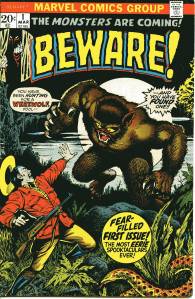
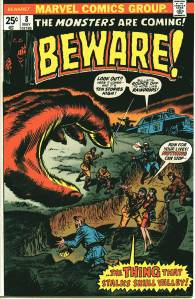
Beware was an 8 issues series that ran from March, 1973 to May, 1974. The series contained reprints of Atlas comics with new covers by Bill Everet, John Romita & Gil Kane The title continued as Tomb of Darkness with issue #9 in July of 1974.
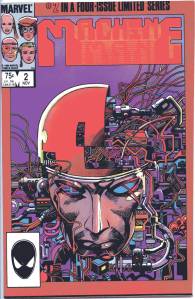
In October 1984 – January 1985, the Machine Man title was resurrected, in a four-issue miniseries written by Tom DeFalco with art by Herb Trimpe (breakdowns only, issues #1-3) and Barry Windsor-Smith (finishes only, issues #1-3 & full art for issue #4), with Windsor-Smith also coloring the entire miniseries & co-plotting issue #4 with DeFalco. This series turned out to be one of the most popular of all the Machine Man titles, tying with previous continuity, but with the action set in the distant cyberpunk future of 2020, starting with Machine Man’s reassembly.
The miniseries was first reprinted as a 96 page trade paperback in 1988 (ISBN 0-07135-458-6), with brand new cover art by Barry Windsor-Smith.
The miniseries was republished again in 1994 as two double-size books, with the name Machine Man 2020. Characters from this alternate future have made appearances in other Marvel books, namely Arno Stark, the mercenary Iron Man 2020.
In 1990, Machine Man guest-starred in Iron Man Annual #11 (part of the “Terminus Factor” storyline). That story created strong hints that the 2020 Machine Man may turn out not to be the true X-51, but instead a duplicate created by Sunset Bain.



Stan Lee said he created a synopsis for the first Fantastic Four story that he gave to penciller Jack Kirby, who then drew the entire story. Kirby turned in his penciled art pages to Lee, who added dialogue and captions. This approach to creating comics, which became known as the “Marvel Method“, worked so well for Lee and Kirby that they used it from then on; the Marvel Method became standard for the company within a year.
Kirby recalled events somewhat differently. Challenged with Lee’s version of events in a 1990 interview, Kirby responded: “I would say that’s an outright lie”, although the interviewer, Gary Groth notes that this statement needs to be viewed with caution. Kirby claims he came up with the idea for the Fantastic Four in Marvel’s offices, and that Lee had merely added the dialogue after the story had been pencilled. Kirby has also sought to establish, more credibly and on numerous occasions, that the visual elements of the strip were his conceptions. He regularly pointed to a team he had created for rival publisher DC Comics in the 1950s, Challengers of the Unknown. “[I]f you notice the uniforms, they’re the same… I always give them a skintight uniform with a belt… the Challengers and the FF have a minimum of decoration. And of course, the Thing’s skin is a kind of decoration, breaking up the monotony of the blue uniform.” The characters wear no uniforms in the first two issues.

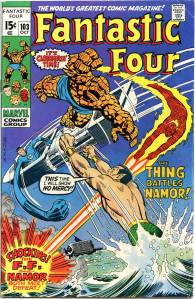


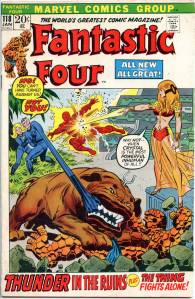


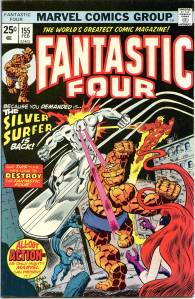
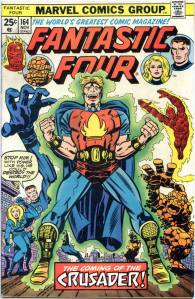








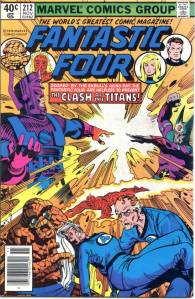
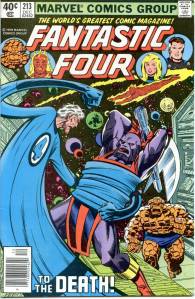
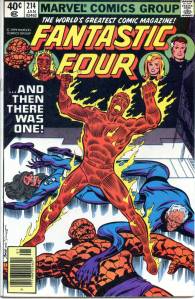

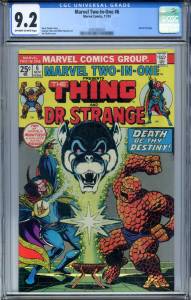
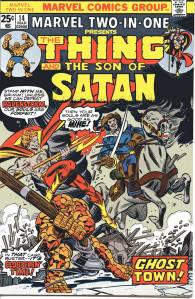
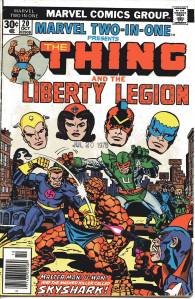
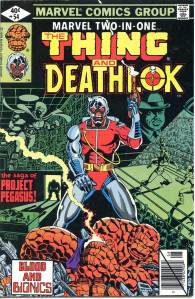
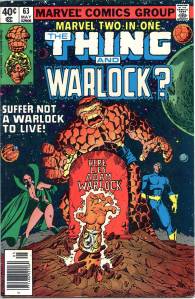
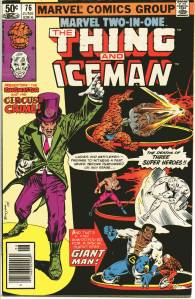
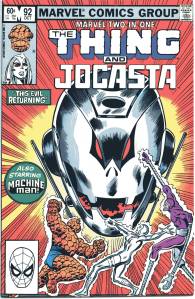
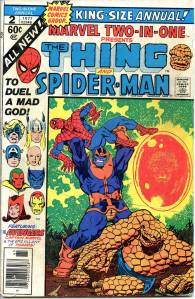
Marvel Two-in-One continued from the team-up stories starring the Thing in the final two issues of Marvel Feature and lasted for 100 issues from January 1974 through June 1983. Seven annuals were also published. Artist Ron Wilson began his long association with the title with issue #12 (November 1975) and worked on it throughout its run. With issue #17, the series had a crossover with Marvel Team-Up #47, which featured Spider-Man. The second Marvel Two-in-One Annual was a crossover with Avengers Annual #7 both of which were written and drawn by Jim Starlin. The “Project Pegasus” storyline in Marvel Two-in-One #53-58 saw the introduction of the name “Quasar” for the Wendell Vaughn character and the transformation of Wundarr into the Aquarian.
Many notable comics creators contributed to the series, including Steve Gerber, Frank Miller, Jack Kirby (who did pencils on several covers during its run), John Byrne, John Buscema, George Pérez and Marv Wolfman.
Marvel Two-In-One ended after one hundred issues and was immediately replaced with a Thing solo series.





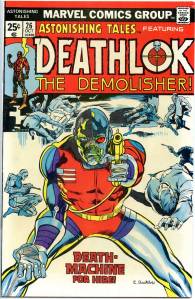
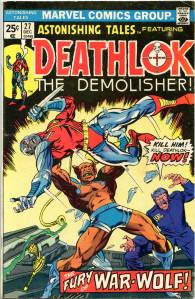
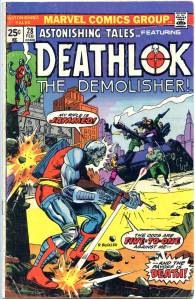
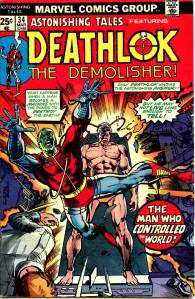
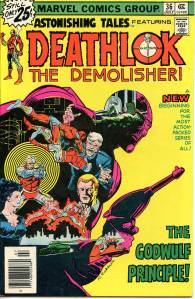
The final feature in Astonishing Tales starred and introduced Deathlok, a conflicted cyborg who predated the popular movie character RoboCop by several years and has become one of the most enduring Marvel characters among those introduced in the 1970s; at least two major iterations of the character, featuring different individuals, starred in series in the 1990s and 2000s. Created by artist Rich Buckler, who devised the initial concept, and writer Doug Moench, the feature ran from #25-28 and 30-36 (Aug. 1974 – Feb. 1975 and June 1975 – July 1976), the final issue. Bill Mantlo scripted issues #32-35, with Buckler himself scripting the finale. Buckler described Deathlok as “an extension of a paranoid fantasy. He was a representation of part of my outlook and world view. He was a culmination of many of the messages in some of the music of the time. He was part of some of the things going wrong in our country at the time. Maybe he was the science that was going wrong.Artist George Pérez made his professional comics debut with a two-page backup feature in issue #25.


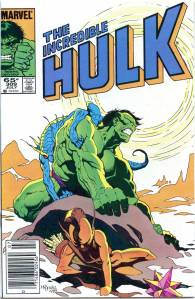
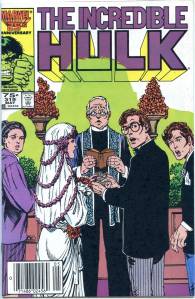
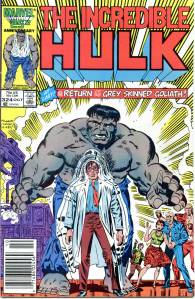
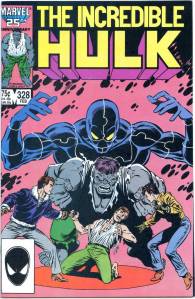
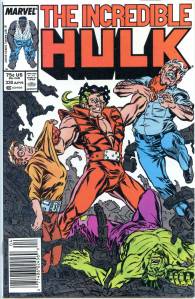
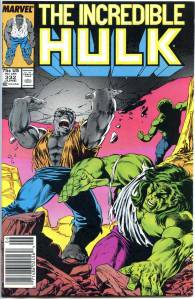
In the 1980s, Banner once again gained control over the Hulk, and gained amnesty for his past rampages; however, due to the manipulations of supernatural character Nightmare, Banner eventually lost control over the Hulk. It was also established that Banner had serious mental problems even before he became the Hulk, having suffered childhood traumas that engendered Bruce’s repressed rage. Banner comes to terms with his issues for a time, and the Hulk and Banner were physically separated by Doc Samson. Banner is recruited by the U.S. government to create the Hulkbusters, a government team dedicated to catching the Hulk. Banner finally married Betty in The Incredible Hulk #319 (May 1986) following Talbot’s death in 1981. Banner and the Hulk were reunited in The Incredible Hulk #323 (Sep. 1986) and with issue #324, returned the Hulk to his grey coloration, with his transformations once again occurring at night, regardless of Banner’s emotional state. In issue #347 the grey Hulk persona “Joe Fixit” was introduced, a morally ambiguous Las Vegas enforcer and tough guy. Banner remained repressed in the Hulk’s mind for months, but slowly began to reappear.









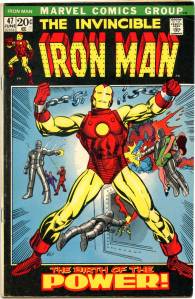
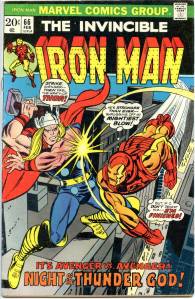
Writer Mike Friedrich and artist Jim Starlin‘s brief collaboration on the Iron Man series introduced Mentor, Starfox, and Thanos in issue #55 (Feb. 1973). Friedrich scripted a metafictional story in which Iron Man visited the San Diego Comic Convention and met several Marvel Comics writers and artists. He then wrote the multi-issue “War of the Super-Villains” storyline which ran through 1975.
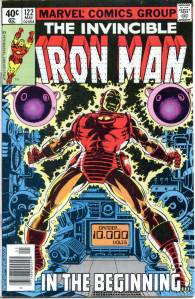
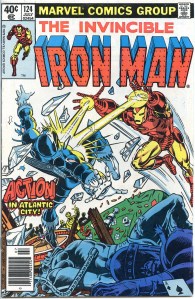
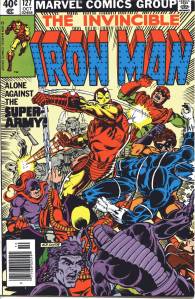
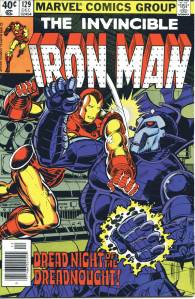
Writer David Michelinie, co-plotter/inker Bob Layton, and penciler John Romita Jr. became the creative team on the series with Iron Man #116 (Nov. 1978). Micheline and Layton established Tony Stark’s alcoholism with the story “Demon in a Bottle“, and introduced several supporting characters, including Stark’s bodyguard girlfriend Bethany Cabe;Stark’s personal pilot and confidant James Rhodes, who later became the superhero War Machine; and rival industrialist Justin Hammer, who was revealed to be the employer of numerous high-tech armed enemies Iron Man fought over the years. The duo also introduced the concept of Stark’s specialized armors as he acquired a dangerous vendetta with Doctor Doom. The team worked together through #154 (Jan. 1982), with Michelinie writing three issues without Layton.








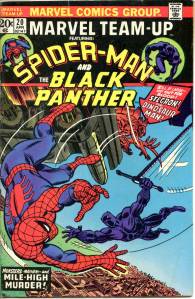
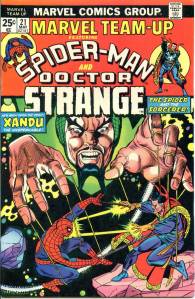
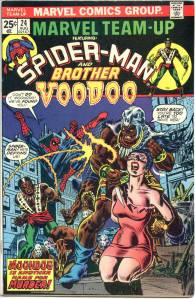
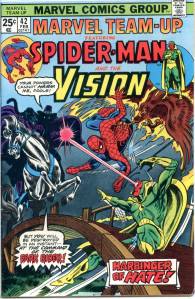
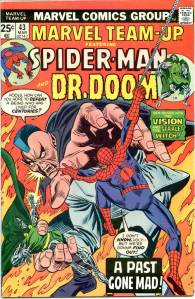
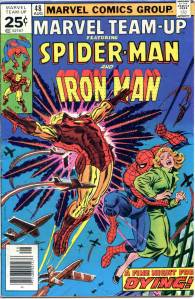
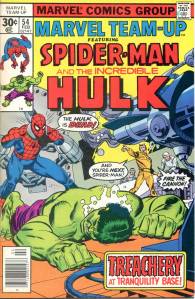
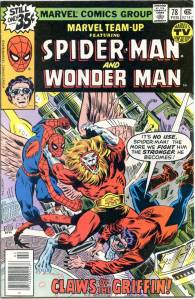
The series featured two or more Marvel characters in one story. The series was originally published from March 1972 through February 1985, and featured Spider-Man as the lead “team-up” character in all but ten of its 150 issues, and in six of its seven Annuals. It was the first major ongoing spin-off series for Spider-Man, being preceded only by the short-lived The Spectacular Spider-Man magazine.










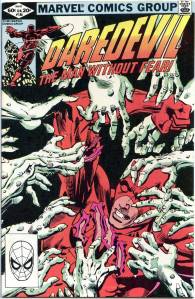
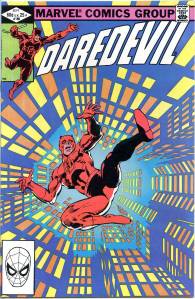
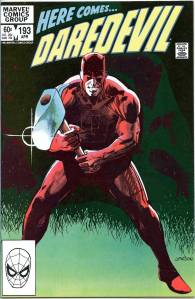
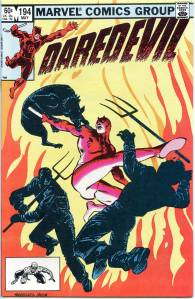
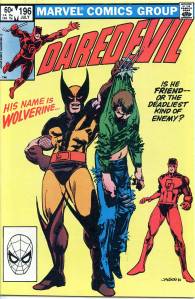
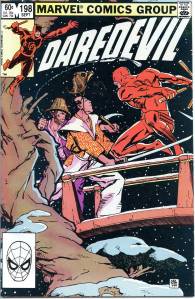
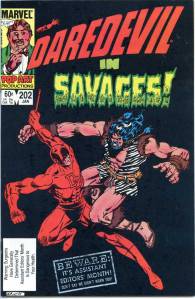
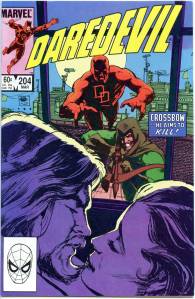
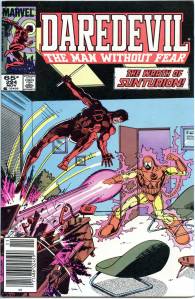
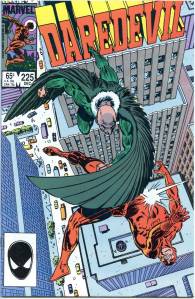
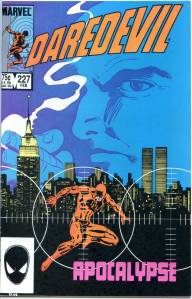
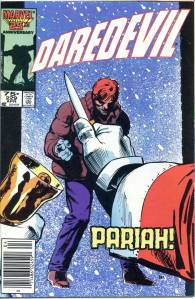
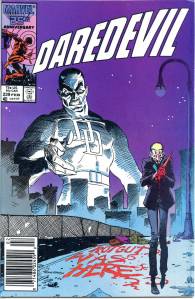
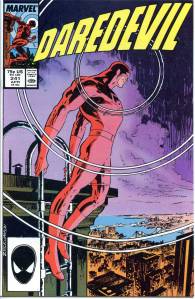
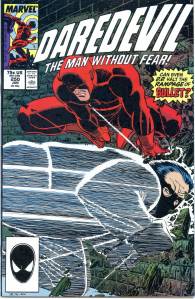
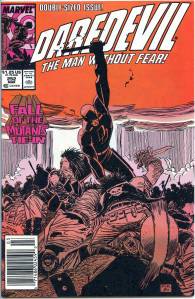
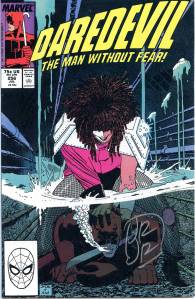
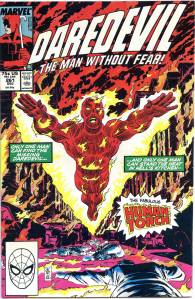
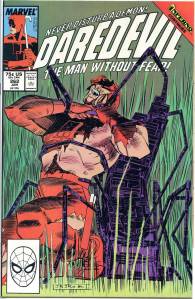
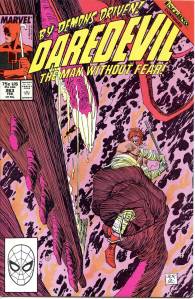
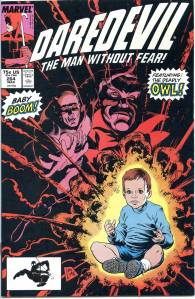
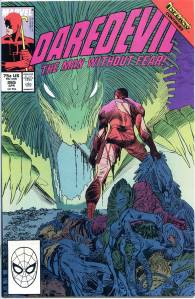
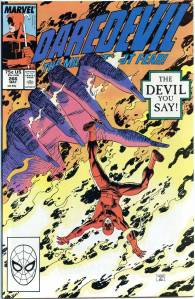
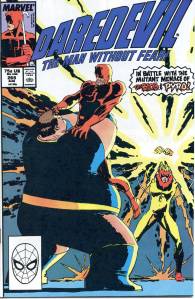
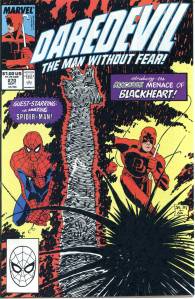
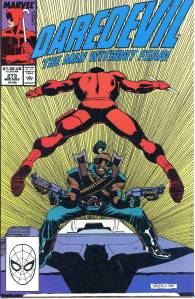
During the 80’s Frank Miller was hired to continue the title and did so in a similar vein to previous writer Roger McKenzie. Resuming the drastic metamorphosis the previous writer had begun, Miller took the step of essentially ignoring all of Daredevil’s continuity prior to his run on the series; on the occasions where older villains and supporting cast were used, their characterizations and history with Daredevil were reworked or overwritten. Most prominently, dedicated and loving father Jack Murdock was reimagined as a drunkard who physically abused his son Matt, entirely revising Daredevil’s reasons for becoming a lawyer. Spider-Man villain Kingpin was introduced as Daredevil’s new nemesis, displacing most of his large rogues gallery. Daredevil himself was gradually developed into an antihero. In issue #181 (April 1982), he attempts to murder one of his arch-enemies by throwing him off a tall building; when the villain survives as a quadriplegic, he breaks into his hospital room and tries to scare him to death by playing a two-man variation on Russian roulette with a secretly unloaded gun. Comics historian Les Daniels noted that “Almost immediately, [Miller] began to attract attention with his terse tales of urban crime.” Miller’s revamping of the title was controversial among fans, but it clicked with new readers, and sales began soaring, the comic returning to monthly status just three issues after Miller came on as writer.
























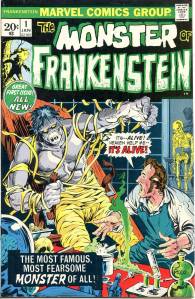
The first appearance of Frankenstein’s Monster in the Marvel Comics Universe came in the five-page horror comics story “Your Name Is Frankenstein”, by writer-editor Stan Lee and artist Joe Maneely in Menace #7 (Sept. 1953), from Marvel’s 1950s forerunner, Atlas Comics. The following decade, a robot replica of Frankenstein’s Monster appeared as an antagonist in The X-Men #40 (Jan. 1968), by writer Roy Thomas and penciler Don Heck, and was destroyed by the titular team of mutant superheroes. The actual Monster first appeared in Marvel Comics continuity in a cameo flashback in “The Heir of Frankenstein” in The Silver Surfer #7 (Aug. 1969), by writer-editor Lee and penciler John Buscema.
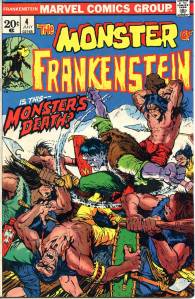
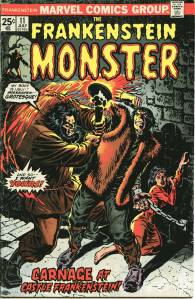
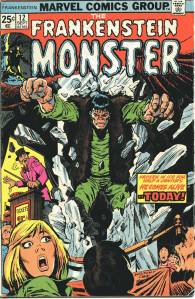
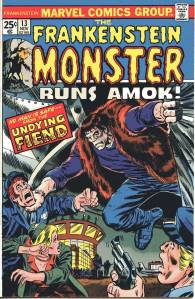
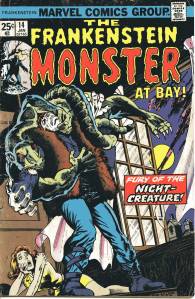
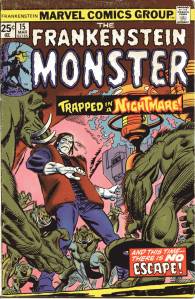
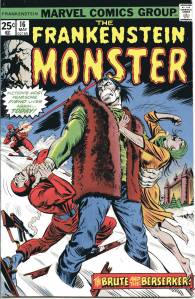
The character received an ongoing series, titled Frankenstein in the postal indicia and initially The Monster of Frankenstein (issues #1-5) and later The Frankenstein Monster as the cover logo, that ran 18 issues (Jan. 1973 – Sept. 1975). This series began with a four-issue retelling of the original novel, by writer Gary Friedrich and artist Mike Ploog. Several more issues continued his story into the 1890s, until he was placed in suspended animation and revived in modern times.