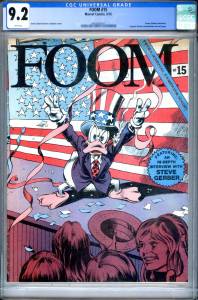
Jim Steranko, in his first-issue introduction, wrote that he had “dropped in at the Marvel bullpen to rap with [publisher] Stan Lee about the current comic scene” and that Lee told him about plans to start an in-house fan club. EC Comics had had its “EC Fan-Addict” club in the 1950s, and Marvel the Merry Marvel Marching Society beginning 1964; after the MMMS had run its course by 1969, Marvel licensed a small company in Culver City, California to produce the fanzine/product catalog Marvelmania, which lasted a year. Steranko, writing that he nostalgically “recalled the days of radio, with all the clubs and super-premiums that were perpetually offered over the air”, volunteered “my services as a designer, writer and comic historian”. Ken Bruzenak served as associate editor, with Marvel editor-in-chief Roy Thomas as consulting editor and Ed Noonchester, Joel Thingvall, and Gary Brown as staff.
Category: Marvel Bronze Age
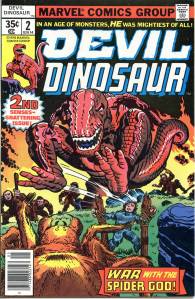
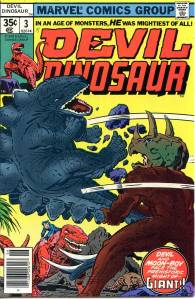
Devil Dinosaur (1978)
Devil Dinosaur and Moon-Boy are the creations of artist Jack Kirby who scripted and penciled all nine issues of the first series. Devil Dinosaur was created during Kirby’s third stint at Marvel (1975–1978). Having learned that DC Comics was working on an animated series featuring Kirby’s Kamandi, Marvel attempted to one-up their competitor by instructing Kirby to create a series similar to Kamandi, but incorporating a dinosaur co-star, since dinosaurs were hugely popular with young audiences of the time. The resulting Devil Dinosaur series was short lived, lasting only nine months (April – December 1978), and the proposed animated series never entered development. The original Devil Dinosaur series chronicled Devil and Moon-Boy’s adventures in their home, “Dinosaur World”. After the cancellation of Devil Dinosaur, the character’s appearances were relegated to one-shot comics, cameos, and supporting roles in other series.
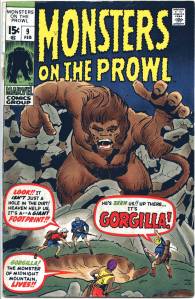
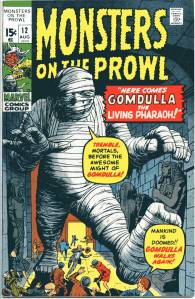
Monsters on the Prowl (1971)
Chamber of Darkness was retitled Monsters on the Prowl with issue #9 (Feb. 1971), this version ran one new story each issue through #13 (Oct. 1971) with the remaining content consisting of reprints from Atlas Comics, Marvel’s 1950s predecessor, and “pre-superhero Marvel”, primarily drawn by Jack Kirby or Steve Ditko. It expanded into a double-sized, 25-cent comic for two issues (#13-14, Oct.-Dec. 1971). Some issues of the reprint books featured new covers by John Severin, Marie Severin, Gil Kane, and Herb Trimpe.
Vision and the Scarlet Witch V1 (1982)
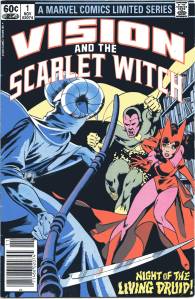
The first limited series was published beginning in November 1982, for four issues. It was written by Bill Mantlo and pencilled by Rick Leonardi. In this series, the villain Magneto is retconned as the father of the Scarlet Witch and Quicksilver, and intending to give up his villainous life. The reveal had some previous clues released in the Avengers and X-Men titles and stayed as comic book canon for decades until it was undone in the 2014 crossover AXIS.
Marvel Team-Up (1972)
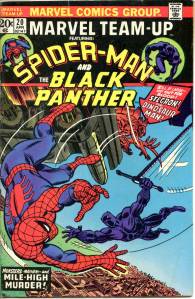
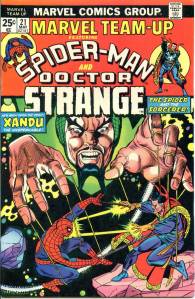
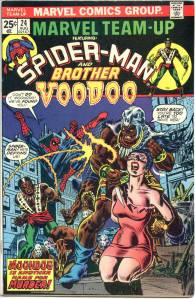
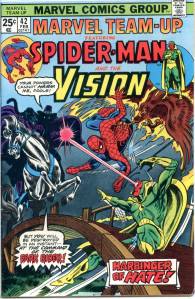
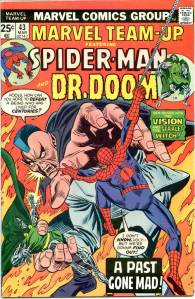
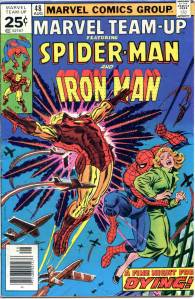
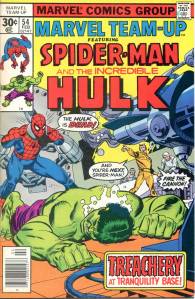
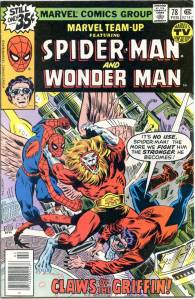
The series featured two or more Marvel characters in one story. The series was originally published from March 1972 through February 1985, and featured Spider-Man as the lead “team-up” character in all but ten of its 150 issues, and in six of its seven Annuals. It was the first major ongoing spin-off series for Spider-Man, being preceded only by the short-lived The Spectacular Spider-Man magazine.
Inhumans (1975)
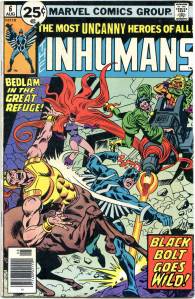
The Inhumans received their own self-titled series in October 1975, which ran for 12 issues and ended in August 1977. All but issue #9 were written by Doug Moench, who has said he was fascinated with the shaggy God story aspect of the Inhumans. A follow-up to the series’s ending appeared in Captain Marvel #53 (November 1977).
Supernatural Thrillers (1972)
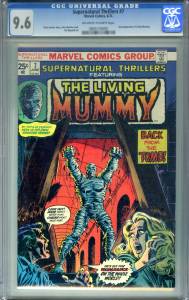
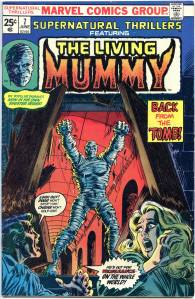
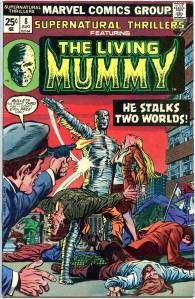
Supernatural Thrillers ran 15 issues (cover-dated December 1972 – October 1975). The title was one of four launched by Marvel Comics editor-in-chief Roy Thomas to form a line of science fiction and horror anthologies with more thematic cohesiveness than the company’s earlier attempts that decade, which had included the series Chamber of Darkness and Tower of Shadows. Whereas those titles generally presented original stories, these new books would instead adapt genre classics and other stories.
Issue #5 (August 1973) introduced the Living Mummy in a standalone story about an African tribal prince enslaved by Egyptians and mummified by an evil priest, who eventually reawakens in modern times. The character, created by writer Steve Gerber and penciler Rich Buckler, returned two issues later as the starring character in a generally 15-page solo series that ran from #7 to the final issue, #15 (June 1974 – October 1975). The cover logo during this time was “Supernatural Thrillers featuring The Living Mummy”.
Strange Tales (1970’s)
Doctor Strange was canceled with #183 (Nov. 1969). Four years later, Strange Tales resumed at its old numbering with #169 (Sept. 1973), which introduced the supernatural feature Brother Voodoo by writer Len Wein and artist Gene Colan. This lasted only to issue #173 (April 1974), with Brother Voodoo continuing briefly in the black-and-white Marvel horror-comics magazine Tales of the Zombie. This was followed by two different creative teams producing three stories of The Golem in four issues (#174–177), the second of these a fill-in monster-reprint issue.
The next feature was writer-artist-colorist Jim Starlin‘s take on Adam Warlock, picking up the character from the 1972–73 series Warlock (a.k.a. The Power of Warlock) and reviving him in Strange Tales #178 (Feb. 1975). Another creative high-water mark, this feverishly imaginative feature from Starlin, who had similarly reinvigorated Captain Marvel, introduced the Marvel characters Gamora, Pip the Troll and The Magus, and helped establish the mythos Starlin would mine in his many “Infinity” sagas of the 1990s. After issue #181 (Aug. 1975), the story would continue in Warlock #9 (Oct. 1975), picking up from the old series’ numbering. Strange Tales soldiered on with Doctor Strange reprints through issue #188 (Nov. 1976).
Marvel Treasury Editions (1970’s)
Marvel Treasury Edition is a series published by Marvel Comics from 1974 to 1981. It usually featured reprints of previously published stories but a few issues contained new material. The series was published in an oversized 10″ x 14″ tabloid (or “treasury”) format and was launched with a collection of Spider-Man stories. The series concluded with the second Superman and Spider-Man intercompany crossover. Marvel also published treasuries under the titles Marvel Special Edition and Marvel Treasury Special as well as a number of one-shots.
Ghost Rider V1 (1970’s)
Ghost Rider is the name of several fictional supernatural antiheroes published by Marvel Comics. Marvel had previously used the name for a Western character whose name was later changed to Phantom Rider.
The first supernatural Ghost Rider is stunt motorcyclist Johnny Blaze, who, in order to save the life of his father, agreed to give his soul to “Satan” (later revealed to be an arch-demon named Mephisto). At night and when around evil, Blaze finds his flesh consumed by hellfire, causing his head to become a flaming skull. He rides a fiery motorcycle and wields trademark blasts of hellfire from his skeletal hands. He eventually learns he has been bonded with the demon Zarathos. Blaze starred in the series from 1972–1983.