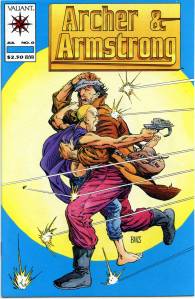
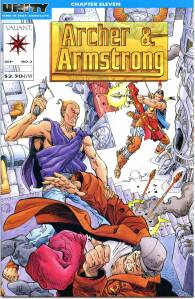
Murdered by his sadistic parents, Obadiah Archer returns from the dead with uncanny physical abilities and a mission: to punish all evil-doers like his parents; Learning martial arts in the Orient, Archer soon becomes the world’s greatest fighter!; He soon encounters Armstrong, a free-spirited immortal with the strength of ten men!; They have just met when they are attacked by Armstrong’s foes, the Sect.; Can they survive their crazy friendship?
Archer and Armstrong #0 CGC 9.8 SS White Pages $189
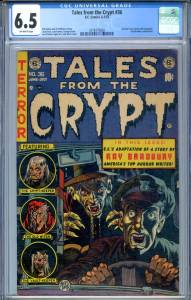
Tales from the Crypt was an American bi-monthly horror comic anthology series published by EC Comics from 1950 to 1955, producing 27 issues (the first issue with the title was #20, previously having been International Comics (#1–5); International Crime Patrol (#6); Crime Patrol (#7–16) and The Crypt of Terror (#17–19) for a total of 46 issues in the series). Along with its sister titles, The Haunt of Fear and The Vault of Horror, Tales from the Crypt was popular, but in the late 1940s and early 1950s comic books came under attack from parents, clergymen, schoolteachers and others who believed the books contributed to illiteracy and juvenile delinquency. In April and June 1954, highly publicized congressional subcommittee hearings on the effects of comic books upon children left the industry shaken. With the subsequent imposition of a highly restrictive Comics Code, EC Comics publisher Bill Gaines cancelled Tales from the Crypt and its two companion horror titles, along with the company’s remaining crime and science fiction series in September 1954.
Tales from the Crypt #36 CGC 6.5 Off-White Pages $1149
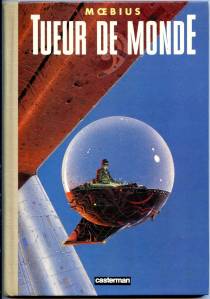
Tueur de Monde (translation: Killer of the World) follows a space traveller named Fildegar, a human crew member on a tubular vessel called the Laché Tout (Drop Everything), a floating greenhouse filled with fields of flowers. When Fildegar is not nurturing the flora inside the ship, he passes his time painting frescoes on the corridor walls, gazing into the ship’s central crystal and on rare occasions filing away old photographs which often reminds Fildegar of past memories. Suddenly Fildegar’s ship enters an unknown galaxy and discovers a planet called Bar-Jona inhabited by the contemplative creatures the Tragos. After landing on the planet’s surface and greeting it’s indigenous population, Fildegar inexplicably becomes pulled by some mysterious force and finds himself gazing up at a giant fungi.
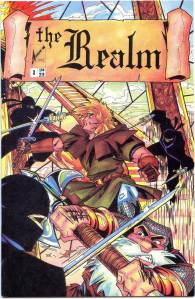
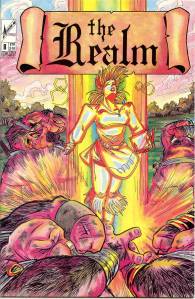
Four normal modern day teenagers are plunged into a world they thought only existed in novels and film. They are whisked away to a magical land where dragons roam the skies, orcs and hobgoblins terrorize travelers, and kingdoms wage war for dominance. It is a world where man is just one race, joining other races such as elves, trolls, dwarves, changelings, and the dreaded night creatures who steal the night. Not a typical “dungeons and dragons” world, for this story follows the adventures of these teens into the unknown as we watch the world unfold with their eyes. It is a world that is foreign to them. We learn as they learn. And what hope do these teens have in this strange Middle Earth world? How can they survive against wizards, dwarves, halflings, dragons, and trolls if they had a hard time making it in high school?
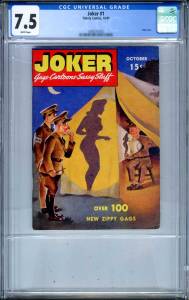
Stan Lee makes an appearance in the one-shot digest Joker, on three separate pages. (The only person to sign their text material.) This title would re-start shortly after as a large bedsheet (Life Magazine size) and run 4 more issues as Volume #1-4 on a quarterly basis. It will also concurrently become a comic book at the same time.
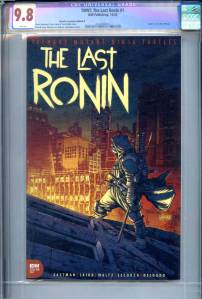
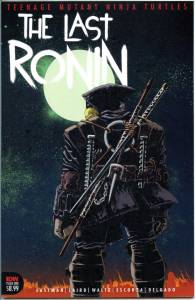
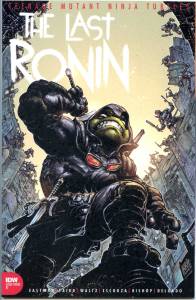
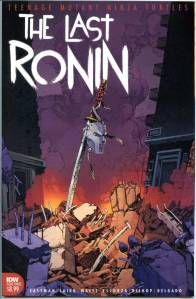
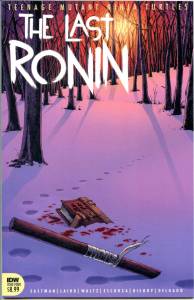
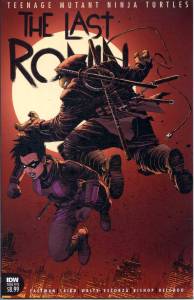
In a future NYC far different than the one we know today, a lone surviving Turtle goes on a seemingly hopeless mission to obtain justice for his fallen family and friends. Kinetic layouts from Eastman, moody inks from Andy Kuhn and a thrilling script full of surprises from longtime TMNT scribe Tom Waltz all combine to make this one of the most memorable TMNT stories you will ever read! This is a perennial TMNT tale that can’t be missed!
The Last Ronin #1 1:25 Retailer Variant CGC 9.8 White Pages $139
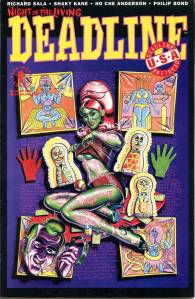
You’ve seen him on MTVs Liquid Television–Richard Sala continues his all-new, ultraterrifying 13 O’clock! He’s harder than hard-boiled, he’s Johnny Nemo by the ultrascientific Peter Milligan and Brett Ewins! It’s sex, it’s rock n’ roll, but is it drugs? It’s Doe, the latest graphic vortex from Harvey Award ultranominee Ho Che Anderson! They play the game, God makes the rules! They’re the A-Men by the ultraconservative Shaky Kane! Plus work by Julie Hollings, Philip Bond, Alec Stevens, D’Israeli and never forget GWAR, puny human! And an ultraspecial music feature! And another ultraschizophrenic cover painting from the corkscrewed psyche of Mitch O’Connell!
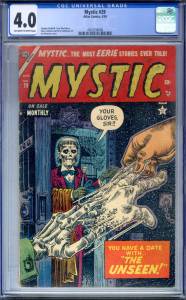
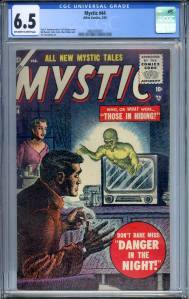
Titled simply Mystic and published by Marvel’s 1950s iteration, Atlas Comics, this was a 61-issue horror-suspense anthology (March 1951-Aug. 1957).
Mystic debuted shortly before Atlas’ Strange Tales, increasing the company’s science fiction/fantasy/horror line from four titles to six. Begun prior to the creation of the comic-book industry’s self-censorship board, the Comics Code Authority, Mystic softened its horror when it went under the auspices of the Comics Code beginning with issue #37 (May 1955). The series’ contributors included artists Bill Everett and John Severin.
Mystic #29 CGC 4.0 Off-White to White Pages $225
Mystic #44 CGC 6.5 Off-White to White Pages Blur $399
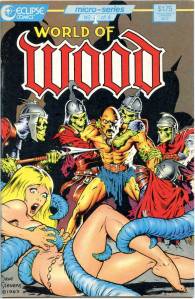
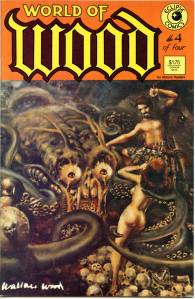
Color anthology reprint series of Wally Wood stories that included the following and more:
The Curse: Originally published in Vampirella Magazine #9 (Harris, 1971)
Overworked: Originally published in Eerie Magazine #131 (Warren, 1966)
The Misfits: Originally published in Heroes, Inc. Presents Cannon #1 (self published, 1969)
ME – 262!: Originally published in Blazing Combat #4 (Warren, 1966)
Prelude To Armageddon: Originally presented in Creepy #41 (Warren, 1971)
The Battle Of Britain!: Originally presented in Blazing Combat #3 (Warren, 1966)
The Manhunters: Originally presented in Eerie #60 (Warren, 1974)
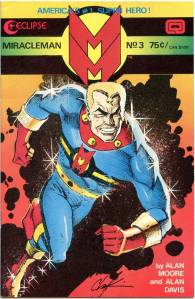
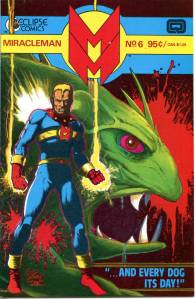
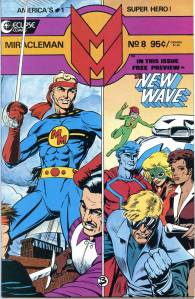
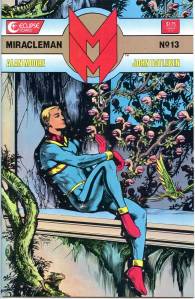
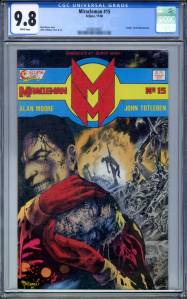
In August 1985, Eclipse began reprinting the Marvelman stories from Warrior, colored, and re-sized. They were renamed and re-lettered throughout as Miracleman to avoid further problems with Marvel Comics.Issues 1-6 reprinted all the Warrior content, after which Eclipse began publishing new Miracleman stories from Alan Moore and new artist Chuck Beckum (now better known as Chuck Austen), soon replaced by Rick Veitch and then John Totleben. Eclipse split the rights to the character, with 2/3 going to Eclipse and 1/3 split between the current writer and artist of the series. Moore wrote the series until issue 16.
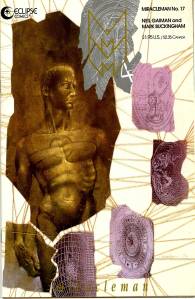
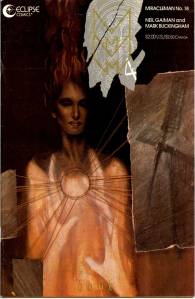
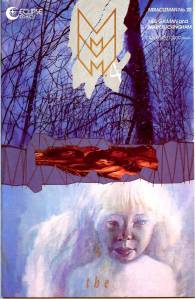
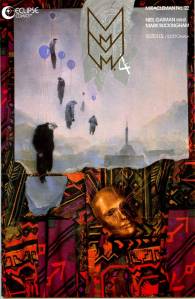
Writer Neil Gaiman picked up the series at #17 and developed it further in the 1990s, working with artist Mark Buckingham. He planned three books, consisting of six issues each; they would be titled “The Golden Age”, “The Silver Age” and “The Dark Age”.












 EHT Comics