After Devil’s Due lost the G.I. Joe comics license in January 2008, the license was given to IDW Publishing, which was officially announced on May 29, 2008. IDW’s G.I. Joe series is a complete reboot of the property, ignoring the continuity from the Marvel and Devil’s Due incarnations of the comic.
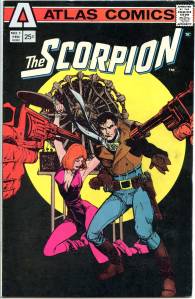
The Scorpion ran three issues, cover-dated February to July 1975. The premiere was written and drawn by character creator Howard Chaykin. On the second issue, Chaykin’s pencil art was inked by the team of Bernie Wrightson, Michael Kaluta, Walt Simonson and Ed Davis.
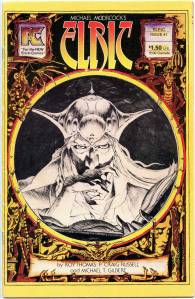
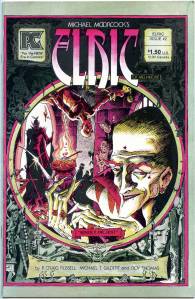
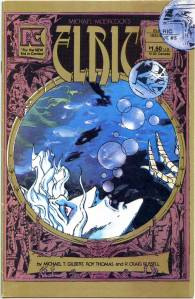
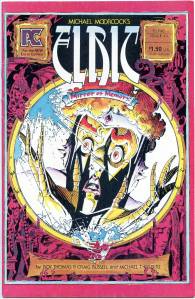
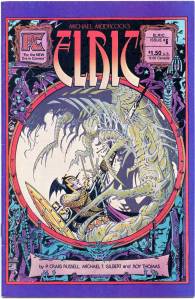
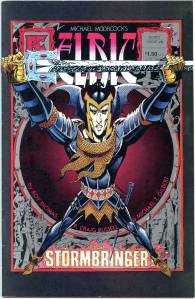
Story by Roy Thomas, adapting the novel Elric of Melnibone by Michael Moorcock. Art by P. Craig Russell and Michael T. Gilbert. Prince Yyrkoon, cousin of Elric believes he should be on the throne of Melnibone, not Elric. While he plots, Elric and his lover Cymoril take a trip to the beach, where Elric dreams of the past, and fears for the future.
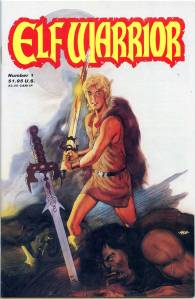
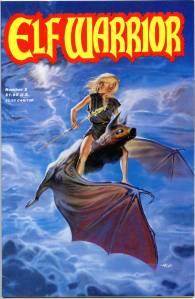
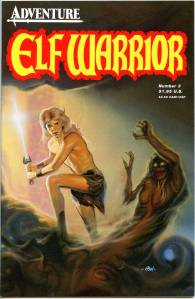
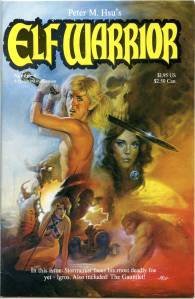
Elf Warrior was a four-issue, black-and-white fantasy that ran during 1987. The first adventures of Stormcrest, the Elf Warrior, can be found in the pages of The Adventurers #1.
An evil overlord named Darkos wants to conquer a place called the Brightland, inhabited by humans. Fearful of almost certain destruction, the humans ask their neighbors, the elves, to aid in the defense of the Brightland. Although the leader of the elves refuses, the elves’ greatest warrior, Stormcrest, can see that the destruction of the humans’ territory will bring Darkos to their door. Stormcrest convinces the Woodland Guard, the elves’ elite fighting force, to fight Darkos. To win the battle, they must risk entering the dreaded home of Darkos, facing terrors almost beyond imagining.
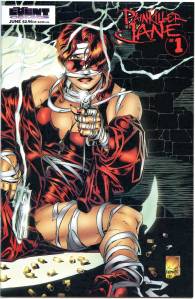
After Event comics, the character was exclusively written by Jimmy Palmiotti and drawn by various artists as it jumped from publisher to publisher. The series relaunched at Dynamite Entertainment with the first mini-series selling out. After that Icon- an independent label for creator owned work at Marvel comics, published two mini-series. The character then came back to PaperFilms, a company owned by Jimmy Palmiotti and Amanda Conner where it is currently published. Painkiller Jane has been published all over the world in at least 8 languages to date. The comics have been the basis for a film and television series and is currently in development with Jessica Chastain.
Dejaj Thoris is a prominent character in Dynamite Entertainment‘s 2010-11 comic miniseriesWarlord of Mars, based on A Princess of Mars. She first appears in issue 4. Dejah Thoris is also the main character of the Dynamite spinoff comic Warlord of Mars: Dejah Thoris, which ran 37 issues. Set 400 years before A Princess of Mars, the first story arc portrays Dejah’s role in the rise to power of the Kingdom of Helium, as well as her first suitor. The second story arc will depict her as the “Pirate Queen of Mars”, other story arcs are: “The Boora Witch”, “The Pirate Men of Saturn”, “The Rise of the Machine Men”, “The Phantoms of Time”, and “Dual to the Death”. Each were collected into a trade paperback. The entire series is being collected into a series of omnibus volume, the first collecting the first 20 issues. There was also 2 other mini-series, the 4-issue Dejah Thoris and the White Apes of Mars (2012) and the 12-issue Dejah Thoris and the Green Men of Mars (2013–14).
In 1994 Topps Comics began running their own continuation of Xenozoic Tales also under the title Cadillacs and Dinosaurs. The series only ran for one year in which they released nine issues. The stories were designed to complement the original series taking place between in the midpoint of the story “Lords of the Earth” in Xenozoic Tales #10 right after Wilhelmina Scharnhorst is elected governor but before Jack has been driven into exile. In the original story that moment lasts for only a few minutes, but Topps Comics sought the permission of Mark Schultz to turn it into a “moment that stretches”. While Mark Schultz did not write or draw any of the comics released by Topps he was consulted on some of the story arcs to make sure they kept as true to his vision as possible.
The series ran three main story arcs over the course of nine issues before “going on hiatus” right before the release of Xenozoic Tales issue 13. A fourth storyline titled Hammer of the Gods was in the works, being drawn by David Roach, however it was never released.
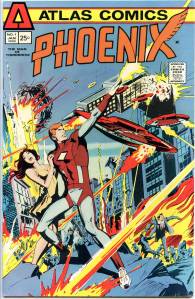
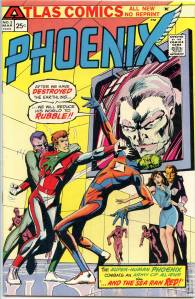
After his spaceship crashes, astronaut Ed Tyler is captured by extraterrestrials. He uses their technology to become the superhuman Phoenix, but the aliens would rather destroy his planet than let him escape. Part of the short-lived Atlas superhero line from former Marvel publisher Martin Goodman.
Turok, Son of Stone, was illustrated by Rex Maxon. The writer-creator credit for the characters of Turok and Andar is disputed, with historians citing Matthew H. Murphy, Gaylord Du Bois and Paul S. Newman as the feature’s earliest writers.
The Western Publishing version of Turok was a Pre-Columbian eraNative American (identified as Mandan in the first issue, on page 21 and 32 of Dell Four Color #596) who, along with his brother, Andar, became trapped in an isolated canyon valley populated by dinosaurs, which they refer to in general as “hoppers”, “monsters” and more often than not, beginning in Dell issue number 9, page 35 as “honkers”, as well as by their most obvious characteristics (tyrannosaurs are called “runners”, pterosaurs are called “flyers”, velociraptors are “screamers”, plesiosaurs are “sea demons”, Triceratops are “rammers”, etc.). The Du Bois stories involve Turok and Andar seeking a way out of the canyon. Du Bois was influenced by his visits to Carlsbad Caverns, New Mexico and developed the “Lost Valley” from his visits to the area.
After two appearances in Four Color #596 and #656, the title ran 27 issues (#3–29) published by Dell Comics (1956–62); then issues #30–125 (1962–80) from Gold Key Comics; and finally issues #126–130 (1981–82) under Western’s Whitman Comics imprint.
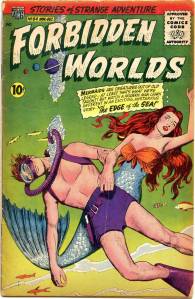
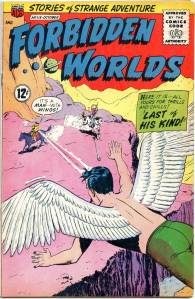
Forbidden Worlds, a 52-page comic with the initial subtitle “Exploring the Supernatural!”, debuted in October 1951. Due to pressure from the 1954 Senate subcommittee hearings on the dangers of comic books, the comic changed its title (and focus) to Young Heroes from March 1955 to June/July 1955 (publishing issues #35–37). However, in August 1955, Forbidden Worlds reappeared with (another) issue #35 and the altered subtitle “Stories of Strange Adventure”.




 EHT Comics