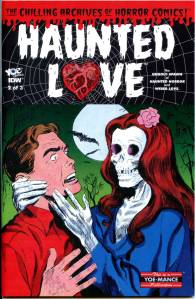
Haunted Love – IDW (2016)

Haunted Love features rotting tales of supernatural Pre-code romance from putrid horror comics from the vile horror comics of the 1950s. Lurid lust! Vicious violence! Creepy kisses! The zombie-fied Haunted Love is 3 throbbing issues that will set your horrid hearts afire. Haunted Love will make your Valentine’s Day massacre and gory gift giving to your vile Valentine unforgettable and unforgivable.

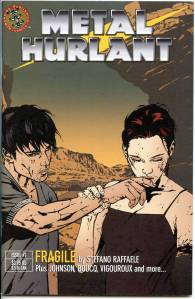
Métal Hurlant (2002)

Métal Hurlant began publishing again in July 2002 by Humanoids Publishing, with a French, English, Spanish and Portuguese version, under the French name. As a “two-headed”, transatlantic (France-US) magazine, led by Fabrice Giger in Los Angeles, it published original short stories, sometimes related to existing or to be published comic books. Its aim was to discover young creators and promote the products from the publisher. This incarnation of the magazine ceased publication with issue No. 14, dated November/December 2004.

Poison Elves – Mulehide Graphics (1990’s)

I, Lusiphur (December 1991-December 1992) – Poison Elves (February 1993-February 1995) Hayes originally self-published the series during the early 90s under his company Mulehide Graphics under the title of I, Lusiphur. The title was changed to Poison Elves because the similarity of Lusiphur to Lucifer led to the misconception that the series was Satanic in nature. Sales were reported to have increased significantly after the name change. Drew claimed in one of his Starting Notes that the name change was prompted by a letter from a teen-aged fan whose mother had thrown out his comics after finding I, Lusiphur comics amongst his collection.

The first ten issues of the Mulehide series were published in a larger magazine size format. In 1995, Drew Hayes signed on with Sirius Entertainment, a move that increased his exposure, fan base, and publishing rate. To date, ten trade paperbacks have been released, but the last issue of the main series published by Sirius was #79. Hayes died in 2007, thus bringing the series to an abrupt end. A commemorative issue #80 was released to give fans a look at sketches and plans Drew Hayes had for the future of the series before his death.

I Before E (1991)

A year or so before Image began publishing Sam Kieth’s most famous work, Maxx, Fantagraphics produced two volumes of Kieth’s drawings and short stories as I Before E. With creepy aliens, prowling tigers, and visual treats like the short story “Max the Hare,” these two comic-sized volumes make a fine companion to any Sam Kieth collection.

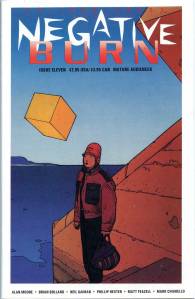
Negative Burn V1 (1993)

Negative Burn is a black-and-white anthology comic book published beginning in 1993 by Caliber Press, and subsequently by Image Comics and Desperado Publishing. Edited by Joe Pruett, Negative Burn is noted for its eclectic range of genres, mixture of established comics veterans and new talents, and promotion of creative experimentation.

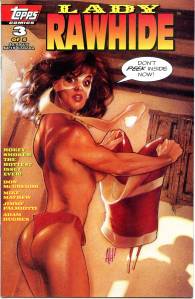
Lady Rawhide (1995)

Lady Rawhide is a scantily clad masked vigilante who defends the people from their oppression against tyrannical officials and other villains. She first appeared in Topps Zorro series, and later appeared in several solo one-shots and two mini-series. Lady Rawhide was created by Don McGregor and Mike Mayhew.

Anita Santiago was driven to create her own costumed identity to seek revenge against the Commandante of Los Angeles, Captain Enrique Monasterio who inflected terrible injures on her brother, Roman Santiago. Anita’s hatred for Zorro came about when her brother, Roman, was falsely mistaken as being Zorro by the nefarious Captain Enrique Monasterio who shot Roman point black which ended up permanently blinding Roman, and disfiguring left half of his face. Since then, Anita swore that she would make Zorro pay with his life.

What seemed like a simple task for vendetta became more complicated after she met her adversary that she eventually fell in love and came to respect what Zorro stood for. She would eventually adopt his goal to fight injustice and help the helpless against the wicked and corrupt.

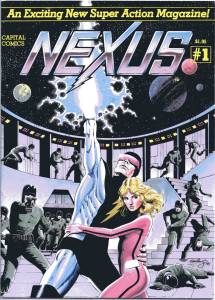
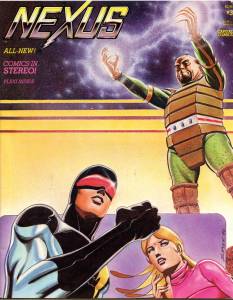
Nexus V1 – Capital Comics (1981)

Nexus is a comic book series created by writer Mike Baron and penciler Steve Rude in 1981. The series is a combination of the superhero and science fiction genres, set 500 years in the future.

The series debuted as a three-issue black-and-white limited series (the third of which featured a 33 RPM flexi disc with music and dialogue from the issue), followed by an eighty-issue ongoing full-color series. The black-and-white issues and the first six color issues were published by Capital Comics; after Capital’s demise, First Comics took over publication.

On the creation of the series: Baron noted that they had originally pitched a series called Encyclopaedias to Capital Comics, but the company rejected this, saying they were looking for a superhero title. Over a drink at a restaurant, Baron outlined his ideas for Nexus to Rude.

Nexus was entirely Baron’s idea. He even came up with the lightning bolt for the costume. All that we needed then was a name… a few weeks passed. Baron calls, and, without preamble, just says “Nexus.” We finally had our name.”

GI Joe: Origins (2009)

G.I. Joe: Origins is a 2009 series published by IDW Publishing. Originally conceived as a five-issue mini-series telling the story of G.I. Joe‘s first mission as a team, it subsequently became an ongoing series with rotating creative teams, featuring a mixture of both standalone character spotlight stories and tie-ins to the main ongoing series.

Many of the book’s standalone stories were originally intended for release as one-shot comics, much like IDW’s The Transformers: Spotlight, before being folded into Origins.

Crossed (2008)

The story follows survivors dealing with a pandemic that causes its victims to carry out their most evil thoughts. Carriers of the virus are generally known as the “Crossed” due to a large, cross-like rash that appears on their faces – other names include “cross-faces” and “plus-faces”. This contagion is primarily spread through bodily fluids, which the Crossed have used to great effect by treating their weapons with their fluids, as well as through other forms of direct fluidic contact such as rape and bites, assuming the victim lives long enough to turn. A major difference between the Crossed and other fictional zombie or insanity-virus epidemics (e.g., in the film 28 Days Later) is that while the Crossed are turned into homicidal violent psychopaths, they still retain a basic human-level of intelligence: thus, they are still capable of using tools and weapons, driving motor vehicles, setting complex traps, and other actions. It is occasionally noted in the series that a Crossed retains any skills they had prior to their infection; most simply lack the patience or sanity to do anything not immediately related to their vicious impulses.

Ironjaw (1975)

Abandoned and left to die by order of his step-father the King, Ironjaw is discovered and raised by the bandit Tar-Lok. Later in life, his jaw is removed by a jealous group of thieves and replaced with a jaw made of iron.