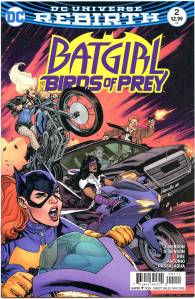
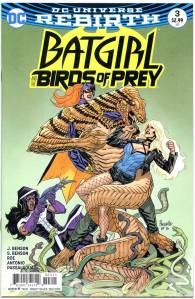
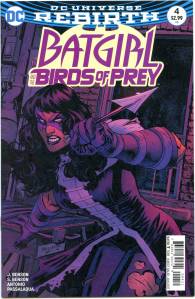
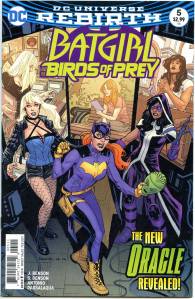
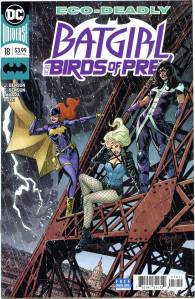
Announced as part of DC Rebirth, the title debuted in July 2016 with a one shot, Batgirl and the Birds of Prey Rebirth #1, before being released monthly. The first story arc follows Batgirl, Black Canary and Huntress as they battle the Snake Men and Oracle, a villain using Batgirl’s former codename.
The series is written by Julie Benson and Shawna Benson. Claire Roe illustrated Rebirth #1 and issues #1 through #3 of the monthly series. Antonio Neto took over illustration duties beginning with issue #4.
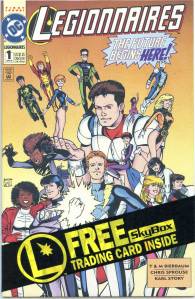
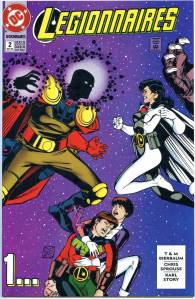
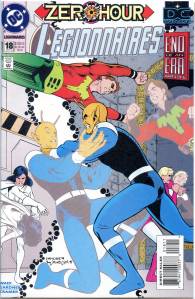
Following Zero Hour, a new Legion continuity was created, beginning with a retelling of the origin story starting in Legion of Super-Heroes (vol. 4) #0 and then continued in spin-off sister series Legionnaires #0 (both released in October 1994). Lightning Lad was renamed Live Wire, and after the group’s founding, a large number of heroes were added to the roster very quickly. Several members from the previous continuity were given new codenames, and some new heroes were added, including XS (the granddaughter of Barry Allen, the second Flash), Kinetix, and Gates.
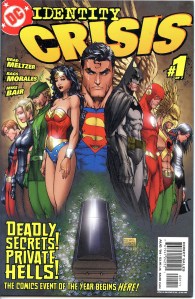
One of DC’s top-selling series, the first issue was released in June 2004 and was ranked first in comic book sales for that period with pre-order sales of 163,111. The second issue saw a decline in sales and ranked third in comic book sales in July 2004 period with pre-order sales of 129,852. The story also adheres to the continuity changes introduced by Crisis on Infinite Earths, as heroine Wonder Woman was retconned out of the pre-Crisis JLA. In all further references to the JLA’s pre-Crisis adventures, including its origin story and the Secret Society incident, Wonder Woman is replaced by Black Canary. Following “Infinite Crisis“, however, Wonder Woman is restored as a founding member.
One of the major plot threads — the breakdown of relationships within the Justice League of America — is examined in the storyline “Crisis of Conscience” in JLA #115-119 (August–December 2005). The mini-series is followed by the crossover event “Infinite Crisis”.
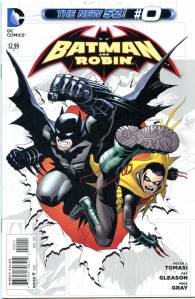
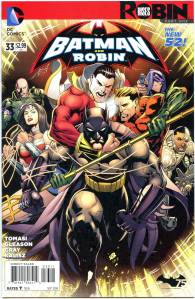
The relaunched DC Universe features several notable differences from its previous incarnation, making all of the established heroes roughly five years younger than their previous versions before the relaunch. While much of Batman’s history from the previous DC Universe remains intact, Bruce Wayne is again the only hero serving as Batman and as such, he has replaced Dick Grayson in this title. Volume 2 features the exploits of Bruce and Damian, father and son, as Batman and Robin.
A two-part Batman/Grendel crossover, Devil’s Riddle and Devil’s Masque, was written and drawn by Wagner and colored by Wagner at the time of the Comico series, but was delayed by Comico’s bankruptcy. It was finally published by DC in 1993.
The story assumes that Hunter Rose and Batman live in the same fictional universe and are contemporaries. Bored with Argent the wolf and the NYPD, Hunter Rose comes to Gotham City to challenge the city’s protector to stop him before he commits an audacious crime. Hunter Rose becomes increasingly impressed with Batman but is still able to pull off his crime. However, Batman’s interference proves to be more trouble than he expected and Grendel winds up unintentionally endangering the life of a child and indirectly causing the death of a person he did not consider an enemy. Grendel and Batman’s final battle ends with the assassin just barely escaping Gotham, his arm broken by the Dark Knight in the process.
Although this story can be seen as out of continuity, Hunter Rose is depicted with a broken arm in the “Devil’s Advocate” short, featured inGrendel: Black, White, & Red.
Moloch, alias Edgar William Jacobi, was an ex-nemesis of the Minutemen who played a macguffin role in the original series. This story reveals engrossing information about Moloch’s childhood, his turn to villainy, and new details surrounding his death.
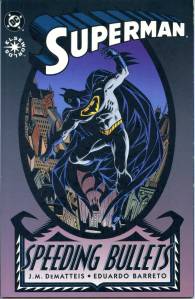
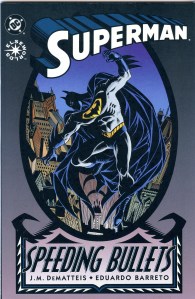
Baby Kal-El crashes into Earth, where he is discovered by Thomas and Martha Wayne. The couple decide to adopt Kal-El, and name him Bruce. One night, Thomas and Martha are gunned down by a mugger. Bruce incinerates the mugger with his heat vision and discovers his superpowers, but it is too late to save his parents. He decides to hide his powers in shame.
Bruce decides to create a secret identity for himself many years later. As the Batman, he begins to brutally strike back at the criminals in Gotham. Meanwhile, criminal Lex Luthor is on the run and is caught in a horribly disfiguring accident. Lex becomes this dimension’s version of the clown prince of crime, The Joker.
Bruce is eventually persuaded by Lois Lane that a more hopeful superhero is needed than his dark, violent Batman persona, giving rise to his new, more heroic identity of Superman.
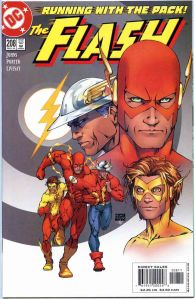
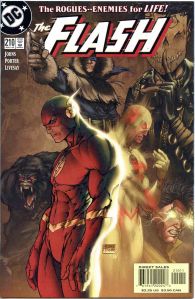
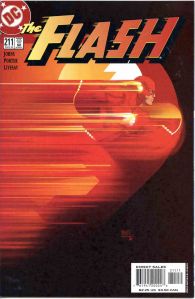
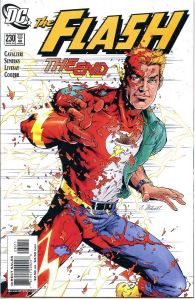
Due to the Infinite Crisis miniseries and the “One Year Later” jump in time in the DC Universe, DC canceled The Flash (vol. 2) in January 2006 at #230. A new series, The Flash: The Fastest Man Alive, began on June 21, 2006. The initial story arc of this series, written by Danny Bilson and Paul De Meowith art by Ken Lashley, focused on Bart Allen‘s acceptance of the role of the Flash.
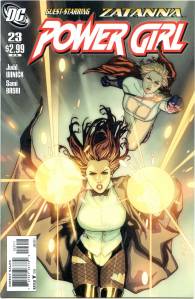
In her own ongoing series at last! Straight from the pages of Justice Society of America, Power Girl starts life anew by building herself a secret identity. But a major villain from her past has other plans in store for the Super Hero, and to get his way, he’s holding Manhattan hostage!





 EHT Comics