Justice League Dark (2011)

Justice League Dark was announced on May 31, 2011 as a First Wave title of The New 52 The title and team was created by Peter Milligan, with art by Mikel Janín. The title launched on September 28, 2011. The title brought several of DC Comics’ occult and offbeat characters, something which had been a trait of sister imprint Vertigo, back into the main DC Universe following Vertigo’s editorial change to publish purely new, creator owned content.

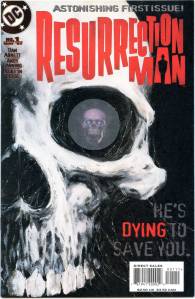
Resurrection Man (1997)

Mitch Shelley made his debut in Resurrection Man #1 (1997). The monthly series was structured to follow a grand story arc planned by Abnett and Lanning, with stories following Shelley as he wandered America, having adventures while searching for the truth behind his past and his transformation. During this, he is pursued by “the Lab”, its former director Hooker, and the bounty hunters known as the Body Doubles.

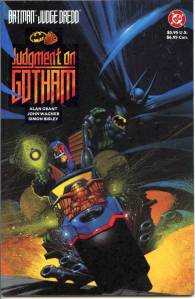
Batman/ Judge Dredd – Judgement on Gotham (1991)

Judge Death makes a dimensional jump to Gotham City, murdering two lovers and a police officer. Batman defeats Death, who flees in spirit form. Among the remains of his host body, Batman finds a dimensional jump belt that he accidentally activates, transporting him to Mega-City One, where is confronted by Mean Machine Angel. As Mean Machine attacks Batman, they are both confronted by Judge Dredd. Mean Machine flees to Gotham using the belt, then wanders into the city looking for Judge Death.

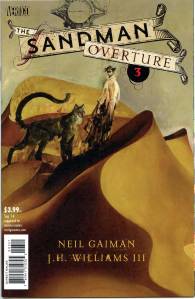
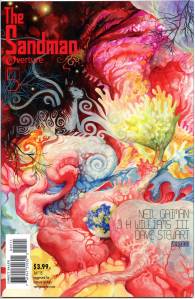
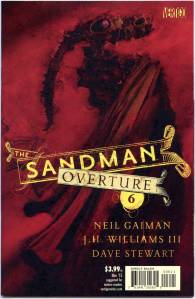
The Sandman Overture (2013)

To commemorate the twenty-fifth anniversary of The Sandman, Gaiman wrote a new tale involving the battle that had exhausted Morpheus prior to the beginning of the original story. Written by Gaiman and with art by J. H. Williams IIIOverture tells the previously hinted story of Dream’s adventure prior to Preludes and Nocturnes, which had exhausted him so much that it made Burgess’ actions capable of capturing him. The limited series had six issues. Issue #1 was released on October 30, 2013, and although it was planned to have a bi-monthly release schedule, issue 2 was delayed until March 2014, which Gaiman explained was “mostly due to the giant signing tour I was on from June, and me not getting script written on the tour, with knock-on effects”. Special editions were released approximately a month after the original editions, which contain interviews with the creative team, alongside rare artwork.

Madame Xanadu (2008)

Madame Xanadu eventually got her own ongoing solo book when Matt Wagner and Amy Reeder Hadley teamed up for it in 2008, followed by more Wagner stories with artwork by many other equally amazing artists. The series went for 29 issues, exploring key moments in Xanadu’s very long life and centering in on the details of her magical powers more than any story had before. After the first couple arcs, most of the issues revolved around Xanadu’s actions at the margins of DC’s superhero community in the ‘40s, which makes the run a must-read for fans of DC’s Golden Age.

In her solo series, we discovered that Xanadu’s given name was Nimue Inwudu, and she was the third sibling after Morgan le Fay and the Lady of the Lake in Celtic mythology. They were descendants of the survivors of the destruction of Atlantis known as the homo magi, and thus all possessed inherent magical skills. After a particularly ill-fated affair with Merlin, she traveled the world and gained her immortality by besting Death in a card game.
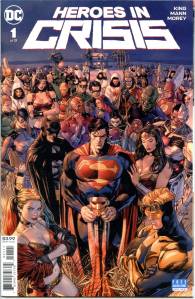
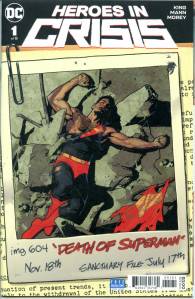
Heroes in Crisis (2018)

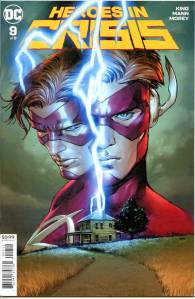
Heroes in Crisis primarily deals with the emotional cost of being a superhero and explores “what violence does to a society”, a common theme in King’s work. King, a former CIA counterterrorism officer, believed this was an important subject that needed to be discussed. King described this creative decision: “Comic books, throughout the whole history of the medium, have been reflective of history. In World War II, there were comics about fighting in World War II. In the seventies, the comics were about psychedelic escape. Today, our moment right now is a moment of violence and living with violence and our comics have to address that”.

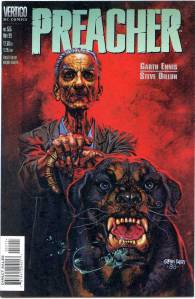
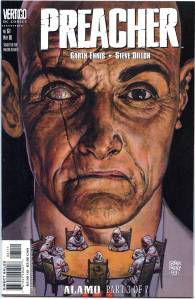
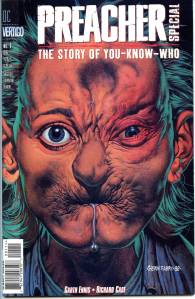
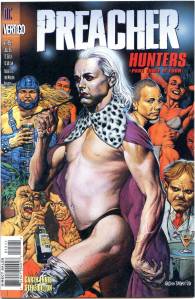
Preacher (1995)

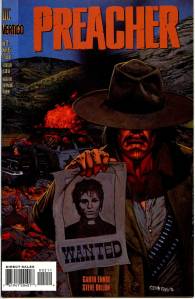
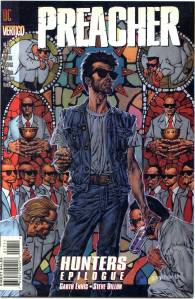
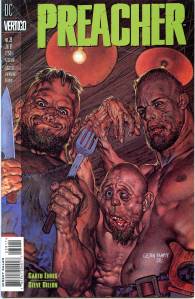
Preacher tells the story of Jesse Custer, a preacher in the small Texas town of Annville. Custer was accidentally possessed by the supernatural creature named Genesis in an incident which killed his entire congregation and flattened his church.

Custer, driven by a strong sense of right and wrong, goes on a journey across the United States attempting to (literally) find God, who abandoned Heaven the moment Genesis was born. He also begins to discover the truth about his new powers. They allow him, when he wills it, to command the obedience of those who hear and comprehend his words. He is joined by his old girlfriend Tulip O’Hare, as well as a hard-drinking Irish vampire named Cassidy.

Batman: White Knight Presents – Von Freeze (2020)

The world of Batman: White Knight expands with this standalone tale! On the night of Bruce Wayne’s traumatic birth, Victor Fries must intervene to save the lives of Martha Wayne and the future Batman. As the evening unfolds, Victor distracts Thomas with the incredible tale of his own father figures-one a Nazi, the other a Jew-and their complex connection to Wayne Laboratories. As the Third Reich roars into power, the deep friendship and working relationship between the Baron von Fries and his research partner, Jacob Smithstein, is in crisis. Ordered by Himmler to speed development of their cryotechnology in service of world domination, Smithstein is forced to go into hiding and compromise his moral code in order to save his wife and infant daughter, Nora, from persecution and certain death. When the S.S. ramps up surveillance over the project, young Victor begins to question his father’s true allegiance. Both families are driven toward an impossible choice and a sinister standoff, and Victor makes a pact with Smithstein that will ripple through generations.

Legends (1986)

Legends served mainly as a launching pad for several new comic series, including the latter-day Flash title, Keith Giffen and J. M. DeMatteis‘ comedy/action take on the Justice League, and the villain-based black ops Suicide Squad. The series also saw the post-Crisis introduction into the DC Universe of Captain Marvel (who was spun off in the miniseries Shazam!: The New Beginning) as well as Wonder Woman, who had been rebooted by DC Comics at the same time Legends was being published.

Batman: The Killing Joke (1988)

Batman: The Killing Joke is a 1988 DC Comics one-shot graphic novel featuring the characters Batman and the Joker written by Alan Moore and illustrated by Brian BollandThe Killing Joke provides an origin story for the supervillain the Joker, loosely adapted from the 1951 story “The Man Behind the Red Hood!“, which was written by Batman co-creator Bill Finger. The Joker’s origin is presented via flashback, while simultaneously depicting his attempt to drive Jim Gordon insane and Batman’s desperate attempt to stop him.

Created by Moore, Bolland, and Higgins as their own take on the Joker’s source and psychology, the story became famous for its origin of the Joker as a tragic character; a family man and failed comedian who suffered “one bad day” that finally drove him insane. Moore stated that he attempted to show the similarities and contrasts between Batman and the Joker. The story’s effects on the mainstream Batman continuity also included the shooting and paralysis of Barbara Gordon (a.k.a. Batgirl), an event that eventually leads her to develop the identity of Oracle, secret data broker for the DC Universe‘s superhero community and leader of the superhero team Birds of Prey.