DC Comics Presents V1 (1978)

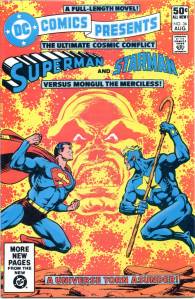
DC Comics Presents debuted with a July/August 1978 cover date . The series was launched with a team-up of Superman and the Flash by writer Martin Pasko and artist José Luis García-López.  Issue #26 included an insert introduction story to the then-upcoming New Teen Titans series by Marv Wolfman and George PérezLen Wein and Jim Starlin co-created the supervillain Mongul in issue #27 (Nov. 1980) as part of a three-issue storyline. Another insert in issue #41 previewed the “new direction” Wonder Woman. In issue #47, Superman traveled to Eternia and met the Masters of the Universe. Ambush Bug made his first appearance in issue #52 (Dec. 1982)  and made additional appearances in issue #59 and #81. The Superman/Challengers of the Unknown tale in issue #84 was drawn by Jack Kirby and Alex Toth. The series also contained the Alan Moore Superman/Swamp Thing story “The Jungle Line” in DC Comics Presents #85 (Sept. 1985), pencilled by Rick Veitch and inked by Al Williamson. Issue #87 featured the first appearance and origin of the divergent Kal-El of the Earth Prime reality, who would become known as Superboy-Prime. The final issue is an exception to the team-up format, instead featuring Superman in an “Untold Tale” involving the Phantom Zone, by Steve Gerber, following up in his limited series of the same title.
Challengers of the Unknown (1977)

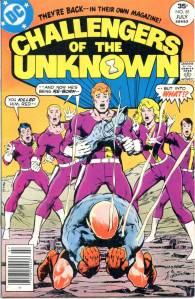
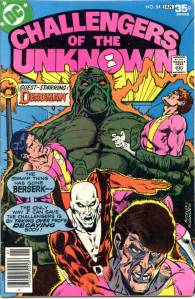
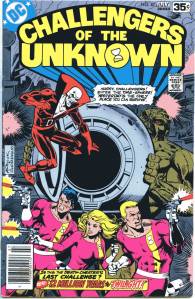
In 1977, the group returned to its own title continuing the number with #81. During this period, they were joined by Deadman and Swamp Thing, and June Robbins got a uniform and official status. No explanation was given for Corinna Stark’s departure, nor June’s joining the team. The revived series was canceled with issue #87 in 1978.

The Brave and the Bold V1 (1970’s)

The title was the first to feature Neal Adams‘ version of Batman, generating fan interest that led to Adams’ style defining the modern Batman image to this day. In addition, Adams updated Green Arrow‘s visual appearance by designing a new costume for the character in issue #85 (Aug.–Sept 1969). The primary artist for the second half of the run was Jim Aparo, starting with #98 (October–November 1971). Haney frequently disregarded continuity by scripting stories which contradicted DC’s canon or by writing major heroes in an out-of-character fashion. Issue #100 (Feb.–March 1972) featured Batman and “4 Famous Co-Stars” (Green Lantern, Green Arrow, Black Canary, and Robin) in a story by Haney and Aparo. Issues #112 (April–May 1974) to #117 (Feb.–March 1975) of the series were in the 100 Page Super Spectacular format.

Batman Family (1975)

The Batman Family ran twenty issues from September-October 1975 to October-November 1978 and featured solo and team-up stories starring Batgirl and Robin. The lead story in the first issue teaming Batgirl and Robin was originally intended for publication in an issue of 1st Issue Special. The series additionally featured reprints of Golden Age and Silver Age stories. Many issues of Batman Family featured Batman supporting characters such as Alfred Pennyworth, Vicki Vale, the Elongated Man, the Huntress, and Ace the Bat-Hound. Writer Bob Rozakis introduced the Duela Dent character in issue #6 (July–August 1976) and revived the original Batwoman in issue #10 (March–April 1977). The series began featuring only new material as of issue #11 (May-June 1977)  and Man-Bat began appearing as a regular feature. Batman Family converted to the Dollar Comics format with issue #17 (April–May 1978).

The Unexpected (1970’s)

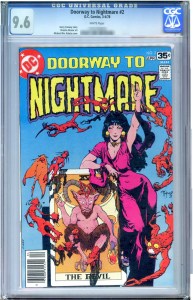
In 1979, The Unexpected converted to the Dollar Comics format and incorporated House of Secrets and The Witching Hour. Each “Unexpected” story would always include the word in its last panel. After the merge, this was only true of the Unexpected section; there would then be complete, ad-free issues of The Witching Hour, hosted by its witches, and The House of Secrets, hosted by AbelThe Witching Hour feature was alternated with Doorway to Nightmare starring Madame Xanadu, which appeared in issues #190, 192, 194, and 195.

New Adventures of Superboy (1980)

his series was published by DC Comics from January of 1980, until June of 1984, branching off from Superboy and the Legion of Super-Heroes, which also split into Legion of Super-Heroes (Volume 2) and from the Superman Family Vol 1. Like its predecessor, Volume 1, this title focused on the adventures of young Clark Kent before he became Superman. The majority of his adventures took place in his home town of Smallville, Kansas. The title contains the final appearances of the Earth-One Superboy prior to the eradication of the Earth-One continuity during the Crisis on Infinite Earths. Between 1984 and the 1986 Post-Crisis continuity relaunch, the only Superboy to appear in DC Comics was Superboy-Prime.

Green Lantern V1 (1970’s)

Green Lantern is the name of a number of superheroes appearing comic books published by DC Comics. They fight evil with the aid of rings that grant them a variety of extraordinary powers.

The first Green Lantern character, Alan Scott, was created in 1940 during the initial popularity of superheroes. Alan Scott usually fought common criminals in New York City with the aid of his magic ring. The publication of this character ceased in 1949 during a general decline in the popularity of superhero comics, but the character saw a limited revival in later decades.

In 1959, to capitalize on the booming popularity of science fiction, the Green Lantern character was reinvented as Hal Jordan, an officer for an interstellar law enforcement agency known as the Green Lantern Corps. Additional members of this agency, all of whom call themselves Green Lanterns, were introduced over time. Prominent Green Lanterns who also have had starring roles in the books include Guy Gardner, John Stewart, Kyle Rayner, and Simon Baz.

Black Magic – DC (1973)

In 1973–1975, DC Comics published a nine-issue series reprinting Simon–Kirby material from the earlier series.[2] The new incarnation featured new covers with the same logo as the earlier issues of the Prize series. The reprint issues generally grouped the stories by theme; for example, all the stories in issue #1 dealt with intolerance toward human oddities, while all the stories in #4 were about death.

The Shadow V1 (1973)

During the mid-1970s, DC Comics published an “atmospheric interpretation” of the character by writer Dennis O’Neil and artist Michael Kaluta in a 12-issue series (Nov. 1973 – Sept. 1975). Kaluta drew issues 1–4 and 6 and was followed by Frank Robbins and then E. R. Cruz. Attempting to be faithful to both the pulp-magazine and radio-drama character, the series guest-starred fellow pulp fiction hero the Avenger in issue #11.

Shade, the Changing Man V1 (1977)

Shade, the Changing Man told the story of a fugitive from the militant planet Meta in another dimension. Shade (whose full name is Rac Shade) was powered by a stolen “M-vest” (or Miraco-Vest, named for its inventor) which protected him with a force field and enabled him to project the illusion of becoming a large grotesque version of himself. The character was the first Ditko had created, or helped to create, for a mainstream publisher for many years. Prior to rejoining DC Comics, Ditko had worked on characters such as his Mr. A. title. Shade was very much a return to mainstream superheroics, although Shade indicated no particular connection with the DC Universe (although the letters columns stated that there is no reason it could not be shown to be there). Michael Fleisher scripted the series based on Ditko’s plotting and art.