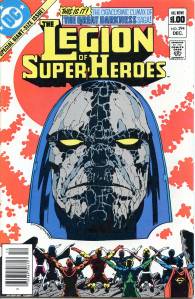
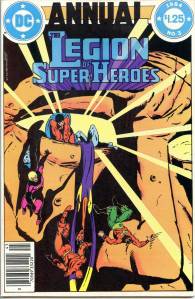
Paul Levitz returned to write the series with #284. Pat Broderick and Bruce Patterson illustrated the title for a short time before Keith Giffen began on pencils, with Patterson, and then Larry Mahlstedt, on inks. The creative team received enhanced popularity following “The Great Darkness Saga“, which ran from #287; #290–294; and Annual #3, featuring a full assault on the United Planets by Darkseid. Comics historian Les Daniels observed that “Working with artist Keith Giffen, Levitz completed the transformation of Legion into a science-fiction saga of considerable scope and depth.”
The Legion celebrated issue #300 (June 1983) by revisiting the “Adult Legion” storyline through a series of parallel world short stories illustrated by a number of popular Legion artists from previous years. The story served to free up Legion continuity from following the “Adult Legion” edict of previous issues.
Legion of Super-Heroes #294 NM- $8Legion of Super-Heroes #303 NM- $3Legion of Super Heros Annual #3 VF-NM $3Tales of the Legion of Super-Heroes #316 VF $3
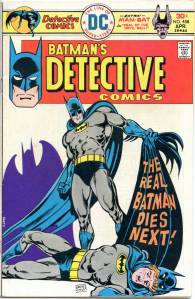
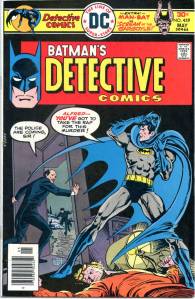
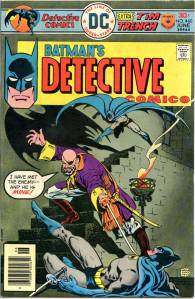
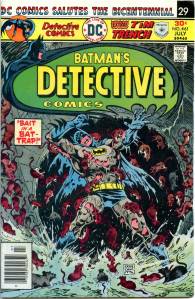
Writer Dennis O’Neil and artist Neal Adams had their first collaboration on Batman on the story “The Secret of the Waiting Graves” in issue #395 (Jan. 1970). The duo, under the direction of Schwartz, would revitalize the character with a series of noteworthy stories reestablishing Batman’s dark, brooding nature and taking the books away from the campy look and feel of the 1966–68 ABCTV series. Comics historian Les Daniels observed that “O’Neil’s interpretation of Batman as a vengeful obsessive-compulsive, which he modestly describes as a return to the roots, was actually an act of creative imagination that has influenced every subsequent version of the Dark Knight.” Adams introduced the Man-Bat with writer Frank Robbins in Detective Comics #400 (June 1970). O’Neil and artist Bob Brown crafted Batman’s first encounter with the League of Assassins in Detective Comics #405 (Nov. 1970) and created Talia al Ghul in issue #411 (May 1971).
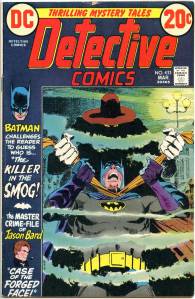
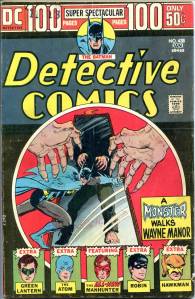
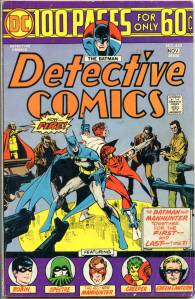
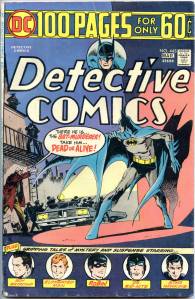
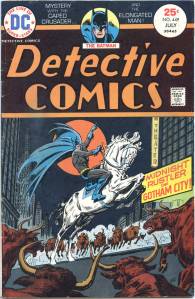
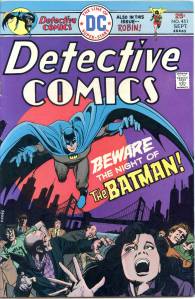
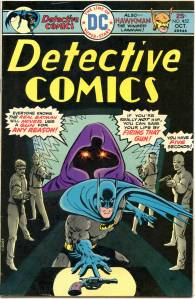
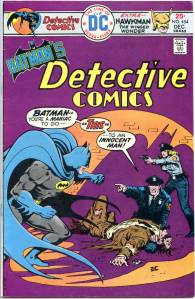
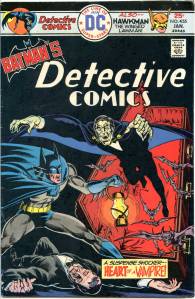
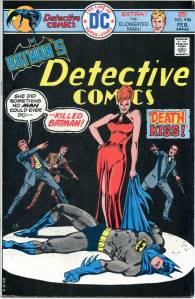
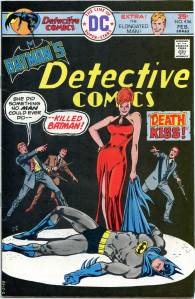
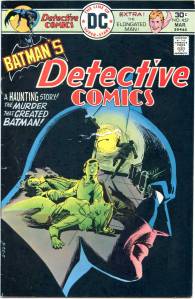
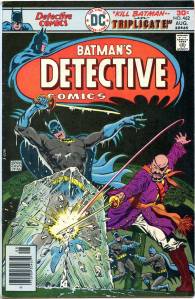
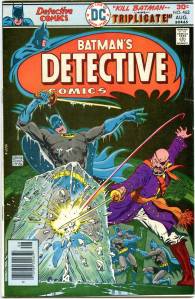
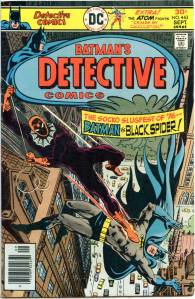
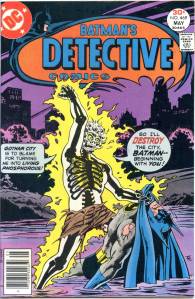
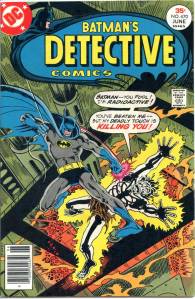
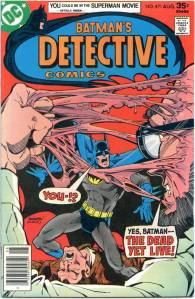
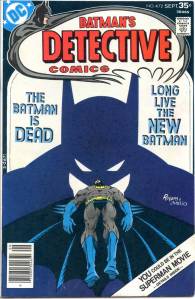
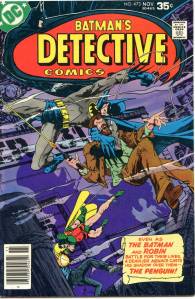
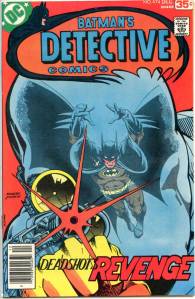
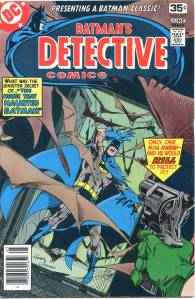
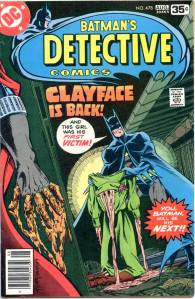
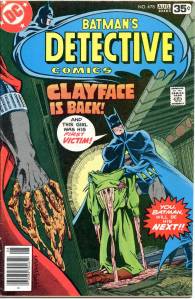
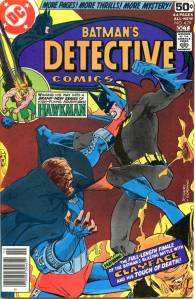
After publishing on a monthly schedule throughout its run, Detective Comics became a bi-monthly book from issues #435 (June–July 1973) to #445 (Feb.-March 1975). Issues #438 (Dec. 1973-Jan. 1974) to #445 (Feb.–March 1975) of the series were in the 100 Page Super Spectacular format. O’Neil and artist Dick Giordano created the Batman supporting character Leslie Thompkins in the story “There Is No Hope in Crime Alley” appearing in issue #457 (March 1976). Writer Steve Englehart and artist Marshall Rogers produced an acclaimed run of Batman stories in Detective Comics #471–476 (Aug. 1977 – April 1978), and provided one of the definitive interpretations that influenced the 1989 Batman movie and would be adapted for the 1990s animated series. The Englehart and Rogers pairing, was described in 2009 by comics writer and historian Robert Greenberger as “one of the greatest” creative teams to work on the Batman character. In their story “The Laughing Fish”, the Joker is brazen enough to disfigure fish with a rictus grin, then expects to be granted a federal trademark on them, only to start killing the bureaucrats who try to explain to him that obtaining such a claim on a natural resource is legally impossible. Writer Len Wein and Rogers co-created the third version of the supervillain Clayface in Detective Comics #478 (July–Aug. 1978). The original Katherine Kane also known as “Batwoman” was killed in the lead story in issue #485 (Aug.–Sept. 1979) by the League of Assassins.
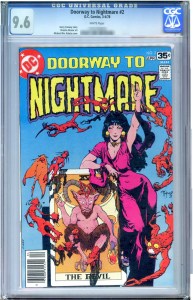
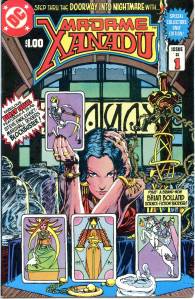
Doorway to Nightmare, introduced in 1978, was the last of the DC “Mystery” line of titles in the 1970s that became the forerunner of Vertigo. It did not have a consistent creative team—the intent was to create writer-artist pairings that had never occurred before, except for the cover art of Michael William Kaluta. Madame Xanadu, the star of the series, was not a host but an active participant, albeit never the main character in her stories.
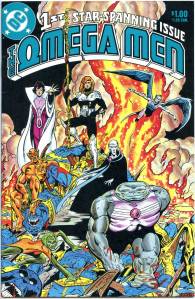
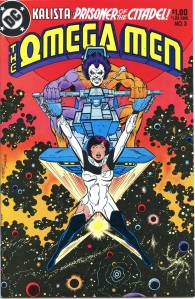
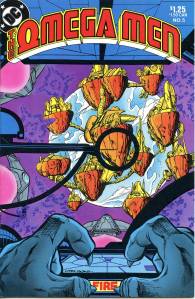
The Omega Men are a team of extraterrestrial superheroes who have appeared in various comic book series published by DC Comics. They first appeared in Green Lantern#141 (June 1981), and were created by Marv Wolfman and Joe Staton.
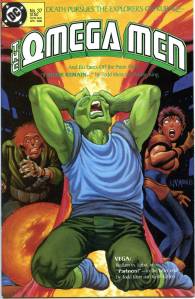
After appearances in Green Lantern, Action Comics and The New Teen Titans, the Omega Men were featured in their own comics series which ran for 38 issues from April 1983 to May 1986. During its run, writer Roger Slifer and artist Keith Giffen created the mercenary anti-hero Lobo.
The Omega Men were assembled as a group of renegades and representatives of conquered Vegan worlds to fight Citadelian aggression. Pre-Infinite Crisis the team was based on the planet Kuraq. The Omega Men are important peacekeepers in their sector because the Green Lantern Corps is not allowed into Vegan space, due to a long standing agreement with the Psions.
Omega Men V1 #1 VF-NM $3Omega Men #3 NM $120Omega Men #5 NM $9Omega Men #10 NM $14Omega Men #37 NM $14
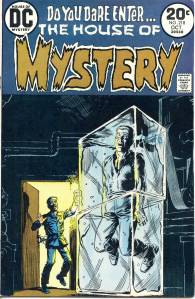
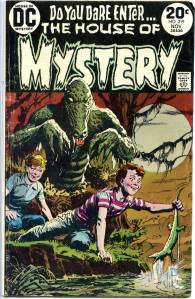
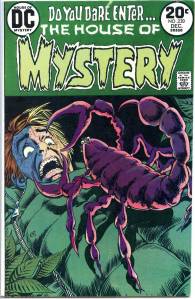
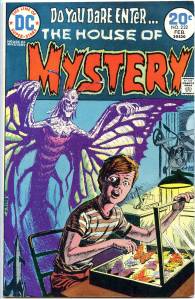
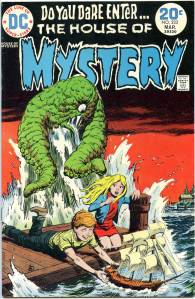
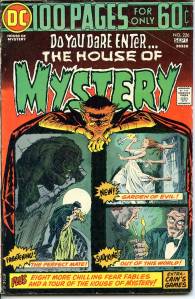
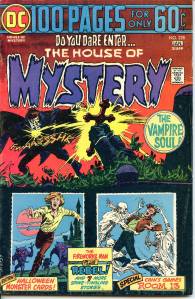
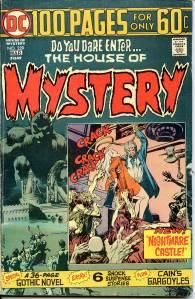
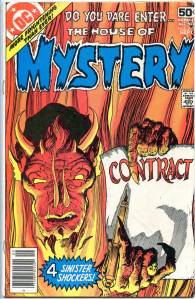
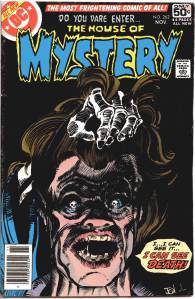
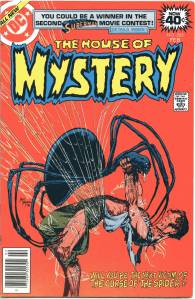
With issue #174, EC Comics veteran Joe Orlando was hired by DC to take over as editor of House of Mystery. As the Comics Code Authority was now being challenged by both DC and Marvel over content restrictions, the series returned to its overt horror themes. The first issue under Orlando would be a reprint issue of old horror/suspense stories, as the new direction would truly begin with #175 (July–August 1968). The issue would introduce a new figure to the series, Cain, the “able care taker” of the House of Mystery who would introduce nearly all stories that would run in the series before its cancellation. Cain would also host the spin-off humor series Plop! and later become a recurring character in Blue Devil and The Sandman.
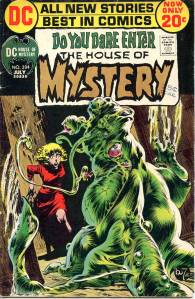
Artist Bernie Wrightson‘s first professional comic work was the story “The Man Who Murdered Himself” which appeared in issue #179 (March–April 1969)
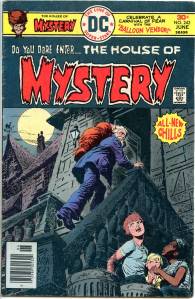
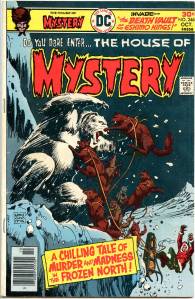
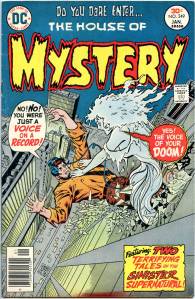
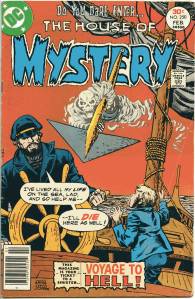
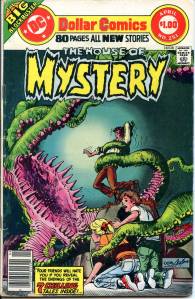
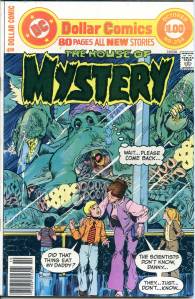
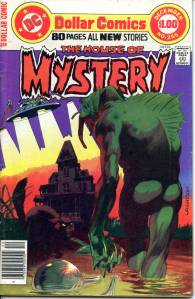
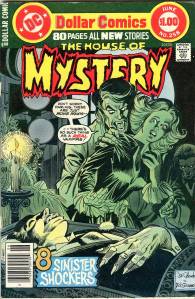
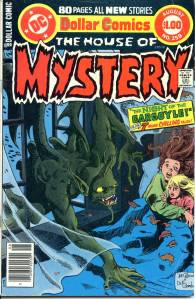
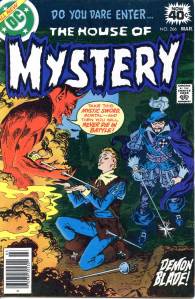
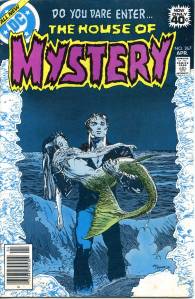
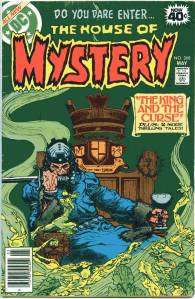
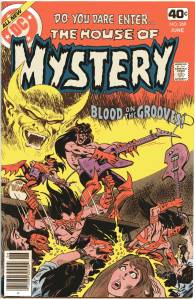
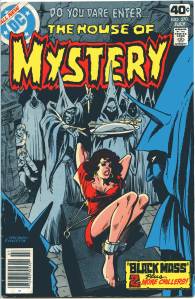
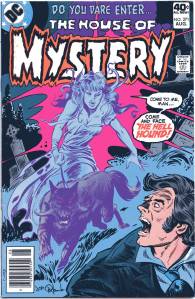
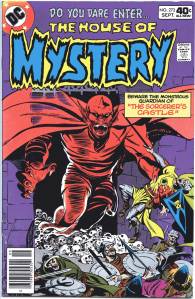
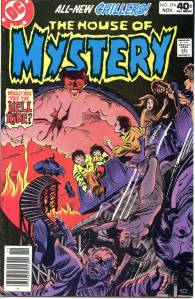
House of Mystery was in the Dollar Comics format for issues #251 (March–April 1977) to #259 (July–August 1978). House of Mystery featured stories by writers T. Casey Brennan (#260, 267, 268 and 274) and Scott Edelman (#257, 258, 260, 264, 266, 270, 272, 273). Orlando’s tenure as editor ended with #257 (March–April 1978).
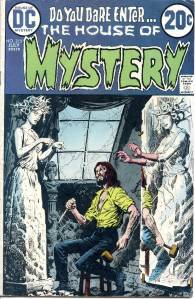
House of Mystery #199 VG+ $14House of Mystery #204 FN $18House of Mystery #209 FN $24House of Mystery #215 FN+ $14House of Mystery #218 FN-VF $16House of Mystery #219 VG $8House of Mystery #220 FN+ $12House of Mystery #222 VF- $12House of Mystery #223 VF- $12House of Mystery #224 VG+ $14House of Mystery #226 VG+ $14House of Mystery #228 FN+ $24House of Mystery #229 FN $19House of Mystery #240 FN-VF $13House of Mystery #242 VG-FN $10House of Mystery #244 FN-VF $15House of Mystery #246 VG-FN $10House of Mystery #249 VG $5House of Mystery #250 FN-VF $10The House of Mystery #251 FN $11The House of Mystery #252 FN+ $12The House of Mystery #254 VF $16The House of Mystery #255 FN- $8House of Mystery #258 VF- $16The House of Mystery #259 FN+ $10House of Mystery #260 VG+ $7House of Mystery #262 FN $8House of Mystery #263 VF $6House of Mystery #265 FN- $6House of Mystery #266 VF-NM $10House of Mystery #267 VF+ $8House of Mystery #268 VG-FN $5House of Mystery #269 VF- $5House of Mystery #270 FN $6House of Mystery #271 VF- $5House of Mystery #272 FN $5House of Mystery #273 VF-NM $12House of Mystery #274 VF $6
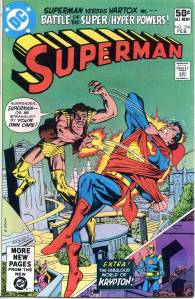
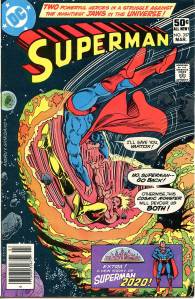
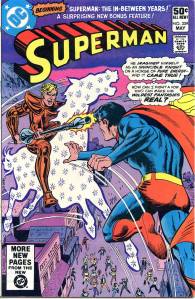
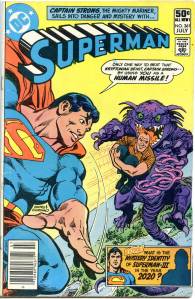
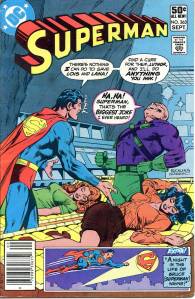
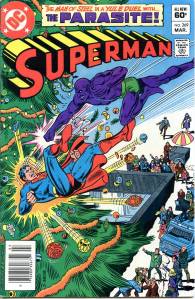
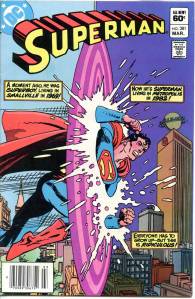
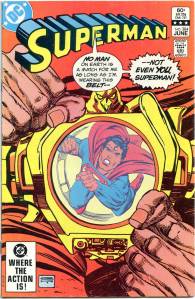
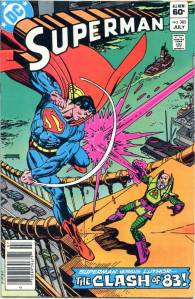
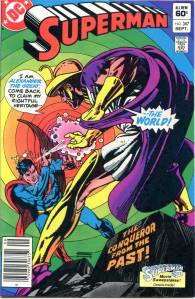
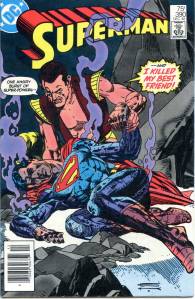
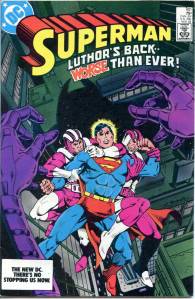
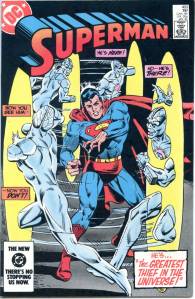
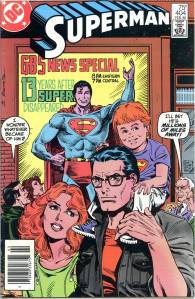
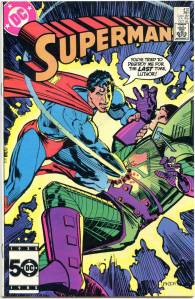
The 1980s saw radical revisions of Superman. DC decided to remove the multiverse in a bid to simplify its comics line. This led to the rewriting of the back story of the characters DC published, Superman included. John Byrne rewrote Superman, removing many established conventions and characters from continuity, including Superboy and Supergirl. Byrne also re-established Superman’s adoptive parents, The Kents, as characters. In the previous continuity, the characters had been written as having died early in Superman’s life (about the time of Clark Kent’s graduation from high school).
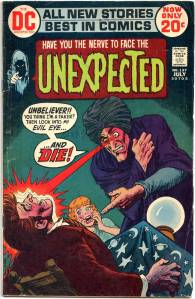
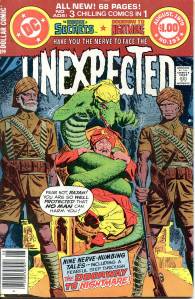
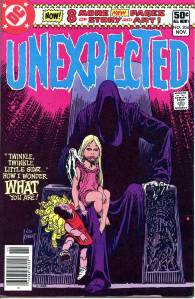
In 1979, The Unexpected converted to the Dollar Comics format and incorporated House of Secrets and The Witching Hour. Each “Unexpected” story would always include the word in its last panel. After the merge, this was only true of the Unexpected section; there would then be complete, ad-free issues of The Witching Hour, hosted by its witches, and The House of Secrets, hosted by Abel. The Witching Hour feature was alternated with Doorway to Nightmare starring Madame Xanadu, which appeared in issues #190, 192, 194, and 195.
Step thru the doorway into nightmare with Madame Xanadu in the 25-page “Dance For Two Demons.” Script by Steve Englehart, art by Marshall Rogers. Madame Xanadu centerfold by Michael W. Kaluta. Plus: A disease that transforms and corrupts is explored in the 7-page science fiction tale “Falling Down to Heaven…” Script by J.M. DeMatteis, art by Brian Bolland. Cover by Michael W. Kaluta.
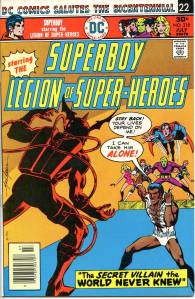
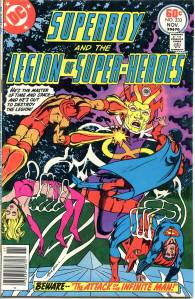
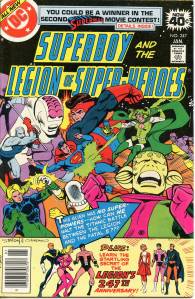
Superboy became Superboy starring the Legion of Super-Heroes with issue #197 (August 1973). Crafted by Bates and Cockrum, the feature proved popular and saw such events as the wedding of Bouncing Boy and Duo Damsel in Superboy #200 (Feb 1974). Cockrum was replaced on art by Mike Grell as of issue #203 (August 1974) which featured the death of Invisible Kid. With #231 (September 1977), the book’s title officially changed to Superboy and the Legion of Super-Heroes and also became a “giant-size” title. At this point, the book was written by longtime fan Paul Levitz and drawn by James Sherman, although Gerry Conway frequently wrote as well. Saturn Girl and Lightning Lad were married in All-New Collectors’ Edition #C-55 (1978), a treasury-sized special written by Levitz and drawn by Grell. In #241–245 (July–December 1978) Levitz and Sherman (and then Joe Staton) produced what was at that time the most ambitious Legion storyline: “Earthwar“, a galactic war between the United Planets and the Khunds, with several other villains lurking in the background. During this period, Karate Kid was spun off into his own 20th Century-based self-titled series, which lasted 15 issues. Levitz left the book, to be replaced full-time by Gerry Conway.
Superboy departed from the Legion due to a plot of a villain, and the book was renamed simply Legion of Super-Heroes starting with issue #259 (January 1980). Editor Jack C. Harris hired Steve Ditko as guest artist on several issues, a decision which garnered a mixed reaction from the title’s readership. Jimmy Janes became the regular artist in a lengthy tale by Conway (and later Roy Thomas) involving Ultra Boy’s disappearance during a mission, and his long odyssey to rejoin the team. This story told the tale of the Legionnaire Reflecto (only glimpsed during the “Adult Legion” stories in Adventure Comics), featured villainy by the Time Trapper and Grimbor the Chainsman, and saw Superboy rejoin the team.
Superboy and the Legion of Super-Heroes #204 FN $5
Superboy and the Legion of Super-heroes #218 VF- $5
Superboy and the Legion of Super-heroes #219 NM- $12
Superboy and the Legion of Super-Heroes #233 VF $6
Superboy and the Legion of Super-Heroes #237 VF+ $8
Superboy and the Legion of Super-Heroes #245 VF+ $7
Superboy and the Legion of Super-Heroes #247 VF+ $7
Superboy and the Legion of Super-Heroes #250 VF-NM $8
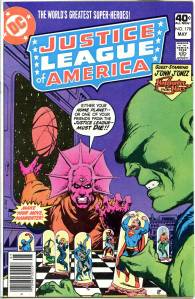
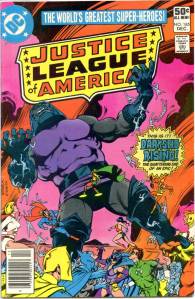
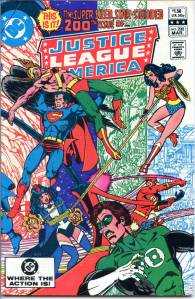
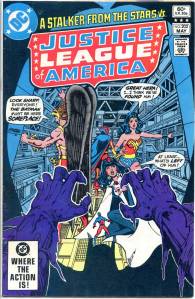
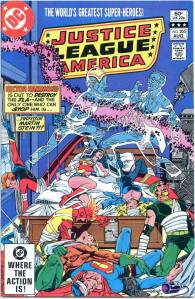
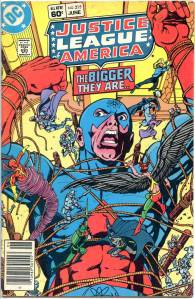
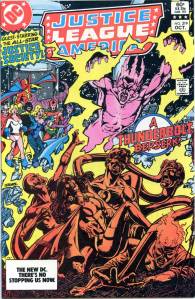
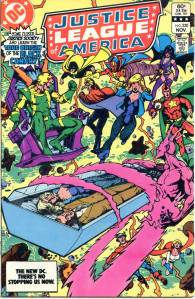
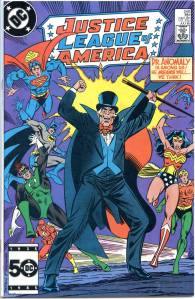
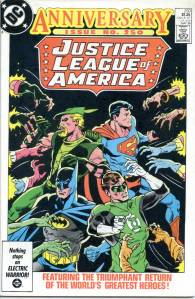
In the early 80’s, George Pérez, Don Heck, and Rich Buckler would rotate as artist on the title. The double-sized anniversary issue #200 (March 1982) was a “jam” featuring a story written by Conway, a framing sequence drawn by Pérez, and chapters drawn by Pat Broderick, Jim Aparo, Dick Giordano, Gil Kane, Carmine Infantino, Brian Bolland, and Joe Kubert. Bolland’s chapter gave the artist his “first stab at drawing Batman.” Pérez would leave the title with issue #200 to concentrate on The New Teen Titans although he would contribute covers to the JLAthrough issue #220 (November 1983). The 1982 team-up with the Justice Society in issues #207–209 crossed over with All-Star Squadron #14–15. A Justice League story by Gerry Conway and Rich Buckler originally intended for publication as an issue of All-New Collectors’ Edition saw print in Justice League of America #210–212 (January–March 1983).
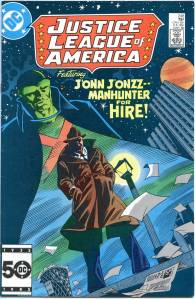
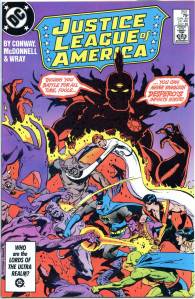
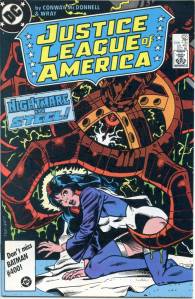
Seeking to capitalize on the popularity of their other team books, which focused upon heroes in their late teens/early 20s, Gerry Conway and artist Chuck Patton revamped the Justice League series. After most of the original heroes fail to help fend off an invasion of Martians, Aquaman dissolves the League and rewrites its charter to allow only heroes who will devote their full-time to the roster. The new team initially consists of Aquaman, Zatanna, Martian Manhunter, Elongated Man, the Vixen, and a trio of teenage heroes Gypsy, Steel, and Vibe. Aquaman leaves the team after a year, due to resolving marital problems, and his role as leader is assumed by the Martian Manhunter.
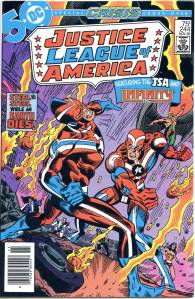
The final storyline for the original Justice League of America series (#258–261), by writer J. M. DeMatteis and artist Luke McDonnell, concludes with the murders of Vibe and Steel at the hands of robots created by long-time League nemesis Professor Ivo, and the resignations of Vixen, Gypsy, and the Elongated Man during the events of DC’s Legends miniseries, which sees the team disband.





























































 EHT Comics