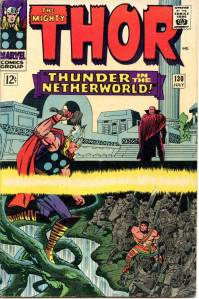
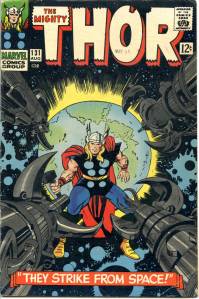
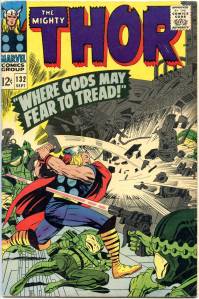
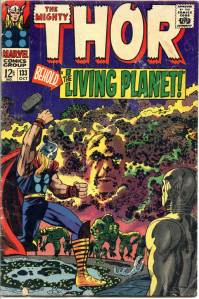
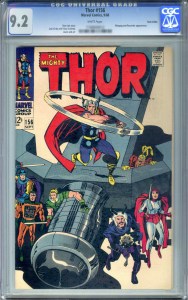
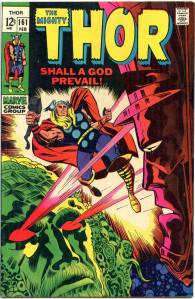
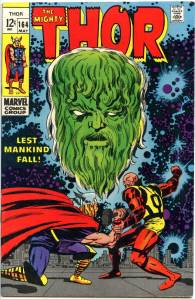
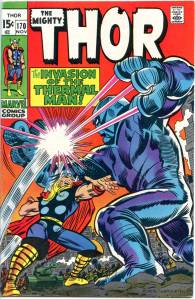
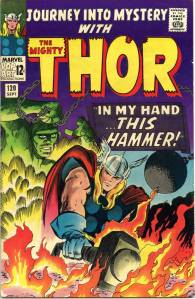
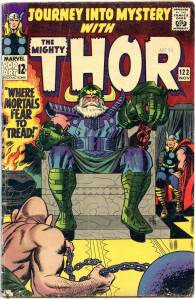
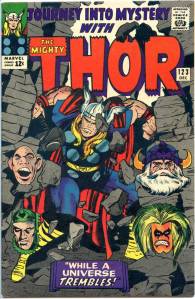
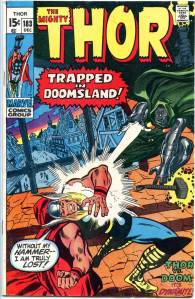
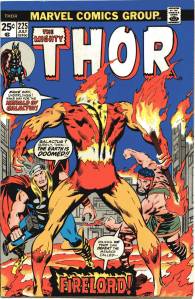
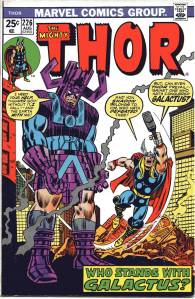
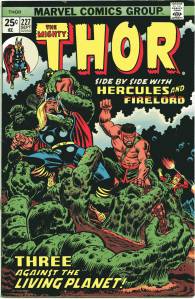
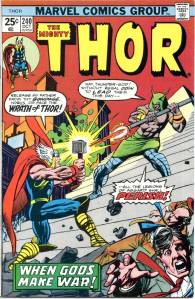
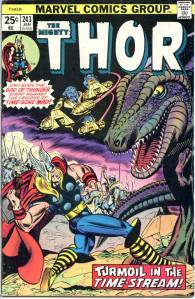
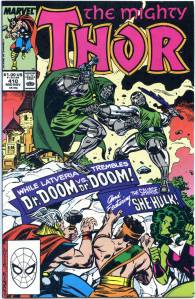
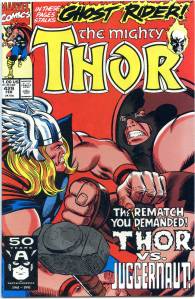
Journey into Mystery was initially published by Atlas Comics, then by its successor, Marvel Comics. Initially a horror comics anthology, it segued to giant-monster and science fiction stories in the late 1950s. Beginning with issue #83 (cover dated August 1962), it ran the superhero feature “The Mighty Thor“, created by writers Stan Lee and Larry Lieber and artist Jack Kirby, and inspired by the mythological Norse thunder god. The series, which was renamed for its superhero star with issue #126 (March 1966), has been revived three times: in the 1970s as a horror anthology, and in the 1990s and 2010s with characters from Marvel’s Thor mythos.
Tag: Thor
Thor (1980’s)
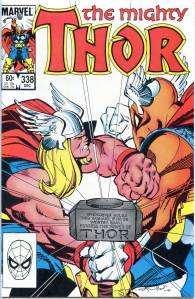
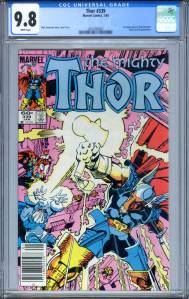
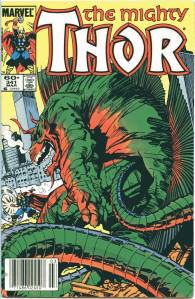
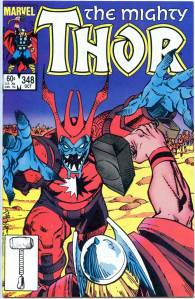
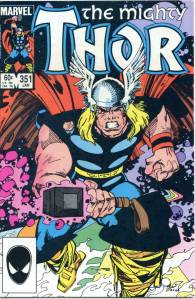
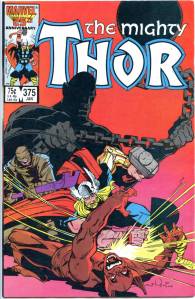
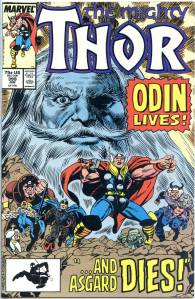
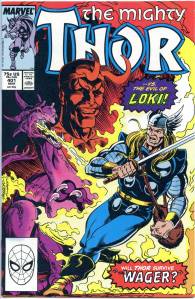
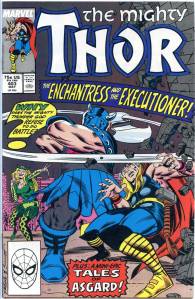
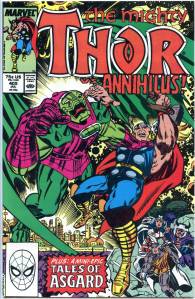
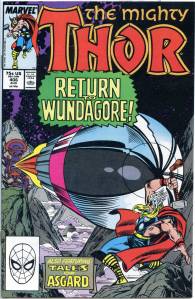
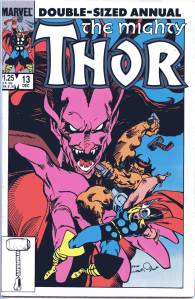
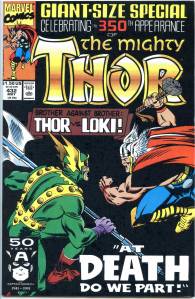
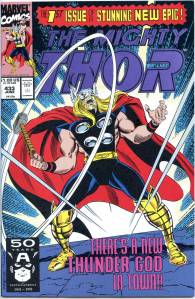
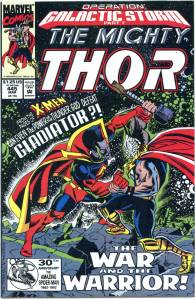
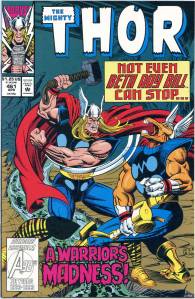
Walt Simonson took over both writing and art as of #337 (Nov. 1983). His stories placed a greater emphasis on the character’s mythological origins. Simonson’s run as writer-artist lasted until #367 (May 1986), although he continued to write – and occasionally draw – the book until issue #382 (Aug. 1987). Simonson’s run, which introduced the character Beta Ray Bill, was regarded as a popular and critical success. Simonson’s later stories were drawn by Sal Buscema, who describes Simonson’s stories as “very stimulating. It was a pleasure working on his plots, because they were a lot of fun to illustrate. He had a lot of great ideas, and he took Thor in a totally new direction.” Asked why he was leaving Thor, Simonson said that he felt the series was due for a change in creative direction, and that he wanted to reduce his work load for a time. After Simonson’s departure, Marvel’s editor-in-chief at the time, Tom DeFalco, became the writer. Working primarily with artist Ron Frenz, DeFalco stayed on the book until #459 (Feb. 1993).
Thor (Silver Age)
Thor debuted in the science fiction/fantasy anthology title Journey into Mystery #83 (cover-date Aug. 1962), and was created by editor-plotter Stan Lee, scripter Larry Lieber, and penciller-plotter Jack Kirby. A different version of the mythological Thor had appeared previously in Venus #12-13 (Feb.-April 1951).
In a 1984 interview Kirby said “I did a version of Thor for D.C. in the Fifties before I did him for Marvel. I created Thor at Marvel because I was forever enamored of legends, which is why I knew about Balder, Heimdall, and Odin. I tried to update Thor and put him into a superhero costume, but he was still Thor.” And in a 1992 interview, Kirby said “[I] knew the Thor legends very well, but I wanted to modernize them. I felt that might be a new thing for comics, taking the old legends and modernizing them.”
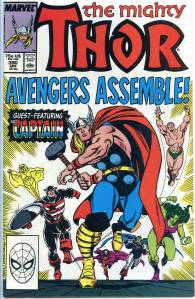
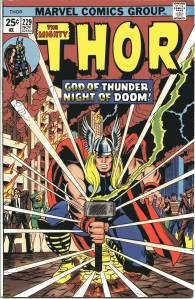
Journey into Mystery was retitled Thor (per the indicia, or The Mighty Thor per most covers) with issue #126 (March 1966). “Tales of Asgard” was replaced by a five-page featurette starring the Inhumans from #146–152 (Nov. 1967 – May 1968), after which featurettes were dropped and the Thor stories expanded to Marvel’s then-standard 20-page length.
Thor (1970’s)
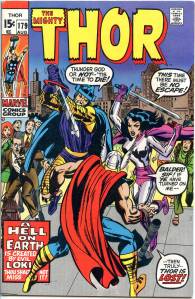
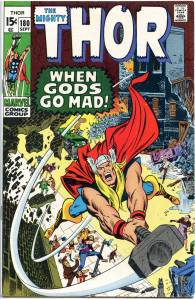
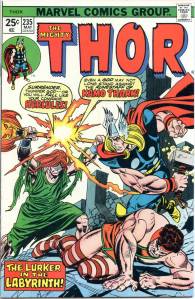
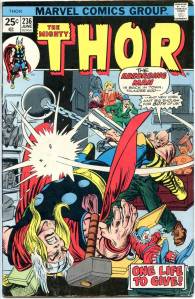
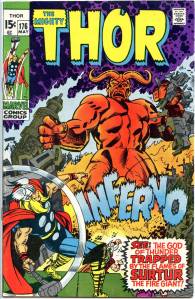
After Kirby left the title, Neal Adams penciled issues #180–181 (Sept.-Oct. 1970). John Buscema then became the regular artist the following issue. Buscema continued to draw the book almost without interruption until #278 (Dec. 1978). Lee stopped scripting soon after Kirby left, and during Buscema’s long stint on the book, the stories were mostly written by Gerry Conway, Len Wein, or Roy Thomas. Thomas continued to write the title after Buscema’s departure, working much of the time with the artist Keith Pollard; during this period Thomas integrated many elements of traditional Norse mythology into the title, with specific stories translated into comics form. Following Thomas’s tenure, Thor had a changing creative team.
In the mid-1970s, Marvel considered giving the character a second series as part of parent company Magazine Management‘s line of black-and-white comics magazines. A story written by Steve Englehart for the aborted project appeared in Thor Annual #5 (1976). A black-and-white Thor story appeared in Marvel Preview #10 (Winter 1977).
Thor (1990’s)
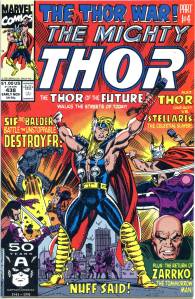
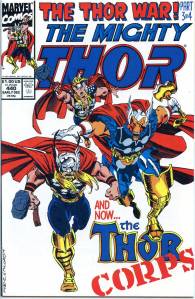
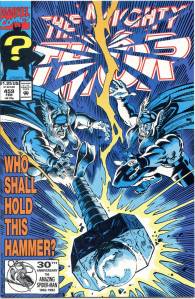
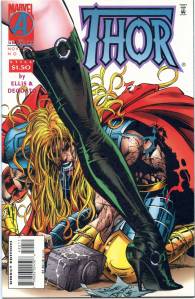
After Simonson’s departure, Marvel’s editor-in-chief at the time, Tom DeFalco, became the writer. Working primarily with artist Ron Frenz, DeFalco stayed on the book until #459 (Feb. 1993). As a consequence of the “Heroes Reborn” crossover story arc of the 1990s, Thor was removed from mainstream Marvel continuity and with other Marvel characters re-imagined in an alternate universe for one year. The Thor title reverted to Journey into Mystery with issue #503 (Nov. 1996), and ran four different, sequential features (“The Lost Gods”; “Master of Kung Fu“; “Black Widow“, and “Hannibal King“) before ceasing publication with #521 (June 1998).
Thor V6 (2020)
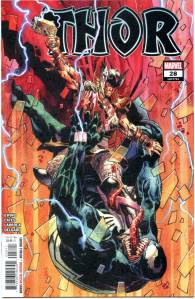
The prince is now a king. All Asgard lies before Thor, the God of Thunder. And after many months of war, the Ten Realms are finally at peace. But the skies above the Realm Eternal are never clear for long. The Black Winter is coming. And the God of the Storm will be powerless before it.
Unworthy Thor (2016)
Odinson’s desperate search to regain his worthiness has taken him out into the cosmos, where he’s learned of the existence of a mysterious other Mjolnir. This weapon of unimaginable power, a relic from a dead universe, is the key to Odinson’s redemption – but some of the greatest villains of the Marvel Universe are now anxious to get their hands on it as well. Can The Odinson reclaim his honor, or will the power of thunder be wielded for evil? The quest for the hammer begins here.
Loki (2004)
Loki has now claimed leadership of Asgard, and all must recognize that fact, even Thor. Finally winning the throne after a long sought out fight is not as sweet as he thought it would be. The ones that helped him now demand their due and the favors he promised them, including the death goddess Hela and seductress Lorelei. While he goes about his kingdom, he continually turns to his prisoners, Thor and Sif. Sif berates him for being jealous of her, and of cutting off her golden hair, only to bring about a greater love between her and Thor. While Balder reminds him that he has died and gone to Hel, while there, sees that there are parallel dimension incarnations of Thor, Loki, and Balder: Some different, yet all play the same roles. And Loki’s role is never to rule. Loki then turns to Karnilla, and agrees to free Balder into her care, in exchange for her to peer into a myriad other dimensions. There he sees confirmation of Balder’s words, all with Thor triumphant. Loki decides that Thor will indeed die at dawn by beheading. As he’s walking out of the dungeons, he runs into Fárbauti, his birth father. Loki decides to go against fate, and spare his brother as well as free him and Hela is revealed to be a failed illusion cast by Loki to convince him to kill his brother. Thor decides that when breaking free from his prison, he defeats his brother.
Thor V3 (2007)
Adrift in the Void, Thor reflects upon the many adventures he has had, notably those that involve his fellow Asgardians, Sif and the Warriors Three. Suddenly, Thor feels a strong summoning and is surprised to discover that it comes from Doctor Donald Blake, the late physician who was once host to the power and essence of Thor. Don tells him that he has more experience with understanding the afterlife than Thor does, and encourages him to return to the world of the living. He tells him that the fate of Midgard is in great peril if he fails to return. Thor battles through a host of ethereal demons before accepting his role as a Child of Mjolnir. With the hammer once more in his possession, Thor announces that he wishes to return.
Thor V2 (1998)
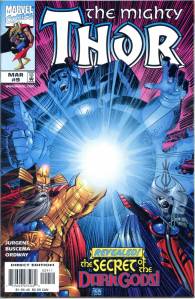
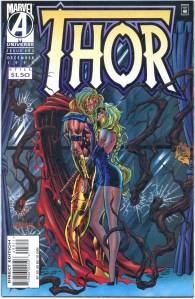
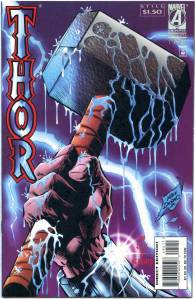
After “Hereos Reborn”, Thor and several members of the Avengers battle the Destroyer. Thor is saved by an enigmatic being called Marnot, who binds the life-force of a mortal called Jake Olson to the thunder god. Thor enters into a war with the Dark Gods with Marnot revealed to be Hescamer, one of Odin’s ravens; and battles the returning Enchanters Three.