Green Arrow – 80th Anniversary (2021)

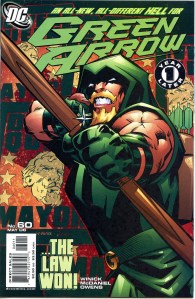
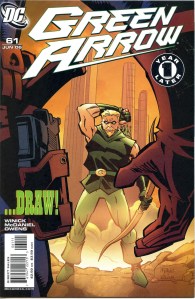
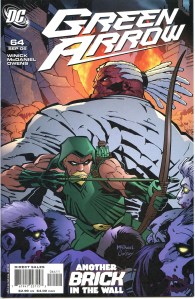
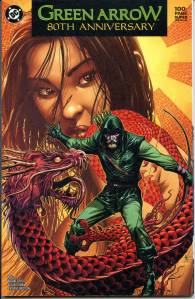
Celebrating the Emerald Archer’s 80th Anniversary! For the last eight decades Green Arrow has been one of the premier (and loudest) characters in the DCU, always at the forefront of where the superhero genre is headed. This over-sized anniversary issue follows in those footsteps, as an all-star lineup of Green Arrow creators, alongside some of the gifted creators of the modern era who have been inpsired by Oliver Queen, unite to pay tribute to the Battling Bowman. See what the past, present and future have in store for Oliver Queen, Black Canary, Connor Hawke, Arsenal, Red Arrow, Speedy, and more in this epic special!
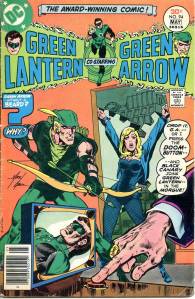
Green Lantern V1 (1970’s)

Green Lantern is the name of a number of superheroes appearing comic books published by DC Comics. They fight evil with the aid of rings that grant them a variety of extraordinary powers.

The first Green Lantern character, Alan Scott, was created in 1940 during the initial popularity of superheroes. Alan Scott usually fought common criminals in New York City with the aid of his magic ring. The publication of this character ceased in 1949 during a general decline in the popularity of superhero comics, but the character saw a limited revival in later decades.

In 1959, to capitalize on the booming popularity of science fiction, the Green Lantern character was reinvented as Hal Jordan, an officer for an interstellar law enforcement agency known as the Green Lantern Corps. Additional members of this agency, all of whom call themselves Green Lanterns, were introduced over time. Prominent Green Lanterns who also have had starring roles in the books include Guy Gardner, John Stewart, Kyle Rayner, and Simon Baz.

Green Arrow V3 (2000)

In 2000, Oliver Queen is revived in a new series, Green Arrow (vol. 3), in the story arc “Quiver“, written by Kevin Smith and illustrated by Phil Hester and Ande Parks. It is revealed that Hal’s resurrection of Oliver (seen on the very last page of Green Arrow #137, the final issue of the Oliver/Connor ongoing series) was in reality a deliberately flawed one. In Hal’s final hours before sacrificing his life to save the Earth during “The Final Night“, Hal speaks with Oliver’s soul in the afterlife. The two agree to bring back a version of Oliver Queen: one without a soul (so Oliver may properly stay in Heaven) and with no memory of the events of The Longbow Hunters mini-series or of the subsequent events that followed, up until his death, Oliver reasoning that things went wrong for him after the events that drove him to kill for the first time and feeling that the copy of him was restored at the best point in his life.

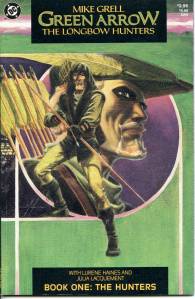
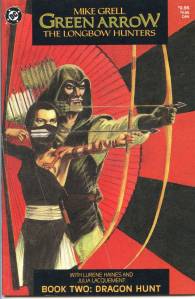
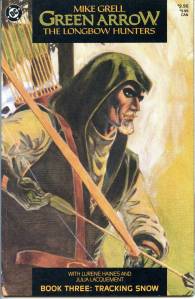
Green Arrow – The Longbow Hunters (1987)

Green Arrow: The Longbow Hunters was nominated for a 1988 Eisner Award for Best Finite Series.

The series proved popular enough that DC Comics commissioned the first ever Green Arrow ongoing series, also written by Grell (writer from issues #1-80, 1988-1993). The series ran for 11 years. Grell would write a retelling of Green Arrow’s origin and first case in Secret Origins, (vol. 2) #38 (March 1989). Grell also wrote and illustrated the official Post-Crisis origin of Green Arrow in Green Arrow: The Wonder Year miniseries in 1993.

The series was major influence on TV series Arrow. Oliver is not referred to as “Green Arrow” in the show, wears a hooded costume similar to that worn in The Longbow Hunters, and in the first season, is willing to use lethal force. Edward Fyers is a main antagonist in the first season, and Shado has a recurring role in the first and second seasons. A character based on the Seattle Slasher, referred to as the Starling Slasher to match the show’s setting, appeared in the episode “Blind Spot.”

In 2014, writer Jeff Lemire used the name “Longbow Hunters” for a team of villains in his final story arc in the New 52 Green Arrow series.