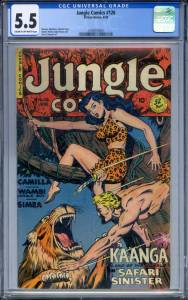
Having not been able to saturate the market’s insatiable demand for jungle sirens with Sheena in Jumbo Comics, Fiction House unleashed another series titled Jungle Comics. Running 163 issues staring January 1940 the series did not end until Fiction House succumbed to the Comics Code Authority over 14 years later.
Stories featured the main character Kaänga, a rather familiar sounding westerner child raised by apes. Another westerner, Ann Mason, became his mate after he rescued her from slave traders.
Jungle Comics #126 CGC 5.5 Cream to Off-White Pages $149
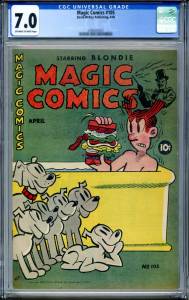
Magic Comics was published by David McKay Company from 1939 to 1949. The series was a compilation of newspaper strip reprints such as “Mandrake the Magician“, “Inspector Wade”, “Henry”, “Jan and Aloysius”, “Popeye”, “Secret Agent X-9”, “The Lone Ranger” and “Blondie”.
Magic Comics #105 CGC 7.0 Off-White to White Pages $129
Life Begins for Andy Panda is a 1939 American short subject cartoon created by Walter Lantz, as the very first Andy Panda film. The short capitalized on public interest surrounding the United States’ first captive panda, Su Lin, who had been donated to the Brookfield Zoo in Chicago three years earlier and whose arrival created a consumer desire for panda-related products.
Andy led a major part of his career in comic books, in Dell Comics‘ Crackajack Comics and New Funnies and his own series. One early Andy Panda comic book adventure was drawn by Carl Barks (New Funnies #76, 1943). John Stanley also did Andy Panda comic book work.
A companion series to Crime Does Not Pay from the same publisher, slightly less violent and with more emphasis on police work. Stories and art by Fred Kida, Dick Rockwell, Carl Wessler, Fred Guardineer, and Charles Biro.
Crime and Punishment #18 CGC 5.5 Off-White to White Pages $85
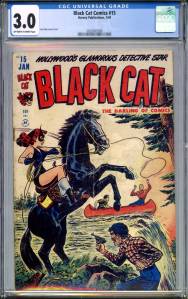
Linda Turner is the daughter of silent filmWestern actor Tim Turner, and a former Hollywood stunt woman. Linda has successfully made the transition from stunt woman to lead actress. During the filming of an unnamed picture, Linda suspects the film’s director, Garboil (no first name given), of being a Nazi spy or at the very least an American Bund member. In order to follow him and gain corroborating evidence, she disguises herself in a backless blue blouse, red shorts, blue flared gloves, red buccaneer boots and a blue opera mask and calls herself the Black Cat.
According to Jess Nevins’ Encyclopedia of Golden Age Superheroes, most of the Black Cat’s opponents are ordinary criminals and Axis agents, but she does fight a female mad scientist, the criminal brothers known as the Three Black Cats, a vampire, and after the war Russians in Afghanistan.
In 1944, The Black Cat’s costume was modified slightly, becoming a one piece blue bathing suit with buccaneer boots, flared gloves and opera mask, all in blue, and a red belt. This look would remain for the rest of her career.
Black Cat #15 (1949) CGC 3.0 Off-White to White Pages $189
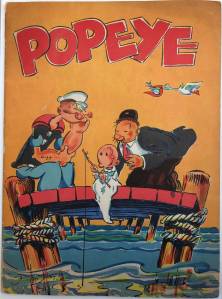
Popeye Story book published in 1936 by King Features. Full color, oversized format 9 1/4-in. x 13-in. Bound in linen-like material. Published before the Feature Book series
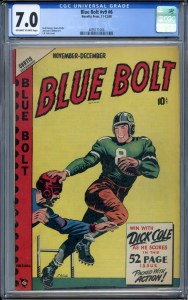
After college football star Fred Parrish is struck by lightning during practice he boards a plane in order to seek help. This plane is struck by a second lightning bolt, causing the plane to crash. Finding himself underground, Parrish is found by a scientist named Bertoff who heals him using an experimental radium treatment. This treatment gives Parrish super powers. Using his powers and a lightning gun given to him by Bertoff, Parrish takes up the name the Blue Bolt and battles the underground forces of his arch-enemy, the evil Green Sorceress.
After a year, the Blue Bolt discovers that World War II has started. He journeys back to the surface to fight against the Nazis.
After the war, Blue Bolt becomes a pilot for Glimpses, the picture magazine, and works with daring photographer Snap Doodle.
Blue Bolt V9 #6 CGC 7.0 Off-White to White Pages $179
Walter Lantz Woody Woodpecker became an independent comic book (starting with issue #16 to reflect the earlier appearances in Four Color) in Dec. 1952-Jan. 1953. It ran for 201 issues, published by Dell and then Western Publishing (Whitman/Gold Key), lasting until 1983.
Dell was the first publisher of the Looney Tunes comic books, starting in 1941 and lasting until 1962, with a total of 246 issues published. Dell also made other comics based on the Looney Tunes characters including Bugs Bunny, Daffy Duck, Tweety and Sylvester, etc. All Looney Tunes publications stopped in 1962, moving over to Gold Key Comics instead. The Looney Tunes title itself took a hiatus till 1975, but the character-based titles continued.
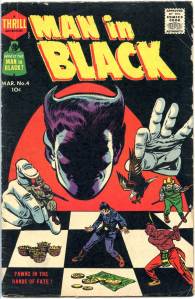
Stories and art by Bob Powell and others. Cover by Bob Powell. The Man in Black tells strange stories, sometimes intervening in person, other times merely letting ironic fate unfold. Fate prevents peace talks between the US and the Apache on the eve of Custer’s Last Stand. Cupid and Venus discover a kiss is the invitation to doom for two people. An unhappy janitor risks his life to steal a valuable treasure. The first movie buff on the moon deals with incompatible formats. Ambush; Jims Eagle; The Thief; Treasure; The Old and the New; Movies on the Moon; How It Might Have Happened. Issue 4 is the final issue of the series.





 EHT Comics