Four Color (1939-1962)

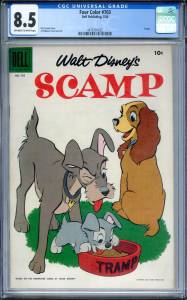
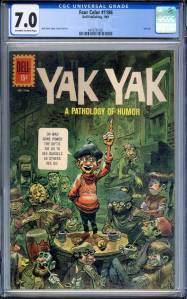
Four Color, also known as Four Color Comics and One Shots, was a long-running American comic book anthology series published by Dell Comics between 1939 and 1968. The title is a reference to the four basic colors used when printing comic books (cyan, magenta, yellow and black at the time).

More than 1,000 issues were published, usually with multiple titles released every month. An exact accounting of the actual number of unique issues produced is difficult because occasional issue numbers were skipped and a number of reprint issues were also included. Nonetheless, the Overstreet Comic Book Price Guide lists well over 1,000 individual issues, ending with #1354. It currently holds the record for most issues produced of an American comic book; its nearest rivals, Action Comics and Detective Comics, ended their initial runs in 2011 at 904 issues and 881 issues, respectively. The first 25 issues are known as “series 1”; after they were published, the numbering began again and “series 2” began. Four Color published many of the first comics featuring characters licensed from Walt Disney.

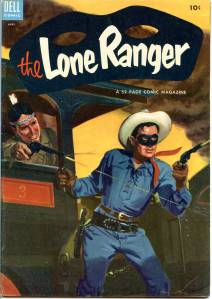
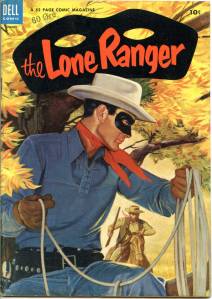
The Lone Ranger (1954)

In 1948, Western Publishing, with its publishing partner Dell Comics, launched a comic book series which lasted 145 issues. This originally consisted of reprints from the newspaper strips (as had all previous comic book appearances of the character in various titles from David McKay Publications and from Dell). However, new stories by writer Paul S. Newman and artist Tom Gill began with issue #38 (August 1951). Some original content was presented as early as #7 (January 1949), but these were non-Lone Ranger fillers. Newman and Gill produced the series until its final issue, #145 (July 1962).

Tonto got his own spin-off title in 1951, which lasted 31 issues. Such was the Ranger’s popularity at the time that even his horse Silver had a comic book, The Lone Ranger’s Famous Horse Hi-Yo Silver, starting in 1952 and running 34 issues; writer Gaylord DuBois wrote and developed Silver as a hero in his own right. In addition, Dell also published three big Lone Ranger annuals, as well as an adaptation of the 1956 theatrical film.

The Dell series came to an end in 1962. Later that same year, Western Publishing ended its publishing partnership with Dell Comics and started up its own comic book imprint, Gold Key Comics. The new imprint launched its own Lone Ranger title in 1964. Initially reprinting material from the Dell run, original content did not begin until issue #22 in 1975, and the magazine itself folded with #28 in 1977. Additionally, Hemmets Journal AB published a three-part Swedish Lone Ranger story the same year.

Felix the Cat (1950)

Otto Messmer pursued the Sunday Felix comic strips until their discontinuance in 1943, when he began eleven years of writing and drawing Felix comic books for Dell Comics that were released every other month. Jack Mendelsohn was the ghostwriter of the Felix strip from 1948 to 1952. In 1954, Messmer retired from the Felix daily newspaper strips, and his assistant Joe Oriolo (the creator of Casper the Friendly Ghost) took over. The strip concluded in 1966.

Turok Son of Stone (Dell)

Turok, Son of Stone, was illustrated by Rex Maxon. The writer-creator credit for the characters of Turok and Andar is disputed, with historians citing Matthew H. Murphy, Gaylord Du Bois and Paul S. Newman as the feature’s earliest writers.

The Western Publishing version of Turok was a Pre-Columbian era Native American (identified as Mandan in the first issue, on page 21 and 32 of Dell Four Color #596) who, along with his brother, Andar, became trapped in an isolated canyon valley populated by dinosaurs, which they refer to in general as “hoppers”, “monsters” and more often than not, beginning in Dell issue number 9, page 35 as “honkers”, as well as by their most obvious characteristics (tyrannosaurs are called “runners”, pterosaurs are called “flyers”, velociraptors are “screamers”, plesiosaurs are “sea demons”, Triceratops are “rammers”, etc.). The Du Bois stories involve Turok and Andar seeking a way out of the canyon. Du Bois was influenced by his visits to Carlsbad CavernsNew Mexico and developed the “Lost Valley” from his visits to the area.

After two appearances in Four Color #596 and #656, the title ran 27 issues (#3–29) published by Dell Comics (1956–62); then issues #30–125 (1962–80) from Gold Key Comics; and finally issues #126–130 (1981–82) under Western’s Whitman Comics imprint.