Deadman: Love after Death (1989)

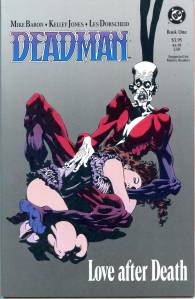
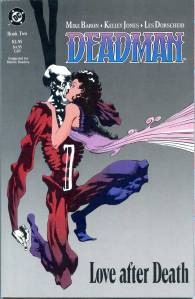
Death is the loneliest state of existence, a fact that Boston Brand never stopped to consider…at least not until he died. But after an assassin’s bullet cuts down the famed circus aerialist, Deadman learns the hard way what it’s like to be truly alone and all he can do is pray that he would one day find love after death. Investigating an abandoned circus in the Wisconsin Northwoods, Deadman comes upon another ghost…the spirit of a female aerialist who was rumored to have been murdered by her husband, the owner of the circus. The two spirits fall in love…but even death can’t protect her from her still-living husband’s jealousy as he unleashes a horde of side show horrors to keep them apart. But that’s only the tip of the supernatural iceberg and something even more sinister is under way.
Super Powers V2 (1985)

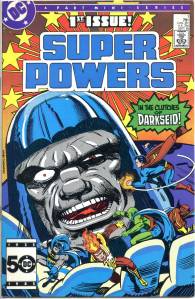
A second Super Powers, six-issue mini-series is published in 1985 and is set after the Hunger Dogs graphic novel. The second mini-series was written by Paul Kupperberg and illustrated by Jack Kirby (inked by Greg Theakston). Like its predecessor, this mini-series takes special attention to spotlight the new characters (and a few vehicles) being released in the wave 2 of the toy line. This second wave of the toy line was notable for including re-designed versions of Kirby’s Fourth World characters (Darkseid, Desaad, Mantis, Parademon, Kalibak, Steppenwolf) and Kirby manages to stay faithful to their toy line appearance throughout the mini-series.

Catwoman (1989)

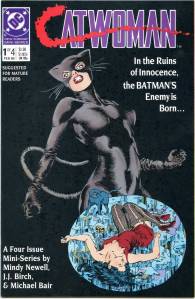
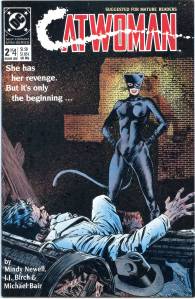
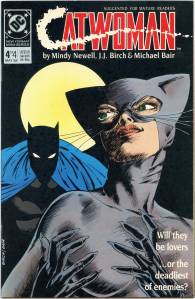
The 1989 Catwoman limited series, written by Mindy Newell and with art by J.J. Birch, expanded upon Miller’s Year One origin. This storyline, known as “Her Sister’s Keeper”, explores Selina’s early life as a dominatrix and the start of her career as Catwoman. The story culminates with Selina’s former pimp, Stan, abducting and beating her sister Maggie, who, in contrast to Selina, is a nun. Selina kills Stan to save her sister, and gets away with it. Most of this is revealed in the former series, but is expanded upon in “Her Sister’s Keeper”.

Mister Miracle V2 (1989)

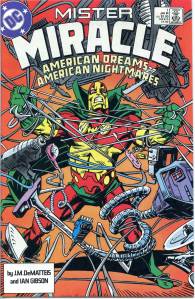
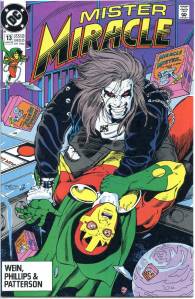
Mister Miracle was revived as part of the Justice League International lineup in 1987, a one-shot special by writer Mark Evanier and artist Steve Rude was published in 1987. This special was followed by an ongoing series that began in January 1989, written by J. M. DeMatteis and drawn by Ian Gibson. Other writers who contributed to the title include Keith GiffenLen Wein, and Doug Moench. This run lasted 28 issues before cancellation in 1991. The series was largely humor-driven, per Giffen’s reimagining Scott Free, his wife Big Barda, and their friend Oberon, who pretended to be Scott’s uncle, as living in suburbia when they were not fighting evil with the Justice League.

Green Arrow – The Longbow Hunters (1987)

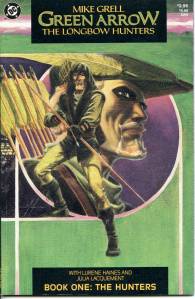
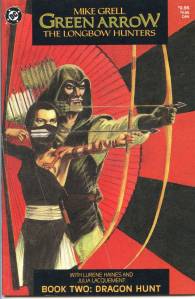
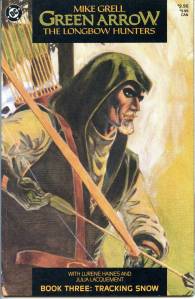
Green Arrow: The Longbow Hunters was nominated for a 1988 Eisner Award for Best Finite Series.

The series proved popular enough that DC Comics commissioned the first ever Green Arrow ongoing series, also written by Grell (writer from issues #1-80, 1988-1993). The series ran for 11 years. Grell would write a retelling of Green Arrow’s origin and first case in Secret Origins, (vol. 2) #38 (March 1989). Grell also wrote and illustrated the official Post-Crisis origin of Green Arrow in Green Arrow: The Wonder Year miniseries in 1993.

The series was major influence on TV series Arrow. Oliver is not referred to as “Green Arrow” in the show, wears a hooded costume similar to that worn in The Longbow Hunters, and in the first season, is willing to use lethal force. Edward Fyers is a main antagonist in the first season, and Shado has a recurring role in the first and second seasons. A character based on the Seattle Slasher, referred to as the Starling Slasher to match the show’s setting, appeared in the episode “Blind Spot.”

In 2014, writer Jeff Lemire used the name “Longbow Hunters” for a team of villains in his final story arc in the New 52 Green Arrow series.

Lex Luthor – The Unauthorized Biography (1989)

He’s arguably one of the most influential men in America today. He’s inarguably the evilest. His name is Lex Luthor…and whatever Luthor wants, Luthor gets – even if it’s the life of a man who threatens his privacy. But it’s Clark Kent who’s arrested for the brutal murder of down-and-out biographer Peter Sands, a man who hoped to climb back to the top with THE UNAUTHORIZED BIOGRAPHY OF LEX LUTHOR. All it got him was dead. What are the secrets of his past that Luthor is willing to kill for…secrets that the merciless criminal mastermind wants kept dead and buried?

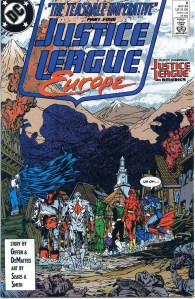
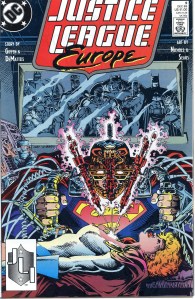
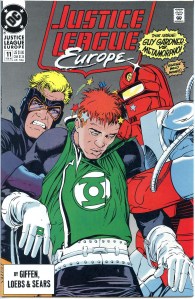
Justice League Europe (1989)

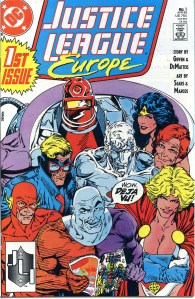
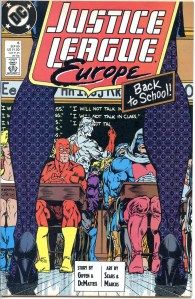
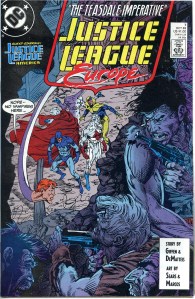
Justice League Europe was a DC Comics book run that was a spin-off of the comic book Justice League America (which was then named Justice League International (vol 1) for issues #7 to #25)

Justice League Europe was published for 68 issues (plus five annuals) from 1989 to 1994. Starting with issue #51 the title was renamed Justice League International (vol. 2). Like Justice League America, the series featured tongue-in-cheek humor but was a much more action-centric series than Justice League America. The action-themed nature of the series was most overt with the series’ most famous arc “The Extremists”. The arc featured the JLE fighting The Extremists, a cadre of psychopathic villains patterned after Marvel Comics villains Doctor Doom, Magneto, Doctor Octopus, Sabretooth and Dormammu.

The team was originally headquartered in Paris, France but later moved to an abandoned castle in Great Britain.

Legion of Super-Heroes V3 (1984)

The new series was launched in August 1984, with a five-part story featuring the Legion of Super-Villains. Giffen left in the middle of the story and was replaced by Steve Lightle, who stayed on the book for a year. The debut story arc saw the death of Karate Kid in issue #4. Levitz and Lightle co-created two Legionnaires, Tellus and Quislet, whose unusual appearances contrasted with the humanoid appearances of the other Legionnaires. Greg LaRocque began a lengthy run in #16, including a crossover with John Byrne‘s recently rebooted Superman titles in #37 and #38. The crossover was the first of several attempts by DC editors to explain the origins and fate of Superboy and his history with the Legion, in light of the revisions to the DC Universe caused by Crisis on Infinite Earths that removed Superman’s career as Superboy from his personal history. In the crossover, the Legion’s Superboy was revealed to have come from a parallel “pocket universe” created by the Time Trapper. The crossover ended with Superboy’s death. Levitz’s run ended with the return of Giffen and a four-part story “The Magic Wars”, concluding in #63 (August 1989).