Legends of the Dark Knight 100-Page Super Spectacular was an ongoing comic book featuring Batman stories by many different creative teams. All the stories were intended to be “continuity free” and do not fit into the canon of any of the mainstream DC universes (Prime Earth, New Earth, Earth-One or Earth-Two). This series was digital first, meaning the stories were first available online, and then later published on paper in this series.
Legends of the Dark Knight 100 Page Super Spectacular #2 NM $10
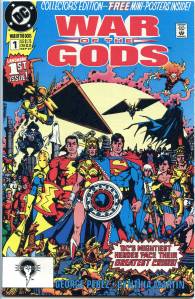
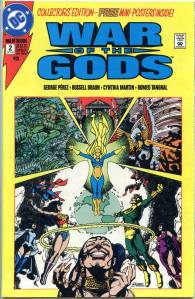
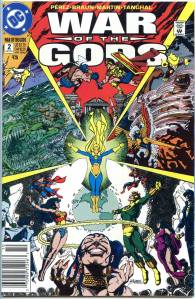
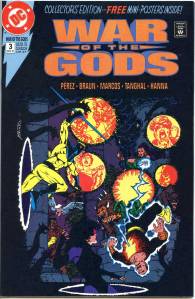
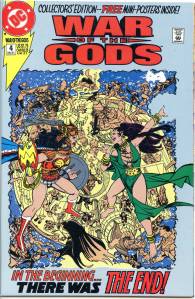
Worldwide, ancient gods suddenly begin trying to destroy the Earth and each other. While the ancient Roman gods wage war with the Olympian gods, the Egyptian, African, Norse, Babylonian and Thanagarian gods each want to recreate the world in their own images, and attack the superheroes who stand in their way. Unknown to them, it is in fact the sorceress Circe who has led each of them to wage war on each other, so she can destroy the Earth goddess Gaea. With the threat of Wonder Woman stopping her, Circe makes sure she has her hands busy fighting Captain Marvel, under the influence of the Roman Gods, before he destroys the Greek Gods.
The five-issue mini-series Final Crisis: Legion of 3 Worlds led into an all-new volume of Adventure Comics, featuring the revived Conner Kent/Superboy and the Legion of Super-Heroes. The main creative team of Geoff Johns and Francis Manapul debuted in a backup story in Adventure Comics #0 (April 2009). A secondary feature starring the Legion of Super-Heroes was co-written with Mike Shoemaker and drawn by Clayton Henry. The first issue of the new run of Adventure Comics was released on August 12, 2009, and features watermarked numbering marking it as both #1 and#504, thus continuing the original numeration of the series concurrently with the volume 2 numeration. For the variant incentive cover editions, the original numeration was dominant on the cover while the vol. 2 numeration was the watermarked numbering marking. The indicia of the comic book also reflects this dual numbering. The title officially returned to its original vol. 1 numbering with #516 (cover dated September 2010), until #529 when it was finally ended prior to DC’s The New 52 company reboot.
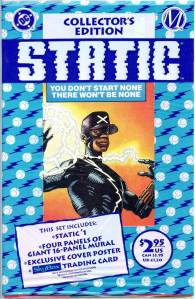
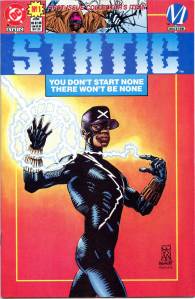
Static is a fictional superhero appearing in American comic books published by DC Comics. The character, a creation of Milestone Comics founders Dwayne McDuffie, Denys Cowan, Michael Davis, and Derek Dingle was initially written by McDuffie and Robert L. Washington III and illustrated by John Paul Leon. Static’s first appearance was made in Static #1. Born Virgil Ovid Hawkins, he is a member of a fictional subspecies of humans with superhuman abilities known as metahumans. Not born with his powers, Hawkins’s abilities develop after an incident exposes him to a radioactive chemical. This event renders him capable of electromagnetic control and generation.
DC celebrates Asian Heritage Month with all your favorite Asian DC characters, old and new! Join Cassandra Cain, Katana, Green Lantern Tai Pham, the Atom, Dana Tan (a.k.a. Batman Beyond), Red Arrow, Lady Shiva, Damian Wayne and the al Ghul clan, New Super-Man, and more as DC presents new tales of these characters from their thrilling history! Plus, Cheshire Cat’s relationship to Cheshire is revealed as Shoes asks Selina Kyle to take her under her wing as Cat Girl.
Following the company-wide rebranding in DC Rebirth with one focus point to bring back legacy and relationships, Arthur finally proposes to Mera in DC Universe: Rebirth #1. Aquaman was given an eighth volume of his eponymous series, which started with a one-shot comic book entitled Aquaman: Rebirth #1 (August 2016). This issue and the subsequent eighth volume of Aquaman kept writer Dan Abnett who had taken over the title of the three last issues in the New 52, having previously written the character for a short time a decade earlier.
The eighth volume of Aquaman focuses on Aquaman’s role as king and diplomat, with Arthur attempting to strengthen Atlantis-surface relationships by opening an Atlantean embassy in Amnesty Bay, with Mera appointed as ambassador. The series largely focuses on the main cast featured in the New 52 series consisting of Aquaman, Mera, and Black Manta, while also fleshing out forgotten side characters such as Murk, Tula (Aquagirl), Black Jack, and others.
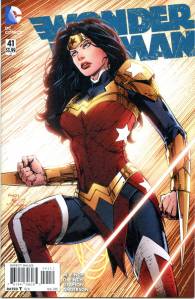
In 2011’s The New 52, DC Comics relaunched its entire line of publications to attract a new generation of readers, and thus released volume 4 of the Wonder Woman comic book title. Brian Azzarello and Cliff Chiang were assigned writing and art duties respectively and revamped the character’s history considerably. In this new continuity, Wonder Woman wears a costume similar to her original Marston costume (except with a red-black-silver color scheme rather than the classic red-blue-gold), utilizes a sword and shield, and has a completely new origin. No longer a clay figure brought to life by the magic of the gods, she is, instead, a demi-goddess and the natural-born daughter of Hippolyta and Zeus. Azzarello and Chiang’s revamp of the character was critically acclaimed, but highly divisive among longtime fans of the character.
In a world where Superman hasn’t aged a day since the Nazis won WWII; Clark Kent infiltrates Axis dominated Europe in pursuit of Lana Lang, who has fallen prey to the enchantress Circe, while Lois Lane finds herself transformed by the power of the ancient gods into a Wonder Woman.











 EHT Comics