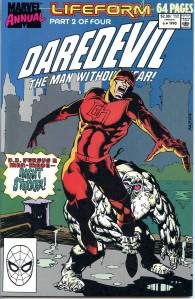
Daredevil debuted in Marvel Comics‘ Daredevil #1 (cover date April 1964), created by writer-editor Stan Lee and artist Bill Everett, with character design input from Jack Kirby, who devised Daredevil’s billy club. When Everett turned in his first-issue pencils extremely late, Marvel production manager Sol Brodsky and Spider-Man co-creator Steve Ditko inked a large variety of different backgrounds, a “lot of backgrounds and secondary figures on the fly and cobbled the cover and the splash page together from Kirby’s original concept drawing”.
Writer and comics historian Mark Evanier has concluded (but cannot confirm) that Kirby designed the basic image of Daredevil’s costume, though Everett modified it. The character’s original costume design was a combination of black, yellow, and red, reminiscent of acrobat tights. Wally Wood, known for his 1950s EC Comics stories, penciled and inked issues #5–10, introducing Daredevil’s modern red costume in issue #7.
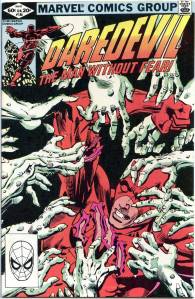
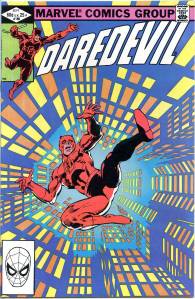
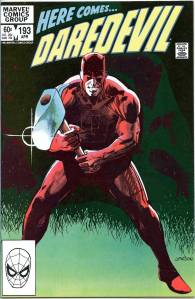
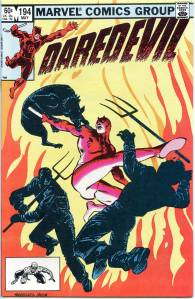
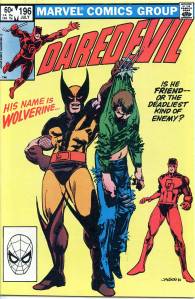
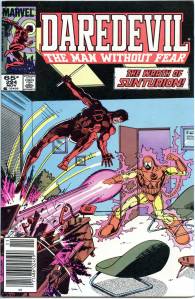
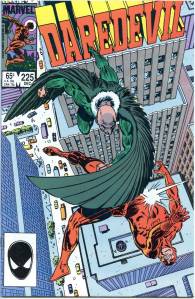
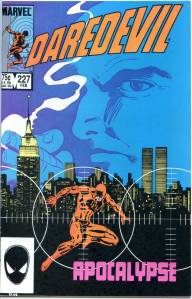
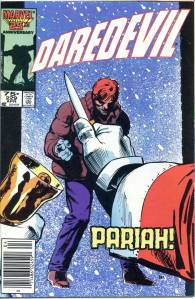
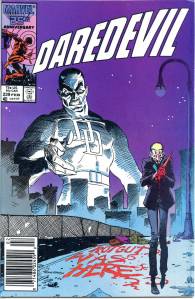
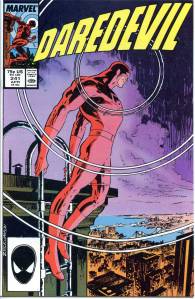
During the 80’s Frank Miller was hired to continue the title and did so in a similar vein to previous writer Roger McKenzie. Resuming the drastic metamorphosis the previous writer had begun, Miller took the step of essentially ignoring all of Daredevil’s continuity prior to his run on the series; on the occasions where older villains and supporting cast were used, their characterizations and history with Daredevil were reworked or overwritten. Most prominently, dedicated and loving father Jack Murdock was reimagined as a drunkard who physically abused his son Matt, entirely revising Daredevil’s reasons for becoming a lawyer. Spider-Man villain Kingpin was introduced as Daredevil’s new nemesis, displacing most of his large rogues gallery. Daredevil himself was gradually developed into an antihero. In issue #181 (April 1982), he attempts to murder one of his arch-enemies by throwing him off a tall building; when the villain survives as a quadriplegic, he breaks into his hospital room and tries to scare him to death by playing a two-man variation on Russian roulette with a secretly unloaded gun.Comics historian Les Daniels noted that “Almost immediately, [Miller] began to attract attention with his terse tales of urban crime.” Miller’s revamping of the title was controversial among fans, but it clicked with new readers, and sales began soaring, the comic returning to monthly status just three issues after Miller came on as writer.
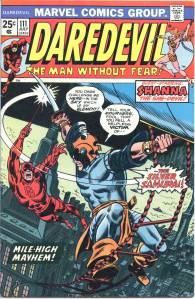
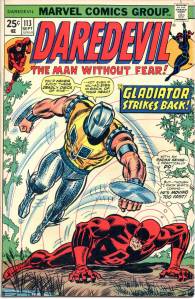
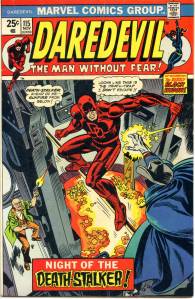
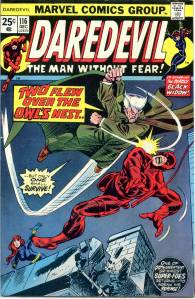
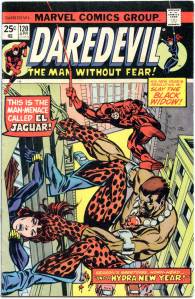
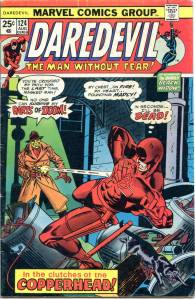
Gerry Conway took over as writer with issue #72, and turned the series in a pulp science fiction direction: a lengthy story arc centered on a robot from thousands of years in the future trying to change history. Even long-standing arch-villain the Owl was outfitted with futuristic weaponry and vehicles. Conway also moved Daredevil to San Francisco beginning with Daredevil #86, and simultaneously brought on the Black Widow as a co-star for the series. The Black Widow served as Daredevil’s crime-fighting ally as well as his love interest from issue #81–124 (Nov. 1971–Aug. 1975), of which #93-108 were titled Daredevil and the Black Widow.
In a story arc overlapping Wolfman, Shooter, and McKenzie’s runs on the series, Daredevil reveals his identity to Heather Glenn and becomes partially responsible for the suicide of her father; their relationship would persist but would prove increasingly harmful to both of them. Though the Black Widow returned for a dozen issues (#155–166) and attempted to rekindle her romance with Daredevil, he ultimately rejects her in favor of Glenn.
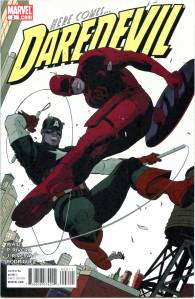
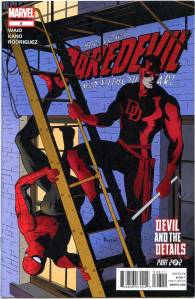
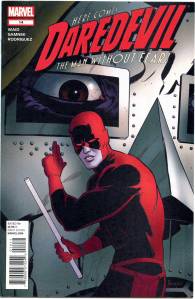
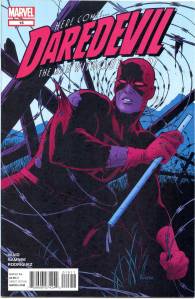
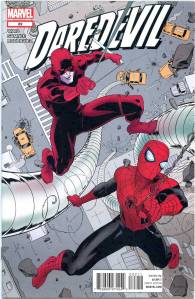
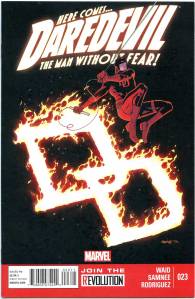
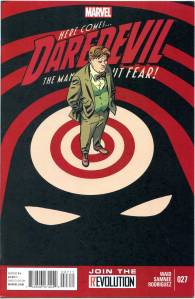
In July 2011, Daredevil relaunched with vol. 3, #1 (Sept. 2011), with writer Mark Waid. Waid focused on emphasizing the character’s powers and perception of the physical world. In the premiere issue, Murdock finds he can no longer serve as a trial lawyer due to past allegations of his being Daredevil causing a case he represents in court to turn into a media circus. Two issues later, Nelson and Murdock have developed a new business strategy of serving as consulting counselors, by teaching clients how to represent themselves in court.
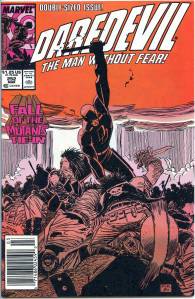
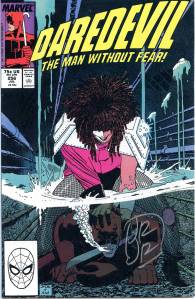
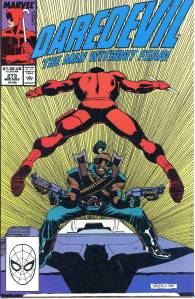
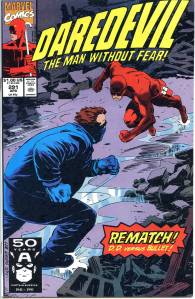
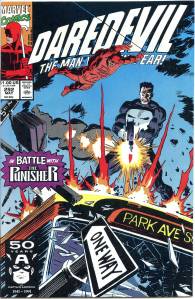
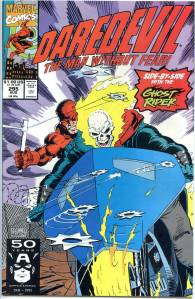
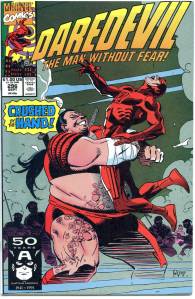
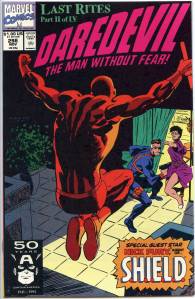
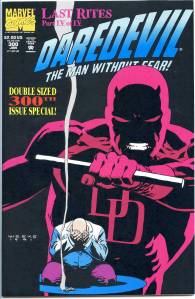
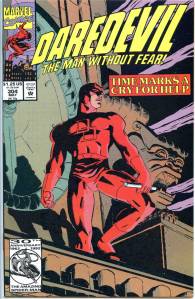
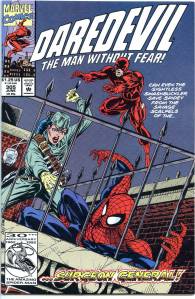
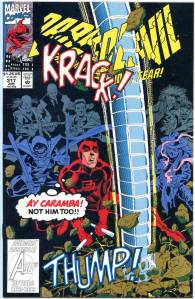
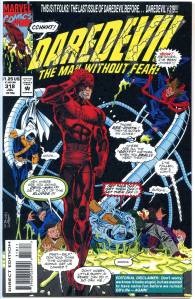
New writer D. G. Chichester and pencilerLee Weeks continued from where Nocenti left off, with Murdock resuming his friendship with Foggy Nelson, struggling to re-win the heart of Karen Page, appealing the revocation of his attorney’s license, and bonding more deeply than ever with Hell’s Kitchen. Chichester’s focus on Daredevil’s relationship with New York City went so far as to have two issues devoted entirely to Daredevil defending New Yorkers from ordinary criminals and even simple accidents. The critically acclaimed “Last Rites” arc from #297–300 saw Daredevil regaining his attorney’s license and finally bringing the Kingpin to justice.
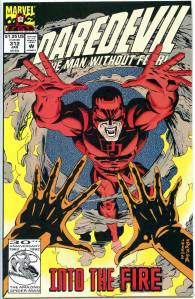
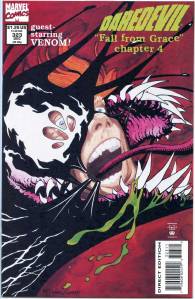
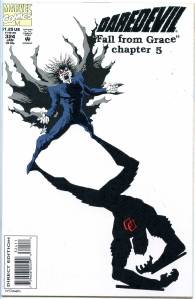
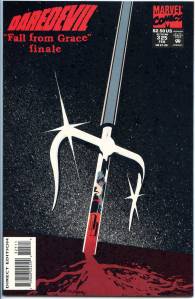
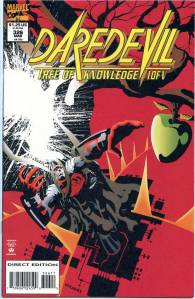
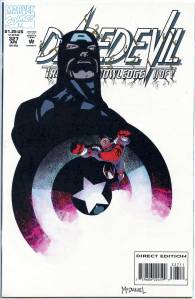
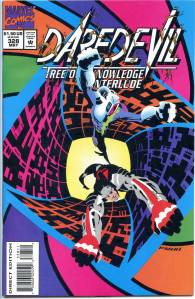
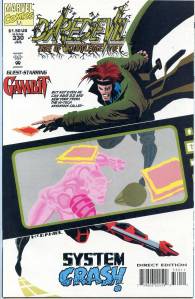
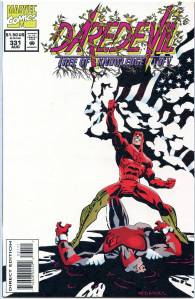
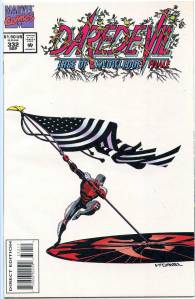
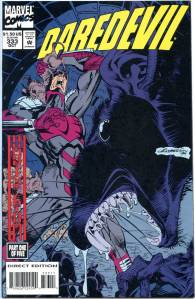
The creative team of Chichester and penciler Scott McDaniel changed the status quo with their “Fall From Grace” storyline in issues #319–325 (Aug. 1993 – Feb. 1994). Elektra, who was resurrected in #190 but had not been seen since, finally returned. An injured Daredevil creates a more protective costume from biomimetic materials: red and gray with white armor on the shoulders and knee pads. Revamped billy clubs could attach to form nunchucksor a bo staff. His secret identity becomes public knowledge, leading to him faking his own death and assuming the new identity of “Jack Batlin”. This new identity and costume lasts for several story arcs, while Murdock finds a way to convince the world that he is not, in fact, secretly Daredevil (courtesy of a double). A short stint by J. M. DeMatteis returned Daredevil to his traditional red costume and Matt Murdock identity.
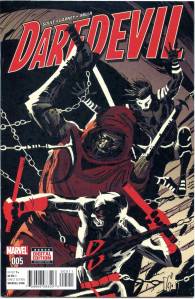
Daredevil V5 began as part of the All-New, All-Different Marvel branding, written by Charles Soule with art by Ron Garney with the first two issues released in December 2015. In this series, Matt returns to New York, where he now works as an Assistant District Attorney. He will have a redesigned costume and a new apprentice in Samuel Chung, an undocumented immigrant who has been living in New York’s Chinatown since he was a child, who has taken up the codename Blindspot. Flashbacks in a later story arc reveal how Matt regained his secret identity; when the Purple Children acquired a machine designed by their father to enhance his powers, after Matt had saved them from a mob, they used the machine to erase the world’s knowledge of Matt’s identity as Daredevil, Matt only allowing Foggy to know his secret identity afterwards, enabling him to be re-instated as a New York Attorney.] Using his restored secret identity, Murdock is able to take advantage of a subsequent court case to establish a precedent for superheroes testifying in court without the need to expose their secret identities. Despite interference from the Kingpin, Murdock succeeds in taking this precedent to the Supreme Court so that all superheroes will have the same rights in future cases, and afterwards returns to his traditional red costume.
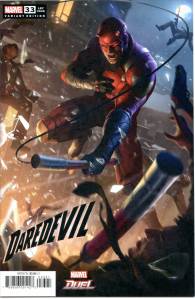
The new era of Daredevil starts here! Industry stars SALADIN AHMED and AARON KUDER have laced up and entered the ring, ready to take Matt Murdock on a knockout of an adventure! Where does Elektra fit into all of this? What is the future of Hell’s Kitchen? Romance! Intrigue! And, of course, ACTION! All delivered in the Mighty Marvel Manner!
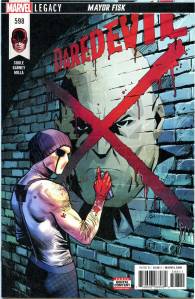
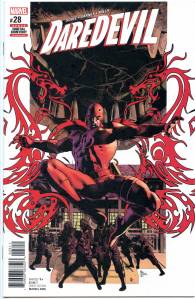
Following the release of Volume 5, Issue 28, much like with other Marvel series as part of the Marvel Legacy event, the Daredevil series official numbering was rebooted back to the original numbering which started with Issue 595 which was released on November 8, 2017, where Daredevil’s longtime nemesis the Kingpin became the Mayor of New York City and begins a campaign to make costumed vigilantes officially criminals. Although Murdock’s attempt to set up a sting operation results in his allies being arrested when the Kingpin turns this trap against him, Fisk’s legal manipulations work against him when he is attacked by the Hand, leaving Fisk in a coma and Murdock legally mayor of New York from his position as deputy mayor due to a loophole added by a prior administration that had not been amended, allowing Matt to take control of the city and release his fellow heroes to help him stop the Hand.
Matt Murdock has clawed his way through physical therapy, but his near death experience that nearly left him crippled has left its mark on him. Reacquainted with pain and fear, the devil is back in hell’s kitchen, but is the man who returned to the rooftops the same man who fell off them? Find out, in Chip Zdarsky’s new era of Daredevil
In 1998, Daredevil‘s numbering was rebooted, with the title “canceled” with issue #380 and revived a month later as part of the Marvel Knights imprint.Joe Quesada drew the new series, written by filmmaker Kevin Smith. Its first story arc, “Guardian Devil“, depicts Daredevil struggling to protect a child whom he is told could either be the Messiah or the Anti-Christ. Murdock experiences a crisis of faith exacerbated by the discovery that Karen Page has AIDS (later revealed to be a hoax) and her subsequent death at Bullseye‘s hands. When he discovers that the true party responsible for the scheme is Mysterio, who is currently dying of cancer, he leaves Mysterio to commit suicide, deciding to use the money Karen left him in her will to re-open Nelson & Murdock.
Smith was succeeded by writer-artist David Mack, who contributed the seven-issue “Parts of a Hole” (vol. 2, #9–15). The arc introduced Maya Lopez, also known as Echo, a deaf martial artist.