The Infinity Gauntlet (1991)

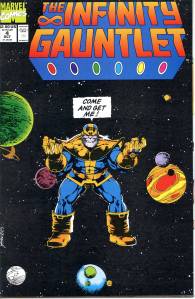
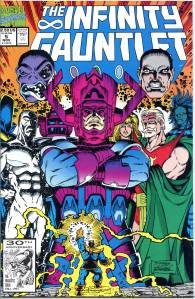
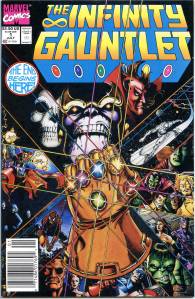
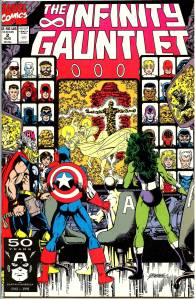
The Infinity Gauntlet is a six-issue limited series published by Marvel Comics from July to December in 1991. The series was written by Jim Starlin and penciled by George Pérez and Ron Lim.

The storyline is the culmination of events from Silver Surfer vol. 3, #34 (Feb. 1990) and the two-issue miniseries The Thanos Quest (Sept.- Oct. 1990).

Thanos mounts the six Infinity Gems (collected in the Thanos Quest limited series) on his left glove to form the titular Infinity Gauntlet. Each Gem grants its bearer complete mastery over one aspect of the multiverse: Time, Space, Mind, Soul, Reality, and Power. Now all-powerful and desperate to win the affections of Death, Thanos decides to offer the entity a gift of love by completing a task she had given him, erasing half the sentient life in the universe (including most of the X-Men, Daredevil, and the Fantastic Four), quite literally with a snap of his fingers.

Additional plotlines not addressed in the main story were featured in other books published during the same time period.

The storyline led to two sequel miniseries, Infinity War and Infinity Crusade. All three series were the core of a company-wide crossover story.
The Brute (1975)

The Brute is a Neanderthal who is thawed from a block of ice after thousands of years of entombment. Part of the short-lived Atlas superhero line from former Marvel publisher Martin Goodman.

Silver Star (1983)

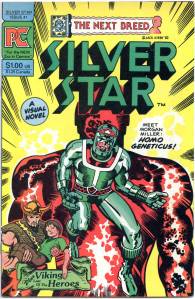
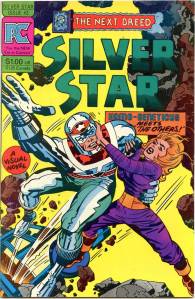
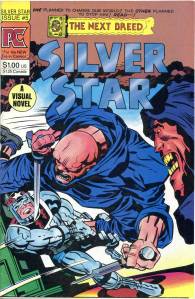
Silver Star is written, and drawn by Jack Kirby, first published by Pacific Comics in 1983. Featuring a title character who becomes super-powered due to genetic mutation, the series continued Kirby’s run of creator-owned work. Reprints of the original series and new stories based on it have subsequently been published by other comic book companies.

Hands of the Dragon (1975)

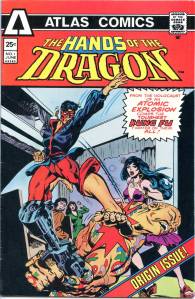
Wu Teh and his brother Ling were augmented by the radiation they were exposed to from the explosion of the dormant bomb on top of Mt. Fuji. Though it is never shown exactly how this radiation changed them, it is implied that like their grandfather, they became full of vigor and strength. Beyond these abilities, Wu Teh was a skilled martial artist who mastered several forms of hand-to-hand combat while at the monastery in the Himalayas.

The Scorpion (1975)

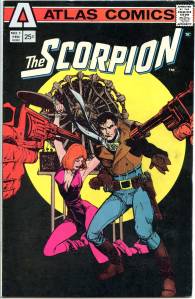
The Scorpion ran three issues, cover-dated February to July 1975. The premiere was written and drawn by character creator Howard Chaykin. On the second issue, Chaykin’s pencil art was inked by the team of Bernie WrightsonMichael KalutaWalt Simonson and Ed Davis.

Citing lack of control over his creation, Chaykin quit and the third issue was produced by writer Gabriel Levy and penciler Jim Craig, with uncredited inker Jim Mooney.

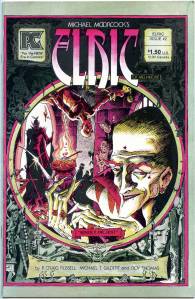
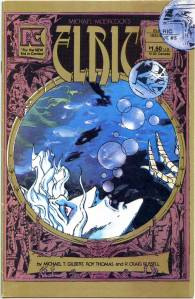
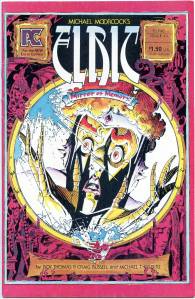
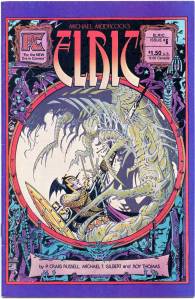
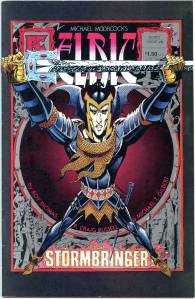
Michael Moorcock’s, Elric (1983)

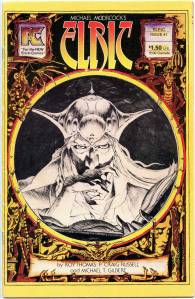
Story by Roy Thomas, adapting the novel Elric of Melnibone by Michael Moorcock. Art by P. Craig Russell and Michael T. Gilbert. Prince Yyrkoon, cousin of Elric believes he should be on the throne of Melnibone, not Elric. While he plots, Elric and his lover Cymoril take a trip to the beach, where Elric dreams of the past, and fears for the future.

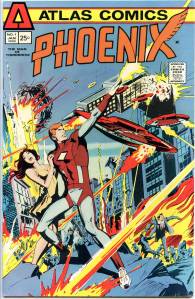
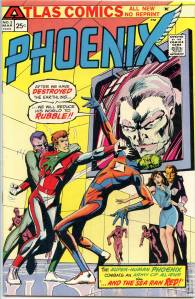
Phoenix (1975)

After his spaceship crashes, astronaut Ed Tyler is captured by extraterrestrials. He uses their technology to become the superhuman Phoenix, but the aliens would rather destroy his planet than let him escape. Part of the short-lived Atlas superhero line from former Marvel publisher Martin Goodman.

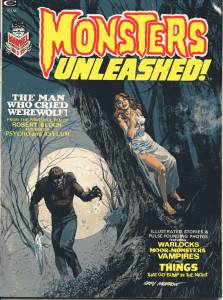
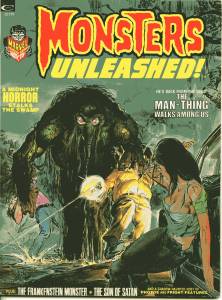
Monsters Unleashed (1973)


A magazine rather than a comic book, Monsters Unleashed did not fall under the purview of the comics industry’s self-censorship Comics Code Authority, allowing the title to feature stronger content — such as moderate profanity, partial nudity, and more graphic violence — than color comics of the time.


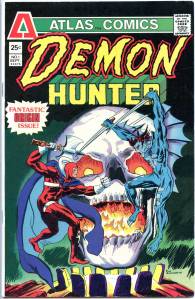
Demon Hunter (1975)

The origin of Gideon Cross, who turns against the demon cult that trained him as a killer. First and only issue of the series; creator Rich Buckler later revised the idea as Marvels Devil-Slayer. Story by Buckler and David Anthony Kraft; art and cover by Buckler.

Giant-Size Spider-Man (1974)

Part of the “Giant-Size” format that Marvel published from 1974 to 1976 that featured comics that were much larger than other Spider-Man books at the time and had multiple stories, with the second one usually being a reprint of an earlier Spider-Man story.